
Last Updated | March 9, 2026

It replaces graphical navigation with conversational interfaces powered by natural language processing and speech recognition. This transition alters both frontend interaction models and backend orchestration logic.
Voice Commerce: How It Actually Works in Real Life
Instead of describing complex architecture, let’s look at how global leaders have implemented voice shopping to reduce friction.
Example 1: Groceries with Walmart (Google Assistant)
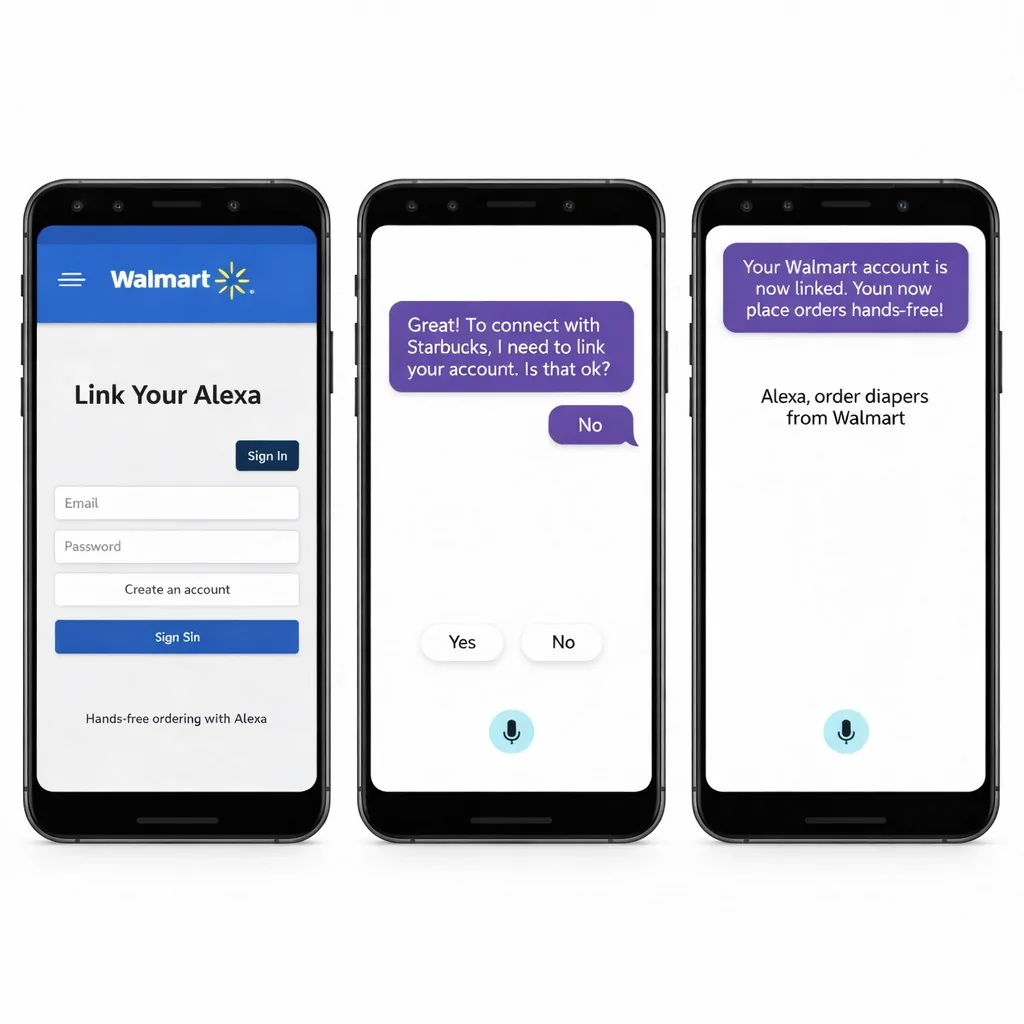
Walmart has partnered with Google to allow customers to manage their shopping carts entirely by voice. To activate it, a user simply says, “Hey Google, talk to Walmart.”
- Learning Preferences: The system learns the brands you love. Instead of saying “one gallon of 1 percent Great Value organic milk,” you can just say “milk,” and Walmart adds the specific item you regularly buy.
- Cart Management: Users can issue commands like “Add 4 more bananas,” “What’s in my cart?”, or “I don’t want bananas anymore”.
- Utility: With over 100,000 grocery items available, the focus is on speed and daily essentials.
Example 2: Quick Service with Starbucks (Alexa)
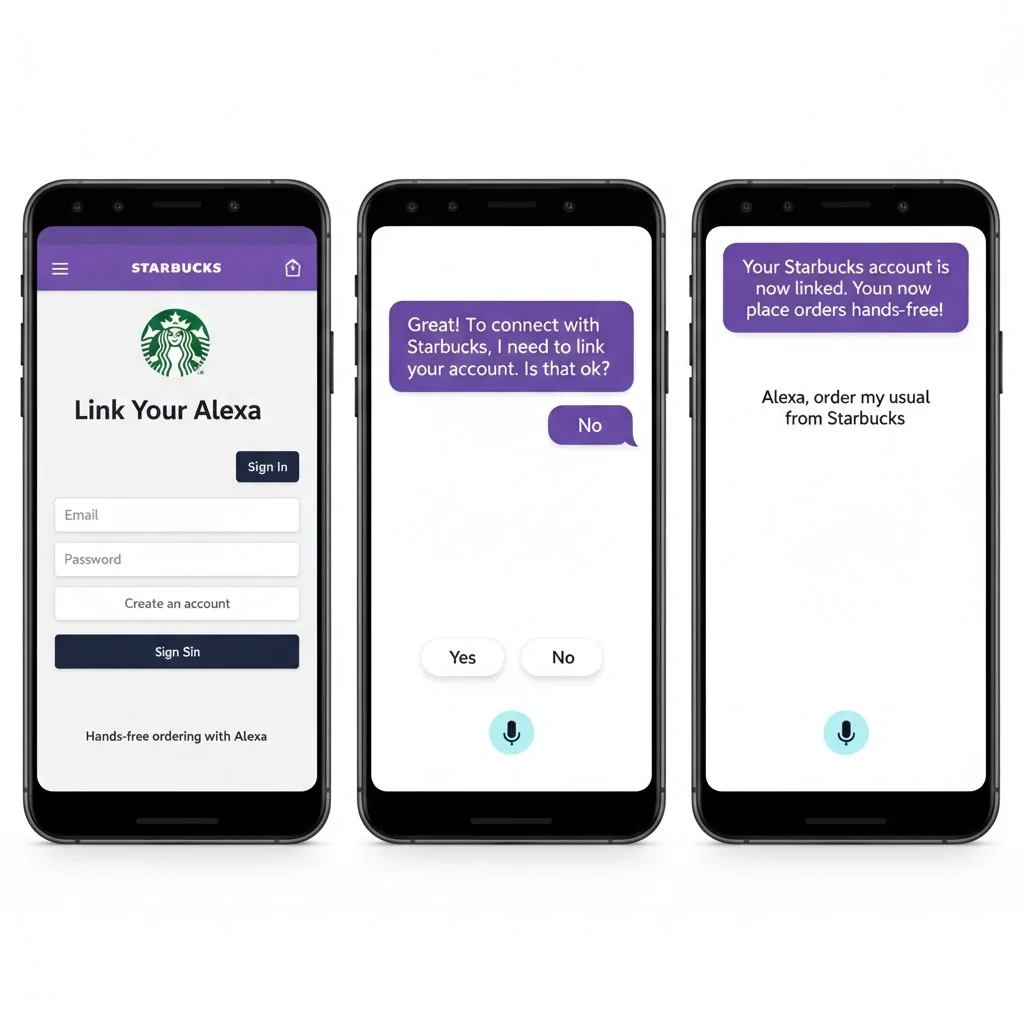
Starbucks utilizes Amazon Alexa to simplify the morning coffee routine through voice-enabled reordering.
- The Flow: Customers can place their “usual” order through any Alexa-enabled device.
- The Pickup: After the voice command, the order is sent to the nearest store, and the customer simply picks it up without waiting in line or using a screen.
- Contextual Ease: This is the perfect example of voice commerce in a hands-free environment (like driving or getting ready for work).
Where Voice Commerce Works Best
Voice shopping is not ideal for everything. It works best for:
- Reorders: Quickly replenishing items you’ve bought before.
- Low-decision products: Groceries, supplements, and household essentials.
- Subscriptions: Managing recurring orders like coffee or vitamins.
It is less effective for fashion browsing or luxury items that require high-quality visuals and complex product comparisons. Voice is about speed and utility, not exploration.
What a Voice-Enabled Website Actually Needs
For voice commerce to function properly, the website behind it must support:
Clean Product Data
Products must have:
- Structured attributes
- Clear pricing rules
- Machine-readable variations
Messy catalogs break voice interactions instantly.
API-First Architecture
Voice assistants do not “browse” your website.
They are called APIs.
Your backend must allow:
- Search by intent
- Real-time price checks
- Inventory validation
- Secure payment confirmation
Without this, voice commerce becomes unreliable.
Conversational UX Design
Voice UX is not web UX.
Instead of:
- Menus
- Filters
- Grids
You design:
- Clarification prompts
- Confirmation logic
- Short summaries
- Error recovery responses
Example of bad UX:
“Sorry, I didn’t understand.”
Example of good UX:
“Did you mean the 500g or 1kg option?”
A Simple Website Flow vs Voice Flow
| Website Shopping | Voice Shopping |
| Browse category | State intent |
| Apply filters | System resolves constraints |
| Compare products visually | System ranks and summarizes |
| Add to cart | Confirm verbally |
| Checkout form | Payment confirmation |
Voice compresses the entire process into dialogue.
Key Benefits of Voice Commerce for eCommerce Brands
Voice commerce offers operational and strategic benefits that differ from traditional UI-based commerce. The primary advantage is reduced interaction friction, as users bypass visual navigation entirely. This compression of the decision path increases task completion speed for repeat and utility-driven purchases.
Another benefit is deeper integration with eCommerce personalization AI. Voice assistants can leverage historical orders, preferences, and contextual signals to propose relevant options proactively. Studies on personalized dialogue systems show increased user satisfaction when recommendations are embedded conversationally.
Voice commerce also expands reach into new usage contexts. Shopping actions can occur while users are driving, cooking, or multitasking, scenarios unsuitable for screen-based interfaces. This context expansion creates incremental demand rather than merely shifting channels.
From a data perspective, voice interactions generate rich conversational signals. These signals provide insight into natural language demand articulation rather than keyword-driven intent. Brands that analyze this data gain strategic advantage in product positioning and taxonomy design.
The table below summarizes key benefits and their technical implications.
| Benefit | Technical Implication | Business Impact |
| Reduced friction | Conversational state management, intent ranking | Faster repeat purchases |
| Personalization | User embeddings, preference models | Higher conversion rates |
| Contextual reach | Multimodal device integration | New demand channels |
| Natural language data | NLP analytics pipelines | Improved merchandising insights |
A closing observation is that benefits materialize only when voice systems are tightly integrated with core eCommerce infrastructure. Isolated voice skills without backend intelligence produce limited commercial value.
Voice Commerce Use Cases in Modern eCommerce
Voice commerce use cases vary by product category, purchase frequency, and user intent complexity. The most effective applications prioritize low-ambiguity tasks and high repetition. These constraints reduce error rates in conversational flows.
Use cases increasingly align with conversational commerce models rather than traditional browsing metaphors. Instead of navigating categories, users express goals, constraints, and preferences verbally. This shifts UX design toward dialogue optimization rather than visual hierarchy.
Voice Search and Product Discovery
Voice search eCommerce focuses on translating open-ended queries into structured product retrieval. Queries such as “find running shoes under one hundred dollars” require semantic parsing and constraint resolution. Ranking models must balance relevance, availability, and personalization simultaneously.
Unlike typed search, voice queries are longer and more natural. This aligns with advances in semantic search and dense vector retrieval models. These models outperform keyword matching in conversational contexts.
A core challenge is result summarization. Voice interfaces cannot present large result sets, so systems must select and justify limited options. This necessitates explainable recommendation logic and confidence scoring.
Voice-Enabled Checkout and Reordering
Voice-enabled checkout is most effective for replenishment and habitual purchases. Users issue commands such as “reorder my usual coffee,” relying on stored preferences and payment credentials. This requires deterministic order mapping and strong confirmation logic.
Security is enforced through voice biometrics, device authentication, or secondary confirmation steps. Research into speaker verification systems demonstrates improving accuracy in consumer environments. These mechanisms are critical for transaction trust.
Voice reordering reduces cart abandonment entirely by eliminating carts. The transaction becomes a single conversational exchange. This model redefines conversion optimization around intent clarity rather than UI persuasion.
UX & Technical Challenges of Voice Commerce
Despite its potential, voice commerce introduces significant UX and engineering challenges. The absence of visual affordances increases the cost of misunderstanding. Systems must handle ambiguity gracefully without frustrating users.
Latency is a critical constraint. Voice interactions feel broken if response time exceeds conversational norms. This places strict performance requirements on speech recognition, NLP inference, and backend APIs.
Error recovery is another challenge. Users need clear, concise correction paths when intent is misinterpreted. Poorly designed fallback flows degrade trust and reduce adoption.
The bullet list below outlines key technical challenges faced by voice commerce platforms.
- Intent ambiguity management through probabilistic ranking and clarification prompts
- Latency control across speech recognition, NLP, and eCommerce service layers
These challenges require coordinated design across voice UX design, AI modeling, and system architecture. Solving them in isolation leads to brittle user experiences.
Is Voice Commerce the Future?
Voice will not replace websites.
It will exist alongside them.
It’s ideal for:
- Hands-free situations
- Reorders
- Smart home ecosystems
- In-car commerce
The brands that benefit most are those with:
- Repeat customers
- Strong customer data
- Clean technical architecture
Voice commerce is not about hype.
It’s about reducing friction where friction is unnecessary. Contact Stellar Soft to prepare your eCommerce platform for voice-first shopping and conversational commerce at scale.
FAQs
What is voice commerce?
Voice commerce is a form of digital commerce where users interact with eCommerce systems through spoken commands rather than graphical interfaces. It relies on voice recognition, natural language understanding, and backend commerce APIs to enable search, comparison, and transactions via voice-enabled devices.
How does voice commerce work in eCommerce?
Voice commerce works by converting spoken input into structured intents using automatic speech recognition and NLP models. These intents are mapped to eCommerce functions, such as product search, recommendation retrieval, cart updates, or order placement, executed through the platform’s commerce, payment, and fulfillment systems.
What are the benefits of voice commerce for businesses?
Voice commerce reduces friction in high-frequency or low-consideration purchases, increasing reorder rates and customer retention. It also enables hands-free interactions, generates conversational data for personalization, and strengthens ecosystem lock-in when integrated with proprietary voice assistants.
Is voice commerce the future of online shopping?
Voice commerce is not a universal replacement for visual eCommerce but a complementary channel optimized for specific contexts such as reordering, accessibility, and ambient computing. Its growth depends on advances in voice UX design, trust, and multimodal integration rather than standalone voice-only shopping.
How can eCommerce brands prepare for voice shopping?
Brands should structure product data for voice search, implement intent-based APIs, and design conversational flows that minimize ambiguity. Preparation also requires integrating personalization logic, securing voice transactions, and testing voice UX across real-world linguistic variability and noise conditions.