AI Quality Control System That Analyzes 2,000+ Calls Daily Instead of a QA Department

Our team implemented AI-powered call evaluation with speaker diarization, automatic identification of 8 call types, and script compliance checks based on 10+ criteria. The company achieved 100% coverage instead of selective monitoring, consistent eva

Founder jack avatar

Reviewed by: Jack Ananchenko, Co-founder, CEO

Sep 24, 20265 min read
page_1

Tier-1 outbound sales organization in the US

B2B Sales / Business Services

The Essentials

AI/ML Development

Speech & Voice Analytics

Custom Software Development

1 Fullstack, 1 Prompt Engineer, 1 QA, 1 PM

Full-time development stage (~1 month) + support

100% coverage: 2,000+ calls per day

$150K–180K/year in savings

Tech Stack

Next.jsLLMPostgreSQL

The Team Was Growing, and So Was the “Blind Spot” in Quality Control

The client is one of the largest outbound sales operators in its niche in the US, with a multi-level team of more than 150 reps. They call prospects, schedule meetings, and pass leads further down the funnel. The primary acquisition channel is cold calling, along with several types of follow-up contacts (referral, LinkedIn follow-up, voicemail, etc.).

Daily call volume reaches 2,000+ calls. Recordings accumulated in the telephony system, but no one systematically analyzed them or checked them for script compliance. At this volume, organizing manual monitoring without creating a dedicated QA team was practically impossible.

At the same time, the company already had its cadence scenarios and scripts in place - what it lacked was a system capable of checking whether reps actually followed them in practice. Management needed an objective view of every call without having to hire and train a separate QA department from scratch.


Three Things We’re Proud Of

100%

Call Coverage

Fully automated audit of 100% of every rep’s calls. Previously, none were reviewed.

$150K–180K

Per Year in QA Savings

The system replaced a team of 3–4 QA specialists who would have reviewed only one-tenth of the calls. Excluding processing costs.

DETAILED

Feedback Within Minutes

The rep receives a detailed analysis of script compliance within minutes after the conversation ends.

Zero Visibility Into 2,000+ Calls Daily and the Risk of Losing Leads and Meetings

The company had no systematic visibility into what was actually happening during its reps’ conversations, where deviations from cadences occurred, or at which stages customers were lost. As a result, management could not determine how many potential meetings and deals were being lost due to script non-compliance or mistakes during lead qualification.

Zero Call Monitoring

Call recordings were simply stored in the system, but no one analyzed them, leaving lead qualification errors and missed details unnoticed for months.

8 Scenarios With Different Evaluation Rules

The company used eight call types - cold calls, referrals, LinkedIn, voicemail, and others - with type-specific scenarios and criteria. Sales managers could edit both without developer support.

Evaluation Based Only on Outcomes

Management evaluated reps only by the number of meetings booked and had no visibility into where during the conversation reps deviated from the script, missed important details, or incorrectly qualified leads.

Automating Call Reviews Through a Centralized AI Pipeline

As part of custom software development, we created a fully automated system that analyzes every call in several stages:

  1. Call recording: The system receives the recording from the existing telephony system, ensuring that every call goes through a single review process.

  2. Transcription and diarization: The recording is converted into text, identifying when the rep is speaking and when the customer is speaking. This makes it possible to analyze each party’s statements separately.

  3. Automatic call type detection: AI identifies one of 8 cadence scenarios, eliminating the need to classify each call manually.

  4. Scenario selection: Once the call type is identified, the system applies the specific scenario, criteria, and rules that correspond to that type of conversation.

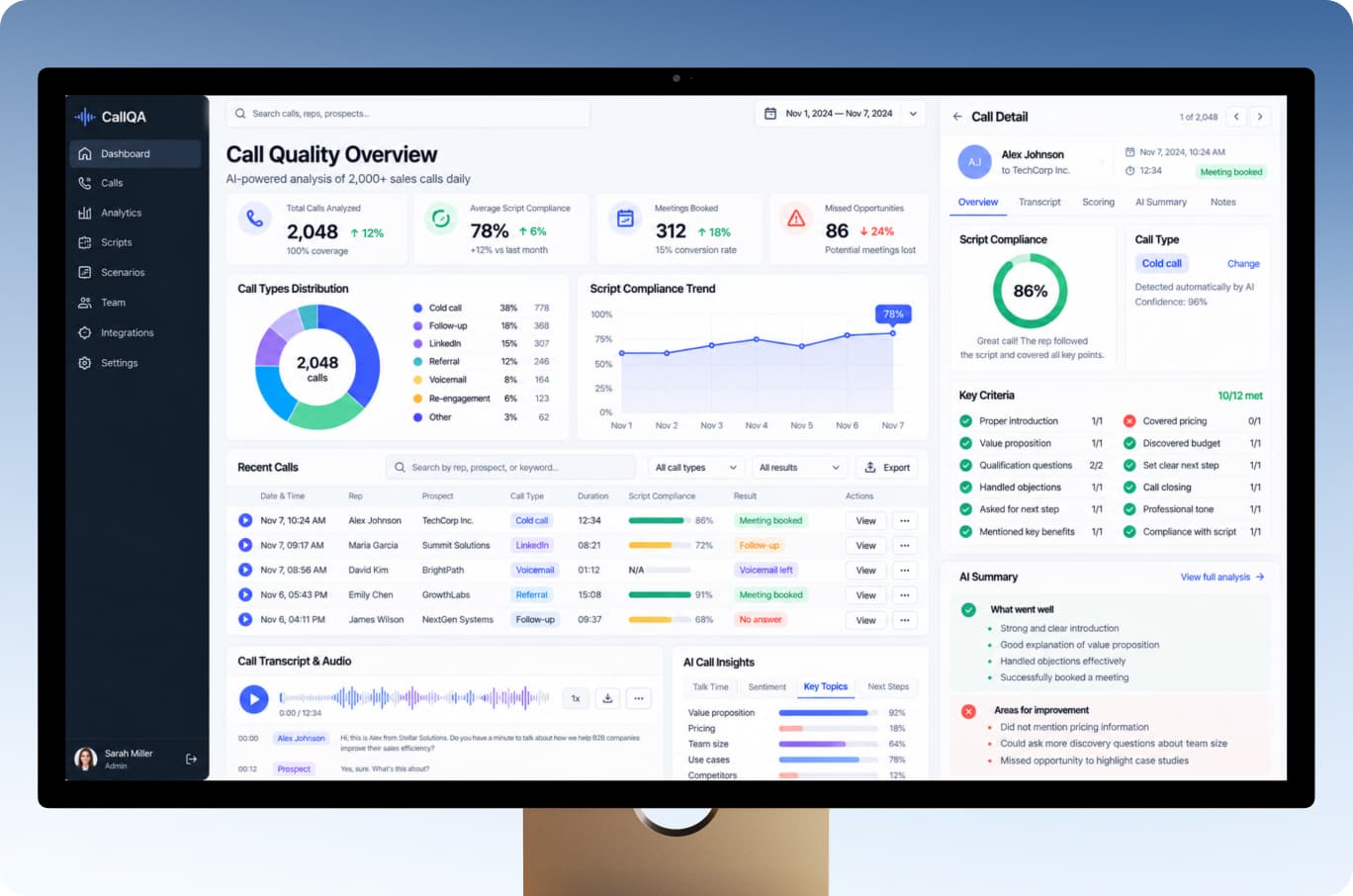
  5. AI scoring across 10+ parameters: The system compares the transcript with the reference script for that call type and evaluates the conversation based on the criteria relevant to it.

  6. Final score: Based on the review, the system generates an overall script compliance score.

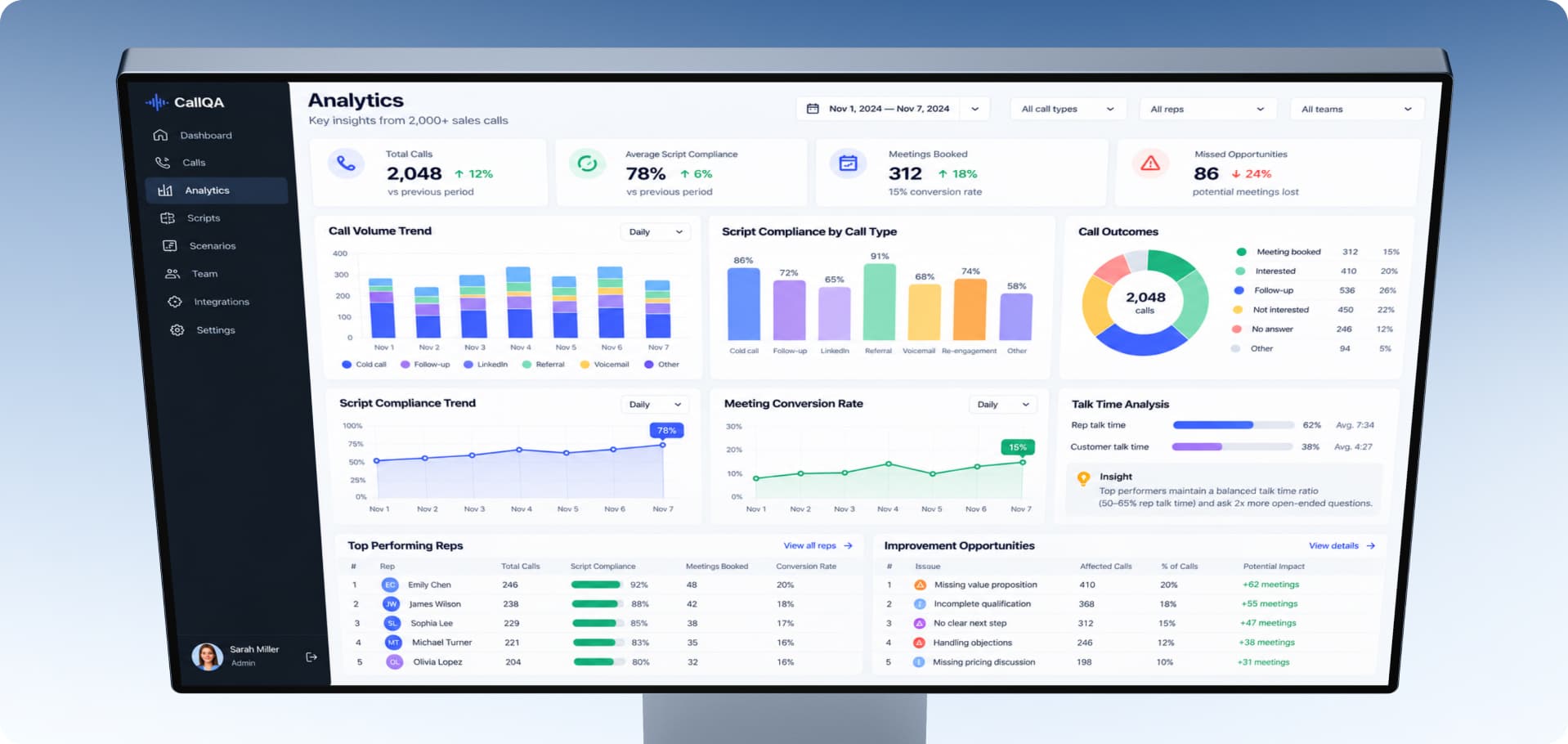
  7. Dashboard: Managers can see each rep’s rating for every call type, while reps can see a breakdown of their own conversations against each point in the script.

Key Capabilities

Distinguishing misunderstanding from objection. AI differentiates between situations where a customer simply did not understand the offer and a deliberate objection - in the first version, these situations were confused.

Tracking mentions of details. The model counts mentions of required details - the company name, location, and referral - and compares them against the optimal range. What matters is not only whether the required detail is mentioned, but also how often it is mentioned.

Scenario builder. Sales managers can modify scenarios and evaluation rules directly in the interface without involving the dev team. Criterion weights can also be configured for each scenario. This makes it possible to adapt the QA logic when sales scenarios change without additional development.

How We Built a Stable Call Evaluation System

  1. Attempts and Solutions

The first version of the system relied on finding exact keyword matches with the script. In practice, this approach had three problems:

  • It did not account for context. The presence or absence of a specific phrase alone did not show what was happening in the conversation.

  • It confused misunderstanding with objection. The system did not distinguish between a situation where the customer did not understand the offer and one where they deliberately declined it.

  • It unfairly lowered the score when a call ended prematurely. If the customer hung up, keyword-based logic could penalize the rep for a part of the script that the conversation never actually reached.

We therefore switched to LLM-based analysis combined with clear business rules. The language model takes the meaning of each statement into account rather than relying only on word matches. The rules distinguish between misunderstanding and deliberate objection. And if the customer ends the call prematurely, the rep’s score is no longer reduced as long as they followed the script up to that point.

2. Different Rules for Different Call Types

Applying the same criteria to all 8 scenarios would be incorrect. Once the call type is identified, the system uses the corresponding scenario, the criteria applicable to it, and the configured weights. For example, a voicemail should not be evaluated according to all the same rules as a full cold call.

3. The Biggest Engineering Challenge

The most difficult part was turning subjective human criteria into clear and reproducible rules. For example, we needed to formalize what counts as a good mention of the location and where to draw the line between “the customer did not understand” and “the customer declined.”

The goal was for similar calls to receive similar scores regardless of who performs the evaluation - a human or AI.

4. Why Custom Development

Most of the functionality was implemented as a SaaS solution tailored to the client’s specific scenarios rather than built on ready-made QA platforms. The reason was the specific business logic: 8 call types with different scenarios and rules, criteria that do not apply to every type, the ability to change rules without developers, as well as separate logic for prematurely ended calls and monitoring the frequency of mentions.

5. Key Components of the Solution

  • Separating the voices of call participants - identifying the rep and the customer.

  • A mechanism for automatically identifying one of 8 call types.

  • A scoring module with configurable weights for each scenario.

  • A module for counting mentions of required details and comparing them against the optimal range.

  • A scenario and evaluation rule editor available to managers without involving developers.

From Zero Monitoring to Automated Analysis of 100% of Calls

For Reps

  • Feedback within minutes: Reps receive a score and a breakdown for each point in the script within minutes after the call ends. Previously, there was no such feedback at all.

  • Consistent evaluation rules: 100% of calls are evaluated using the same system for everyone and with virtually no human involvement; the result does not depend on who would have reviewed the call.

  • Faster time to target performance: Reviewing every call accelerated coaching and reduced the time it takes new reps to reach target performance.

For Management

  • 100% coverage: The system automatically analyzes every call from every rep using consistent criteria.

  • Ratings by call type: Managers can see each rep’s rating for every call type.

  • Visibility into conversations: Management can see not only the number of meetings booked but also the stages of the conversation where reps deviate from the script.

  • Budget savings: The system eliminated the need to build a separate QA team of 3–4 specialists. The estimated savings from avoided salaries are $150K–180K per year.

  • linkedin
  • x
  • facebook
  • Clutch
  • Upwork
  • Reddit

Want 100% Visibility Into Your Sales or Support Team’s Performance?

We will develop and integrate a custom AI-powered speech analytics system that automatically evaluates conversation quality, identifies weaknesses in reps’ performance, and saves your operational monitoring budget - without the need to hire a large team of QA specialists.


Jack ananchenko

Jack Ananchenko

CEO and Co-founder

Vladimir gubarev

Vladimir Gubarev

COO and Co-founder

By submitting this form, you agree to our Privacy Policy and Terms Conditions.

See What Else We've Built