AI-Powered Automation of Initial Video Interview Screening to Scale Hiring

We created an AI module for transcribing and scoring video applications and integrated it with WordPress and the HR system. This eliminated manual review and made it possible to double the volume of applications processed without expanding the team.

Founder jack avatar

Reviewed by: Jack Ananchenko, Co-founder, CEO

Sep 16, 20264 min read
page_1

US-based sales organization

HR Tech / Recruitment Technology

The Essentials

AI/ML Development

Workflow Automation

Custom Software Development

1 Backend/AI Developer, 1 Frontend, 1 QA, 1 PM

~1 month (MVP) + support

Hundreds of video applications per month

50+ hires per quarter across several US regions

Initial decision in less than 1 hour (instead of 3–5 days)

100% automated screening

Tech Stack

PythonWordPressGoogle DriveCloud Run functionsLLMATS/CRM IntegrationEmail / WhatsApp / SMS

High-Volume SDR Hiring: Eliminating Routine Video Application Processing

The client is a fast-growing US sales company whose business model relies on high-volume, continuous hiring of cold sales specialists (SDR/BDR “hunter” roles). These positions have high turnover, so the company continuously expands its sales team and hires more than 50 new specialists per quarter across several regions of the country.

Revenue growth depends directly not only on hiring speed but also on how accurately the company identifies salespeople with the right temperament for outbound sales.

Every month, hundreds of asynchronous video applications were submitted through a form on the website. Candidate data was automatically transferred to the ATS. However, a small recruiting team manually reviewed the entire flow, spending an average of 10–15 minutes on each video.

In addition to watching the videos, recruiters spent time taking notes, entering screening results into the ATS, changing candidate statuses, and switching between applications, so the actual time spent on each application was significantly longer than the video itself.

As candidate volume grew, manual processing became the main bottleneck at the very first stage of the funnel - before any interview took place. Hiring volumes were growing faster than the recruiting team could physically review video applications. The goal of the project was therefore to remove recruiters from the initial screening process while maintaining the quality and consistency of candidate evaluation.

Achievements in Numbers

100%

Automated Screening

Automation of the first stage: recruiters work only with candidates who pass the PASS threshold.

<1

Hour to Decision

Reduced the time from video application submission to interview invitation from 3–5 days to less than 1 hour.

≈$120K–150K

Per Year in Savings

Freed up recruiter time equivalent to the workload of 2–3 full-time employees and doubled application processing volume without expanding the team.

How to Scale Hiring Without Expanding the Team or Losing Strong Candidates

Initial screening had become the bottleneck of the entire hiring funnel: manually reviewing hundreds of videos per month stretched the time from application submission to a decision on a single candidate to 3–5 days.

According to the client, “We were losing strong candidates not because they weren’t a good fit, but because we couldn’t review their videos in time.”

100% Manual Review of Video Applications

Recruiters had to manually review every 10–15-minute video, spending working hours even on applications from candidates who clearly did not match the role profile.

Human Bias in Evaluation

Selection depended on the individual judgment of different recruiters because there was no single standardized evaluation scale.

Gap Between Video and ATS

Video review results were not automatically linked to the candidate’s status in the internal HR system, creating delays and requiring additional manual work.

Solution Requirements

The system had to integrate directly with the existing ATS/CRM and automatically update the candidate’s status after evaluation. Candidates had to receive notifications via email and WhatsApp, with SMS used as a backup channel if WhatsApp was unavailable. In addition to a PASS/FAIL verdict, the system had to generate a clear report with scores, strengths, and risks so that the result could be reviewed and explained.

Automated AI Pipeline Instead of Manual Review

Instead of expanding the recruiting team, we built an end-to-end AI pipeline that automates initial candidate screening, from video upload to moving the candidate to the next stage of the hiring process.

  1. Application submission. The candidate fills out a form on the WordPress website and uploads a video interview.

  2. Storage and transcription. The video is uploaded to Google Drive, after which a background cloud function converts the audio track into text.

  3. AI scoring across 7 categories. The model evaluates responses using a structured rubric covering 7 competencies with a maximum score of 100 points: resilience to rejection, results orientation, ambition, competitiveness, energy, proactive prospecting mindset, and speaking ability.

  4. Verdict and automatic screening. Based on the results, the system assigns the candidate a PASS / FAIL status and automatically filters out applications that clearly do not match the role profile.

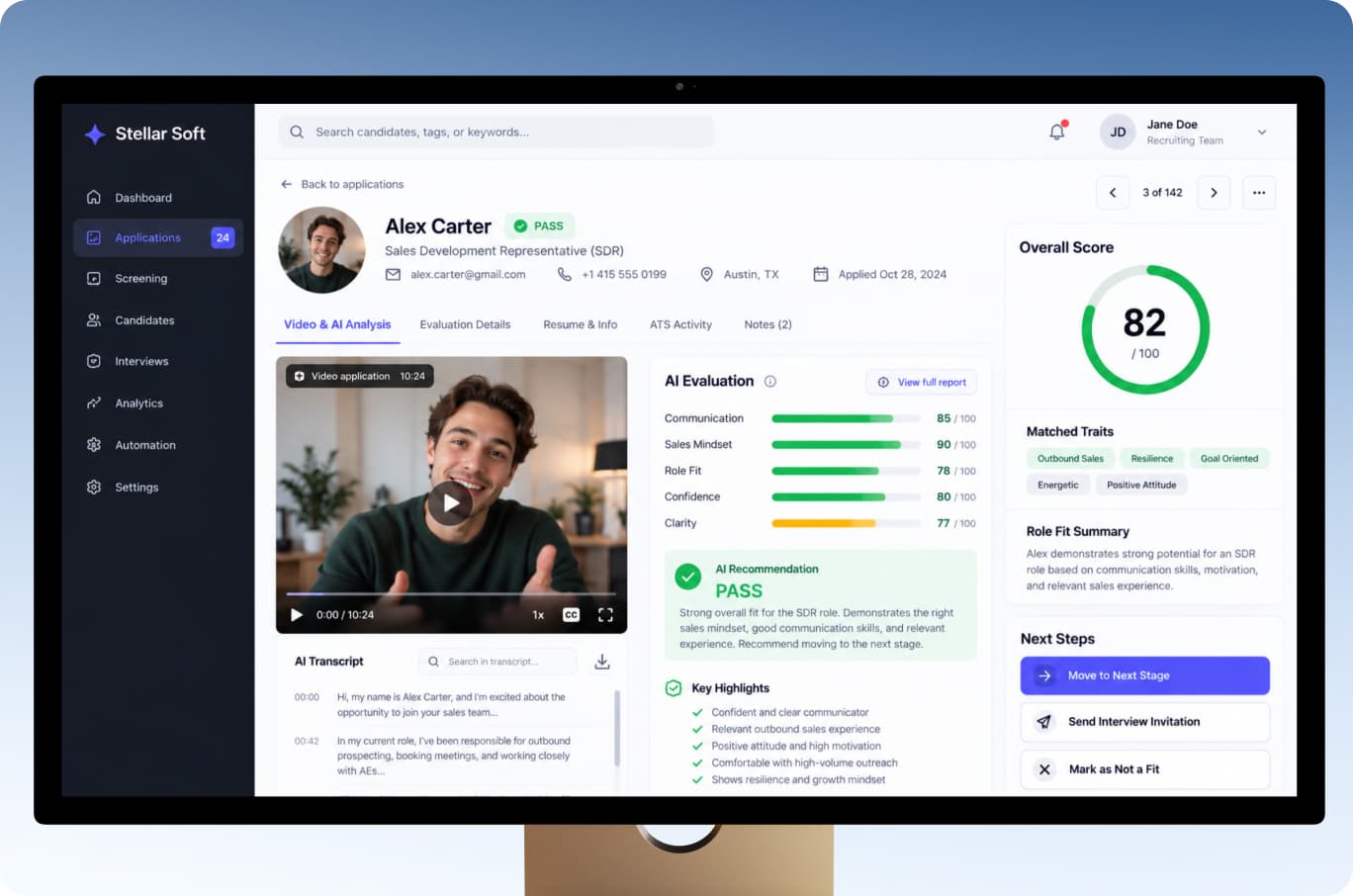
  5. Report generation. For each candidate, the system creates a structured report with category scores, an overall result, AI confidence level, strengths, and risks.

  6. ATS/CRM synchronization. The screening result is automatically transferred to the existing candidate management system, where the candidate’s status is updated and, for those who pass the screening, the transition to the next stage is initiated.

  7. Automated notification. Candidates with PASS status receive a link to select their interview time via email and WhatsApp. If WhatsApp is unavailable, the system uses SMS as a backup channel.

What the Recruiter Sees

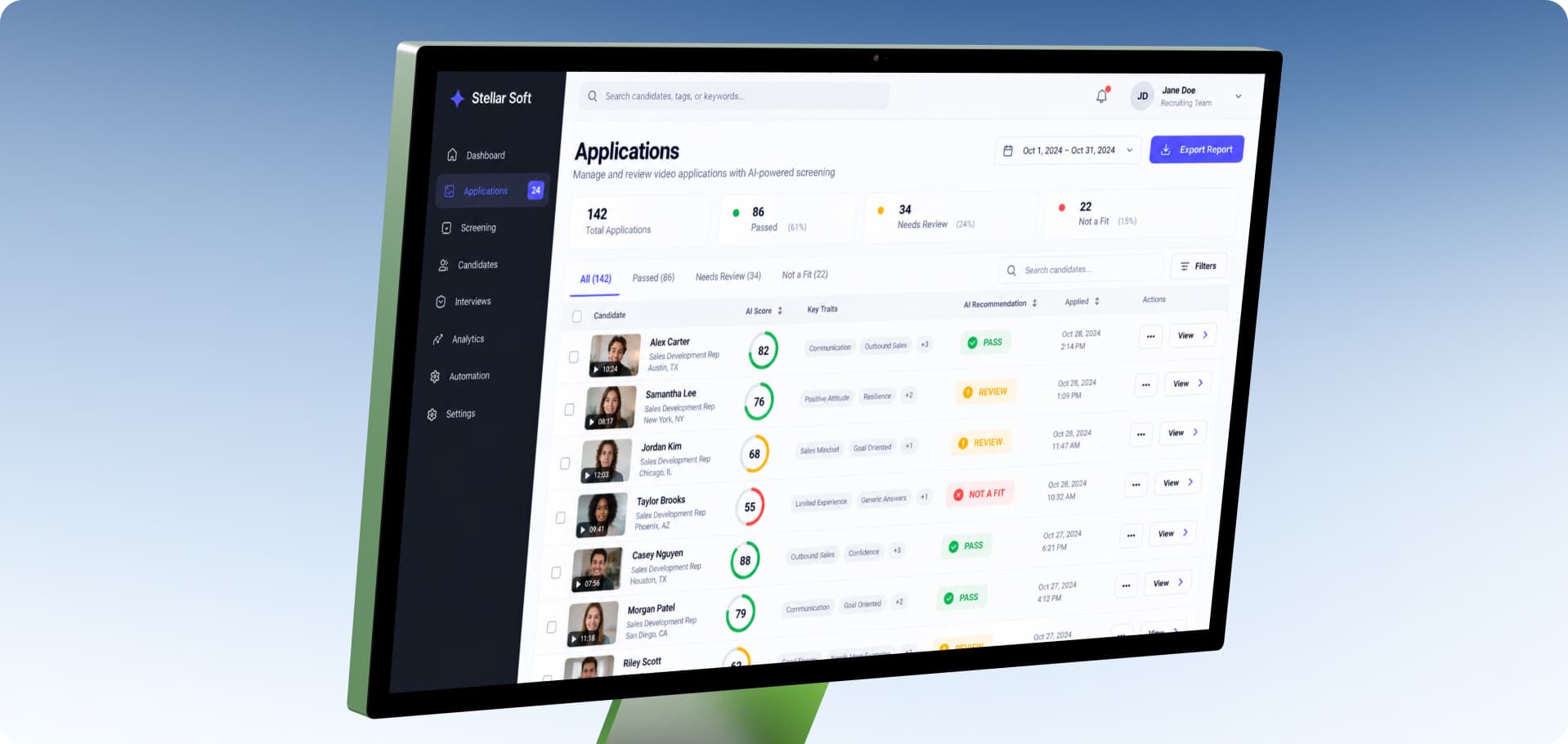
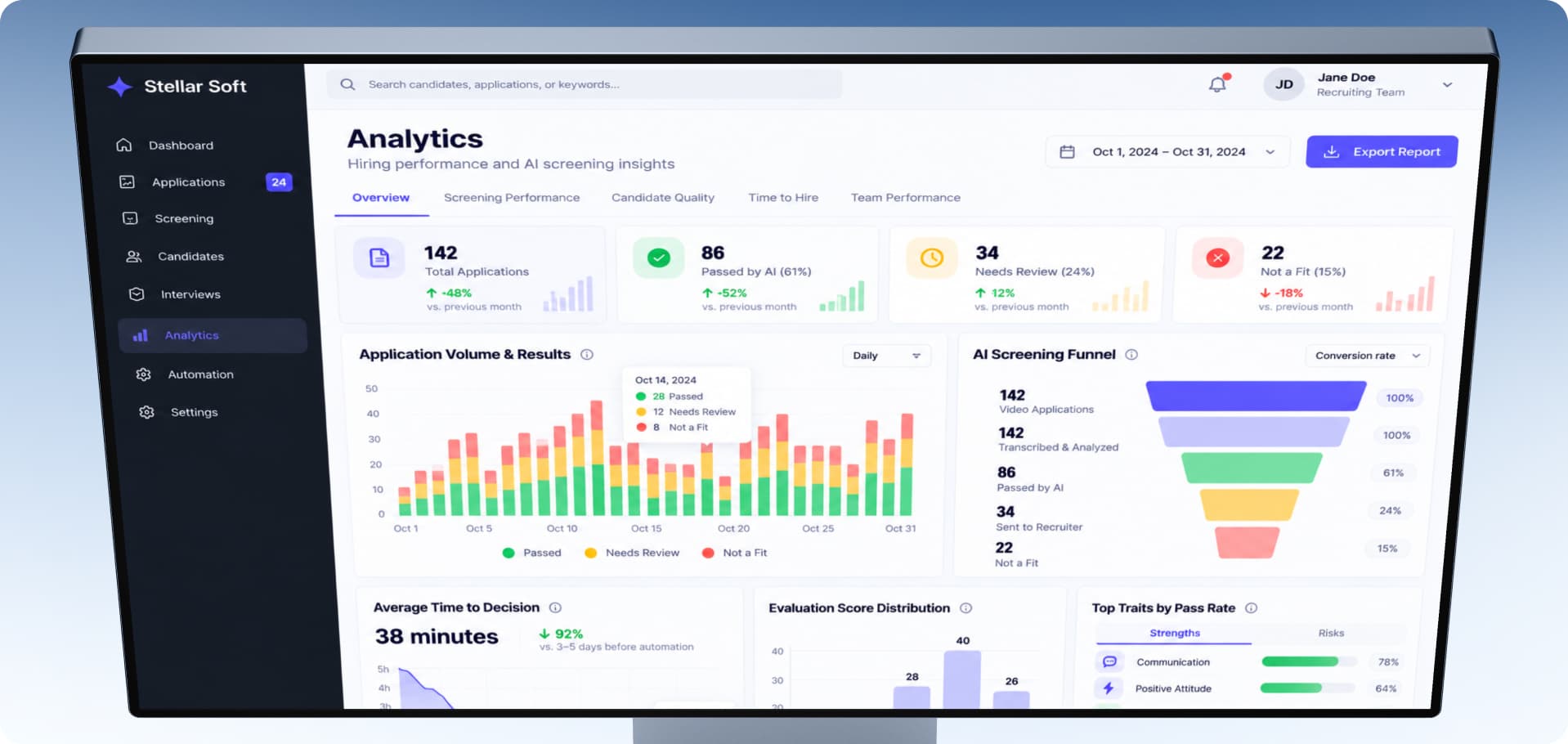
After screening is complete, the recruiter receives not just a PASS / FAIL verdict but a structured result: scores across 7 categories, an overall score, AI confidence level, the candidate’s strengths, and potential risks. This makes it possible to review the reasoning behind the decision before the interview and understand why the candidate passed or failed the initial screening.

How We Turned AI From a “Black Box” Into a Stable Tool

1. Engineering Journey

Attempt #1: Vague criteria. The first version essentially asked the LLM whether a candidate was “good” or “bad” based on general descriptive criteria. As a result, the model could produce inconsistent scores even for very similar candidate responses.

Successful solution: Structured rubric. We replaced the general evaluation with a formalized system: 7 categories and a maximum of 100 points. For each category, we defined positive indicators, red flags, and clear scoring ranges, while the weights can be configured according to business logic. This made AI decisions reproducible and explainable rather than a “black box” assessment.

2. The Main Engineering Challenge

The most difficult part was formalizing the difference between the profile of a candidate suited for cold sales and one more typical of customer service or retail roles.

For outbound sales, resilience to rejection, results orientation, and willingness to make 300+ calls per day were important. At the same time, a candidate with strong support or retail service skills could demonstrate different behavioral patterns.

The challenge was not simply to teach the system to distinguish between these profiles, but also to prevent a return to the subjective evaluation that had caused unstable results in the initial version.

3. Custom Development

We implemented most of the functionality as part of custom software development - built from scratch around the client’s business logic without using off-the-shelf HR platforms:

  • Video intake and transcription module - automatically processes video applications and converts speech into text.

  • Scoring engine - evaluates responses across 7 categories with configurable weights.

  • ATS/CRM integration - matches the application to the candidate profile using email and phone number, updates the status, and automatically moves the candidate to the next stage.

  • Multi-channel notification service - sends successful candidate notifications via email / WhatsApp / SMS with a link to schedule an interview. We previously used a similar notification approach in a custom Shopify revenue forecasting app, where notifications about metric changes were sent via email, Slack, and WhatsApp.

4. Tech Stack

  • Python - pipeline service logic: application processing, scoring, and integrations.

  • WordPress - application and candidate video submission form.

  • Google Drive - storage for uploaded video files.

  • Cloud Run functions - background processing and transcription triggering.

  • LLM - analysis of candidate responses and scoring according to the defined rubric.

  • ATS/CRM Integration - candidate matching, status updates, and progression to the next stage.

  • Email / WhatsApp / SMS - automated candidate notifications and delivery of the interview scheduling link.

Full Automation of the First Stage of Hiring

Results for the Business

  • Speed: The time from video application submission to a decision was reduced from 3–5 days to less than 1 hour.

  • Scalability: The hiring team doubled the volume of applications processed without expanding the team.

  • Savings: Recruiter time equivalent to the workload of 2–3 full-time employees (FTEs) was freed up. Estimated savings are approximately $120K–150K per year.

Results for Recruiters

  • Focus on key hiring stages: Recruiters no longer spend time on the initial review of every video application and can focus on interviews and closing offers.

  • Consistent evaluation scale: All candidates go through initial screening using the same scoring system instead of an evaluation that depends on the individual judgment of a particular recruiter.

  • Explainability: For every decision, the system generates a rationale that the recruiter can review before interviewing the candidate.

Results for Candidates

  • Faster feedback: Candidates receive a decision and a link to the next step within an hour of submitting their video instead of waiting several days.

  • Lower drop-off: Faster progression to the next stage significantly reduced the drop-off of strong candidates at the early stage of the funnel.

  • linkedin
  • x
  • facebook
  • Clutch
  • Upwork
  • Reddit

Is Your Hiring or Application Processing Workflow Holding Back Business Growth?

We implement AI tools to automate routine tasks and improve data visibility - from an internal module within your existing infrastructure to full-scale SaaS product development if the solution needs to be scaled to other companies.


Jack ananchenko

Jack Ananchenko

CEO and Co-founder

Vladimir gubarev

Vladimir Gubarev

COO and Co-founder

By submitting this form, you agree to our Privacy Policy and Terms Conditions.

See What Else We've Built