
Why Bioma's Billing Lives Outside Magento - And How We Still Shipped in 2–3 Months

Inherited code, an immovable deadline, and a billing decision that became Kilo Health's blueprint for every brand after Bioma.

Jack Ananchenko

Reviewed by: Jack Ananchenko, Co-founder, CTO

Aug 12, 20265 min read
page_1

Bioma

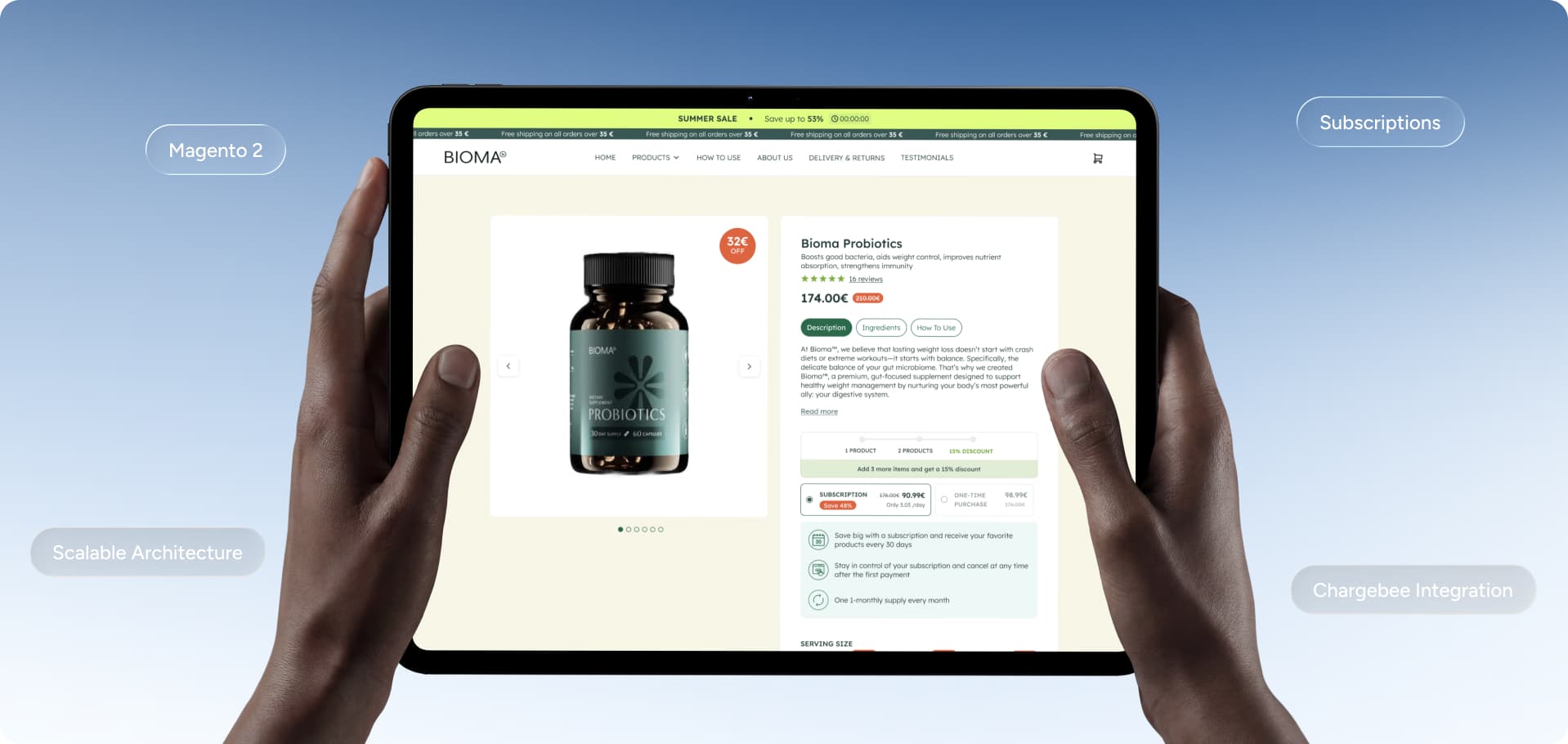
A subscription-first Magento store for Bioma, part of Kilo Health, one of Europe's fastest-growing digital health companies.

The Essentials

9 Stellar Soft engineers

2025 - Present

Kilo Health blueprint brand

Magento + Chargebee subscriptions

Scaled for seasonal traffic spikes

Tech Stack

Adobe Commerce (Magento 2)PHP 8.1Chargebee Billing

Reusing Moerie's Code Without Inheriting Moerie's Problems

We didn't get a blank canvas on this one. Kilo Health already had internal packages built for another brand in the portfolio, Moerie, and the plan was to reuse as much of that as made sense. The catch: reuse without inheriting someone else's technical debt, and - just as important - without dragging everything into one more heavyweight monolith with a single database as the "source of truth."

That second part turned out to be the real trigger for the whole architecture decision, not just a nice-to-have. Bioma's storefront had to handle subscription purchases at scale from the very first day it went live. Cramming subscriptions, payments, and fulfillment into one monolithic system meant that any spike in checkout traffic could take the whole store down with it - not an option for a business that runs on recurring revenue. That's what pushed us toward a modular setup with an independent billing backbone instead of one shared database everything depends on.

And we had to get there in 2–3 months, in time for the brand's most important sales season of the year.
The Numbers, Upfront

2-3 MO

On time, no exceptions

Fully functional store launched in the 2–3 month window, right before peak season

DAY 1

Live from day one

subscriptions, payments, and fulfillment order transfers worked end-to-end with no post-launch scramble

GREEN

Held up under load

Core Web Vitals (LCP, FID, Speed Index) stayed in Google's green zone through peak traffic

Three Priorities, One Immovable Deadline

Missing peak season isn't recoverable for a DTC brand — the problem broke into three priorities.

Three Priorities

Discovery

Before coding, we defined which system owned checkout and a data-sync strategy that wouldn't fail under load.

Billing Beyond Magento

We paired Aheadworks SARP2 with Kilo's custom Payment modules, keeping billing logic out of Magento's core.

Fast Enough to Survive

We built the frontend on Hyvä Themes, tuned for seasonal traffic spikes that make or break Core Web Vitals scores.

Four Independent Services Instead of One Database

Instead of one shared database everything reports to, we split the store into independent, synchronized services:

  • A dedicated Magento instance for Bioma, connected to Chargebee as a fully independent billing backbone - not a plugin bolted onto Magento's checkout, but a separate system Magento talks to.

  • Subscriptions, payments, marketing automation, and fulfillment as isolated services that sync with each other but scale on their own.

  • The Aheadworks SARP2 subscription engine paired with custom Kilo Payment gateways, running on a mobile-first storefront built with Hyvä Themes and Alpine.js.

  • Kilo Health's existing internal packages, adapted to automate email campaigns and fulfillment - reused not just to save time, but to keep operations consistent across every brand in the Kilo Health portfolio, since Bioma was always meant to become the template other brands would build from next.

Chargebee, SARP2, and the Code in Between

Attempt #1 - We tried building our own billing engine. The instinct was to build subscription logic natively on top of Magento - full control, no external dependency. But once we mapped out what "thoroughly tested" billing logic actually requires - edge cases in renewals, failed payments, prorations, dunning - it was obvious that doing it properly would blow past the 2–3 month deadline. Payment reliability isn't something you cut corners on to hit a date, so we killed this approach early rather than let it become a liability later.

Attempt #2 - We integrated Chargebee instead. Going with a mature, cloud-based billing platform meant we weren't reinventing subscription logic that already exists and works. That freed up our engineering time for the part that actually needed custom attention: making sure Chargebee and Magento agreed with each other in real time, and that the end-to-end business workflow - signup to renewal to fulfillment - never broke.

SARP2 Meets Kilo Payment: Where the Friction Was

The hard part wasn't Chargebee itself - it was making Aheadworks SARP2's requirements play nicely with custom Kilo Payment modules, inside an ecosystem of internal packages that weren't always built to talk to each other. We were effectively building a subscription system from scratch, but constrained by tools we didn't get to design from zero.

Two Modules We Had to Write Ourselves

  • Kilo Payment Modules - extend Aheadworks SARP2 with Kilo Health's corporate payment methods, and handle real-time synchronization of subscription status between Magento and Chargebee so neither system ever shows stale data.

  • Internal Kilo Packages (Tracker, Mailer, Fulfillment) - event tracking, queue-based email processing, and automated order transmission to fulfillment warehouses, adapted from Moerie's setup to work with Bioma's architecture.

The Stack

  • Core Platform: Adobe Commerce (Magento 2)

  • Billing: Chargebee (cloud-based, independent from Magento's database)

  • Subscriptions: Aheadworks SARP2, custom Kilo Payment modules

  • Frontend: Hyvä Themes, Alpine.js, Tailwind CSS

  • Backend: PHP 8.1, MySQL

  • Internal Utilities: Kilo packages (Tracker, Mailer, Fulfillment)

Worth flagging: SARP2 and Kilo Health's internal packages aren't the default choice for a typical Magento build - they're specialized tools most Magento shops won't have touched. That's part of what made this project non-trivial.

What Went Live, What It Saved

Technical Results

  • Go-live, on schedule. The store launched inside the 2–3 month window, exactly when it needed to. Recurring payments, subscription renewals, and fulfillment ran correctly from the first live order - no post-launch firefighting.

  • Held the line under peak load. After a round of load testing and optimization ahead of the season, Core Web Vitals (LCP, FID, Speed Index) stayed in Google's green zone throughout - including during the multiple-fold traffic spikes the store was built for. The cloud infrastructure scales horizontally, with extra capacity reserved ahead of the season rather than scrambled together once traffic hit.

Business Results

  • Budget stayed in check. Reusing and adapting Kilo Health's existing packages instead of building every piece from zero meant real savings on development time and cost compared to starting the billing and fulfillment layer from a blank slate.

  • More than a working store. Bioma became a reusable, mobile-first technical blueprint - the next Kilo Health brand that needs a subscription storefront doesn't start from zero. They start from Bioma.

  • linkedin
  • x
  • facebook
  • Clutch
  • Upwork
  • Reddit

Building Something With a Deadline Like This One?

We'll design a modular architecture around Magento and Chargebee — built to stay stable, scale on demand, and survive peak season.


Vladimir Gubarev

CEO and Co-founder

Jack Ananchenko

CТO and Co-founder

By submitting this form, you agree to our Privacy Policy and Terms of Use.

How We Can Help You

See What Else We've Built