Every Product Sells Once

How we helped a London retailer of antique and vintage furniture cut order processing time by 22% and lift ROAS by 18%.

Founder jack avatar

Reviewed by: Jack Ananchenko, Co-founder, CTO

Feb 19, 20265 min read
Woman reading in vintage room with retro TV and wooden walls.
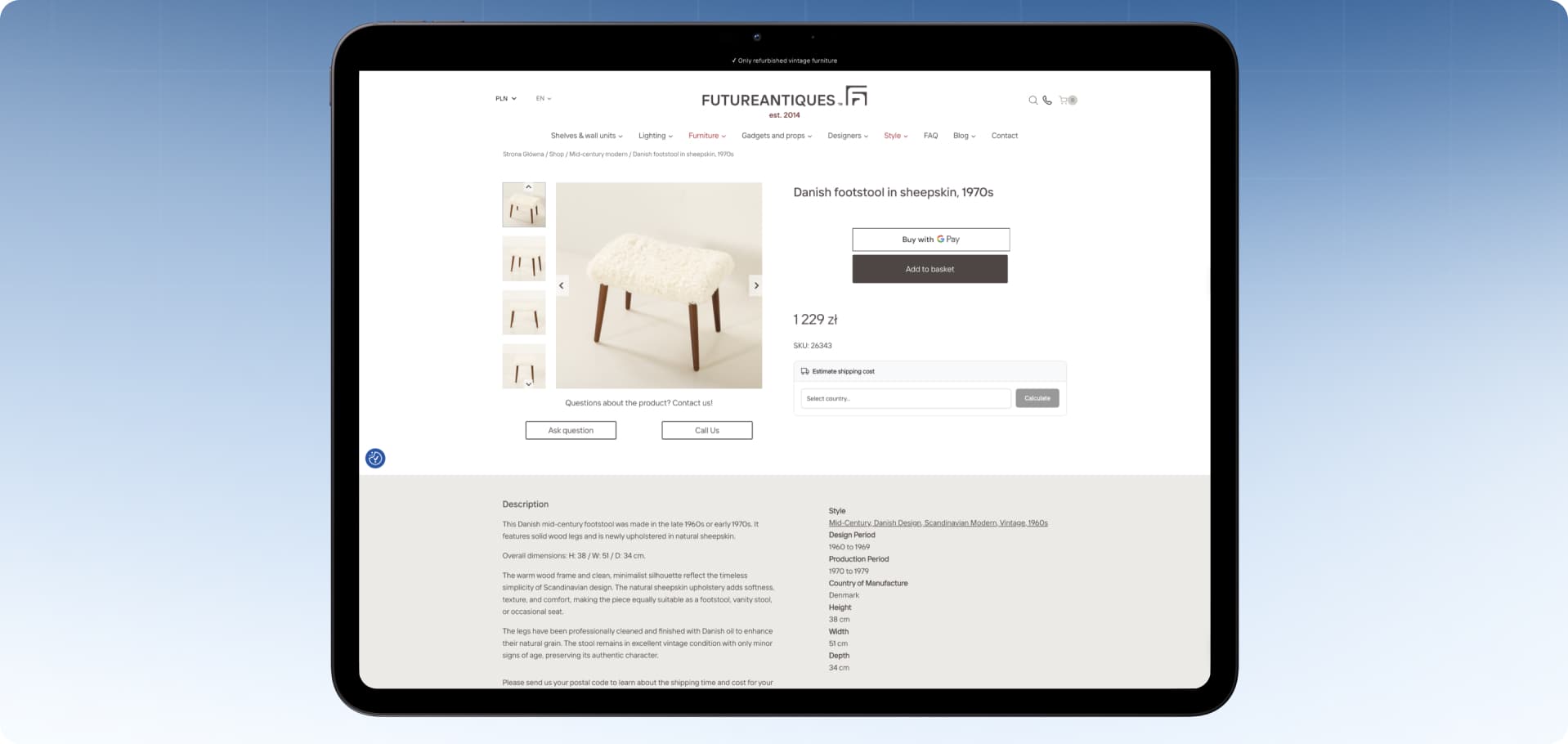
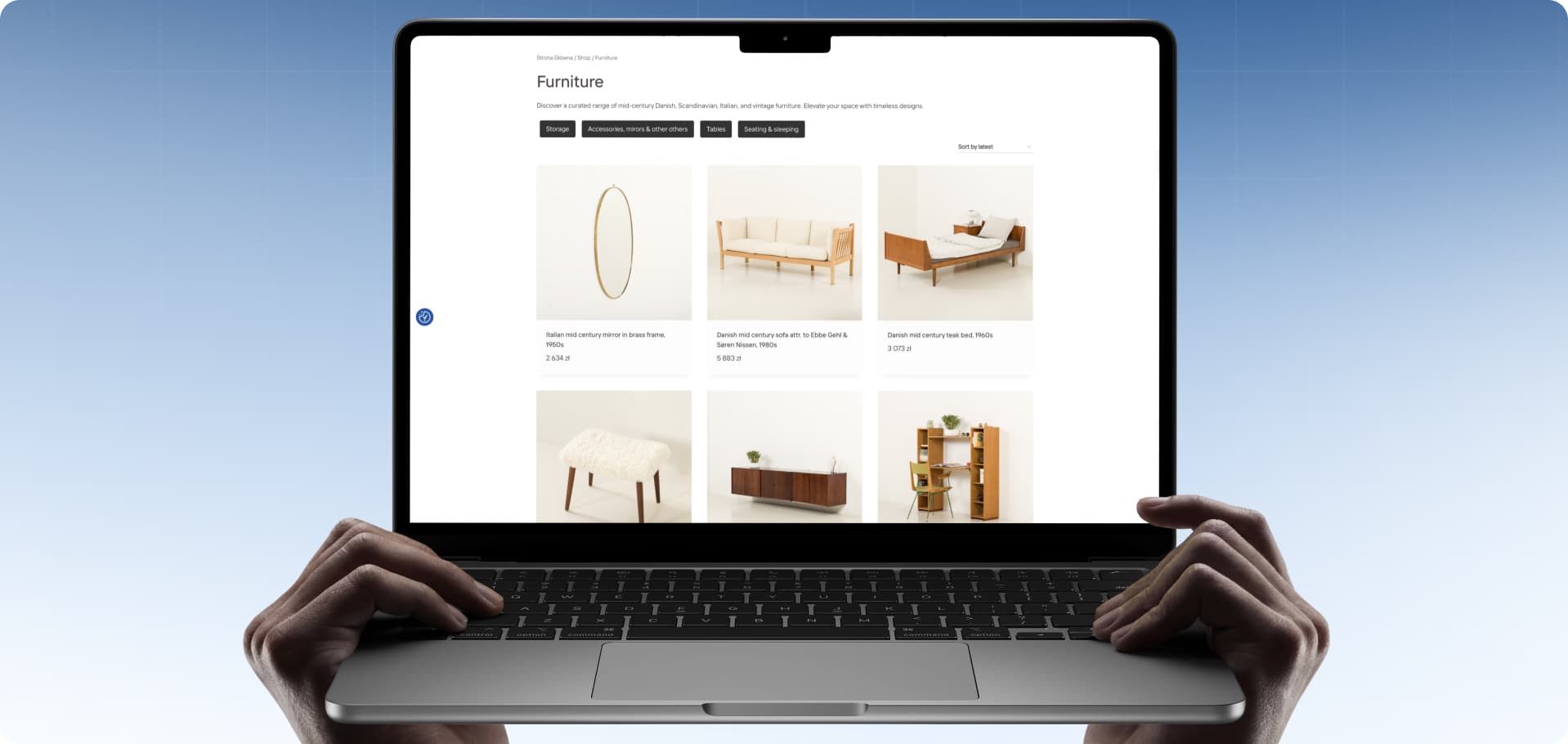
Tablet screens displaying an online vintage furniture shop with various product categories.
Tablets displaying various antique furniture listings on an online marketplace.

UK Antique & Vintage Furniture Retailer

A well-known London retailer with a flagship brick-and-mortar store and a growing online channel

The Essentials

5 Stellar Soft specialists

December 2017 – present

Vintage Furniture

Magento 2 Analytics

Tech Stack

Magento 2PHP 8.1REST API

A Store That Worked - But Held Growth Back

Our client is a well-known London retailer of antique and vintage furniture, with a flagship physical store and a growing online sales channel.

When the engagement began, the client already had a working Magento 2 site. But the platform was capping further eCommerce growth: navigation needed work, performance fell short, and Magento's out-of-the-box analytics gave the sales team too little to work with.

The trigger was the client's ambition to strengthen their digital presence and turn the online store into a real sales tool - making products easier to discover, simplifying search, speeding up the platform, and giving the sales team something stable to rely on day to day.

The Results, in Three Numbers

+18%

ROAS

SKU-level analytics made it clear which categories were worth promoting.

−22%

Order Processing Time

Faster access to order data cut the sales team's routine work.

10+

Hours Saved Weekly

Automated reporting replaced manual data compilation.

Why the Platform Fell Behind

Modernising the live store had to avoid disrupting sales, creating three constraints unique to an antiques catalogue:

Products stayed unseen

Every antique is unique and can't be reordered. Standard Magento navigation left some products invisible.

Performance hurt sales

High-quality photography for one-off pieces overloaded the platform, slowing both shoppers and staff.

Flying blind on data

Sales data was scattered across Magento and spreadsheets, forcing manual reports and guesswork-driven ad budgets.

No Room For Error

All three fronts had to be addressed at once - on a store that was selling every day. Online sales couldn't be paused, and the London flagship relied on the same site as its shop window: customers browsed the catalogue before visiting.

That set a hard frame around every technical decision. We couldn't rewrite the platform from scratch, couldn't afford a rollback after a failed release, and had no licence to break anything that already worked for shoppers.

Three Directions That Removed the Limits

After a detailed assessment, the Stellar Soft team focused on three areas of modernisation that together lifted the store's core constraints.

A better shopping experience
We refined navigation, filtering and search so buyers could find rare antique and vintage pieces faster.

Higher performance
We optimised the Magento platform's speed, cutting page load times and keeping the store running reliably.

Analytics tooling
We built the Retail Metrics Dashboard and the Dynamic Admin Analytics Suite, bringing sales, order and customer behaviour data together in real time. This let the team read performance faster, segment products more precisely, and automate internal reporting.

How It Works Under the Hood

How We Got There

The work began with a detailed audit of the platform. The goal wasn't to catalogue every problem, but to pinpoint which elements of navigation and internal workflow had the biggest effect on the sales team's day - so we wouldn't spend effort optimising things that were never the bottleneck.

Based on the findings, the modernisation was split into three consecutive stages.

Stage 1. A custom analytics dashboard. We built analytics first rather than last. The reasoning is simple: without a way to measure, every optimisation that follows is judged on gut feel. The Retail Metrics Dashboard gave the team a baseline - visibility into which categories and SKUs actually convert, how orders break down, where shoppers drop off. That same data later showed the impact of the two stages that followed.

Stage 2. Product search and filtering. The second stage tackled the problem shoppers felt most directly: reaching a specific item in a catalogue where every entry is unique.

Stage 3. End-to-end performance optimisation. Speed was deliberately left for last: optimisation makes sense once the structure of pages and queries has settled, otherwise part of the work would have needed redoing after the changes to search and filtering.

The Hardest Part

The toughest challenge was delivering substantial performance and analytics improvements on a live store with a large catalogue of one-off antique pieces - without disrupting ongoing online sales.

That constraint shaped the entire approach. Rewriting the platform from scratch was off the table: the store was selling every day, and the London flagship relied on the same site as its shop window. So instead of replacing the architecture, the team worked through incremental, isolated changes - each stage delivering value on its own and testable on its own, without dragging the rest along with it.

What We Built from Scratch

Off-the-shelf extensions from the Magento marketplace are designed for conventional retail - repeat products, a stable assortment. A catalogue where every item exists in a single copy and disappears for good once sold called for its own logic. So the team built two tools around the client's specific workflows.

Retail Metrics Dashboard - real-time analytics on sales, orders and customer behaviour. It replaced manual data compilation and gave the sales team a picture that's current at the moment they look at it, not at the moment the report was assembled.

Dynamic Admin Analytics Suite - an extension of Magento's standard admin capabilities. Reporting that used to be assembled by hand is now generated inside the admin panel, in an interface the team already knows - no exports, no external spreadsheets. This is the tool behind the 10+ hours saved every week.

What It Runs On

The stack on this project is, above all, a set of choices in favour of longevity. The engagement has run since December 2017, and the code had to survive several generations of the platform.

Magento 2 + Luma Theme. The team stayed on Magento's native theme rather than a custom frontend or a headless architecture. It's a deliberate trade: less design freedom - but platform updates don't break the storefront, and maintenance costs stay predictable year after year.

PHP 8.1, following PSR standards. A project that started in 2017 ran on considerably older PHP versions - meaning the custom modules survived major language version migrations without being rewritten. Sticking to PSR here isn't a formality; it's what made those migrations possible.

Native HTML, CSS and Less instead of heavy frontend frameworks - in favour of faster catalogue page loads.

MySQL and REST API. The API handles integrations and supports performance - the analytics tools pull their data through it.

Full stack: Magento 2, PHP 8.1 (PSR), MySQL, REST API, Luma Theme, HTML, CSS, Less.

Results & Impact

The engagement has run since December 2017, so the results below aren't the effect of a single release - they're the cumulative outcome of staged modernisation and continuous technical support.

On the Technical Side

Performance 

  • Before: catalogue pages and image-heavy product cards loaded slowly - felt by shoppers and by the sales team working in the site all day.

  • After: page load times dropped considerably, and moving through the catalogue became noticeably faster.

    Analytics

  • Before: sales, order and customer behaviour data was compiled manually; a report lost part of its relevance before it was even finished.

  • After: the Retail Metrics Dashboard and Dynamic Admin Analytics Suite surface that data in real time - inside the familiar Magento admin, with no exports or external spreadsheets. 

    Search and navigation

  • Before: in a catalogue where every item is unique, some products were effectively invisible - no convenient path led to them.

  • After: refined filtering and search let shoppers get to a specific style, period or type of piece - and every new arrival starts working for sales from day one. 

    Stability

  • Before: the platform was holding the online channel back, and any change carried risk for sales.

  • After: proactive technical support has kept the platform running without interruption for over eight years - including the migration to PHP 8.1 without rewriting the custom modules.

On the Business Side

ROAS: +18%
SKU-level analytics revealed which categories and items genuinely convert. Ad budget started following the data rather than experience and assumption - and every pound spent now returns 18% more.

Order processing time: −22%
Faster access to order data and a quicker platform cut the sales team's routine work by nearly a quarter. For a retailer where every piece is unique and every deal needs individual attention, that time goes straight back into working with customers.

Internal reporting: 10+ hours per week
Preparing reports is no longer manual work. That's more than 40 hours a month - effectively a full working week of one specialist, every month, returned to sales.

Customer experience
Shoppers find rare pieces faster, and the site works as a genuine shop window for the London flagship - customers browse the catalogue before they visit.


  • linkedin
  • x
  • facebook
  • Clutch
  • Upwork
  • Reddit

Is Your Site Losing Sales Because of Speed Too? Let’s Fix That!

Is your eCommerce project also suffering from slow load times or abandoned carts? Reach out, and Stellar Soft’s specialists will build a custom Shopify 2.0 migration strategy to he


Vladimir gubarev

Vladimir Gubarev

CEO and Co-founder

Jack ananchenko

Jack Ananchenko

CТO and Co-founder

By submitting this form, you agree to our Privacy Policy and Terms Conditions.

How We Can Help You

See What Else We've Built