In their efforts to catch up with the customers, firms have to put forth unique characteristics in an already highly competitive industry. Amazon, eBay and Shopify are the major players in the use of AI tools for eCommerce to transform the online retail sector. AI has turned out to be a necessity rather than a luxury.
It’s almost impossible not to have heard a multitude of times that the deployment of AI technology is the shortcut to business growth. The truth is, you are probably already relying on some eCommerce tools. But are you really maximizing the potential of AI ‘tech stock’?
To ensure you don’t miss the boat, we will unveil the top AI technologies in the eCommerce area for 2026 and also how to adopt them in your firm. By the conclusion of this tutorial, you will have the perfect know-how to exploit AI innovations in getting significant competitive whiffs.
How AI Is Changing eCommerce Growth in 2026
AI-driven recommendation engines have reshaped the retail industry by analyzing behavioral, contextual, and predictive customer data. They power real-time product suggestions, dynamic merchandising, and personalized shopping experiences. While tech giants such as Amazon and Netflix pioneered these systems, many retailers now rely on advanced tools like Algolia Recommend and Luigi’s Box to provide similarly tailored experiences.
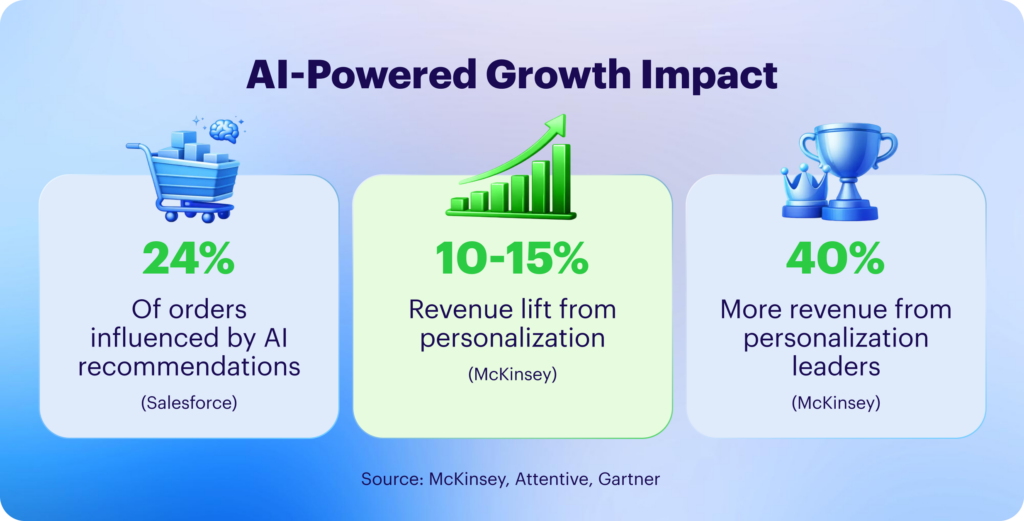
The effect is well-documented across multiple industry studies:
- Salesforce “State of Commerce” Report shows that AI-powered recommendations influence 24% of orders and 26% of revenue for digital retailers.
- McKinsey reports that personalization can drive a 10-15% lift in revenue and that companies excelling at personalization generate 40% more revenue from these activities than their peers.
- Algolia Recommend publicly cites reductions in friction and increases in click-through and add-to-cart rates due to behavioral and similarity-based product suggestions.
- Luigi’s Box reports measurable increases in product discovery efficiency and conversions through AI-enhanced search and recommendation modules.
Together, these findings illustrate why hyper-personalization is no longer optional – it is becoming a defining advantage in digital commerce. Retailers adopting AI recommendation engines consistently see improvements in:
- conversion rate
- customer satisfaction
- retention
- average order value
- marketing efficiency
Hyper-personalized retail experiences are rapidly shifting from “premium differentiator” to “industry standard,” especially as customer expectations continue to rise in 2026.
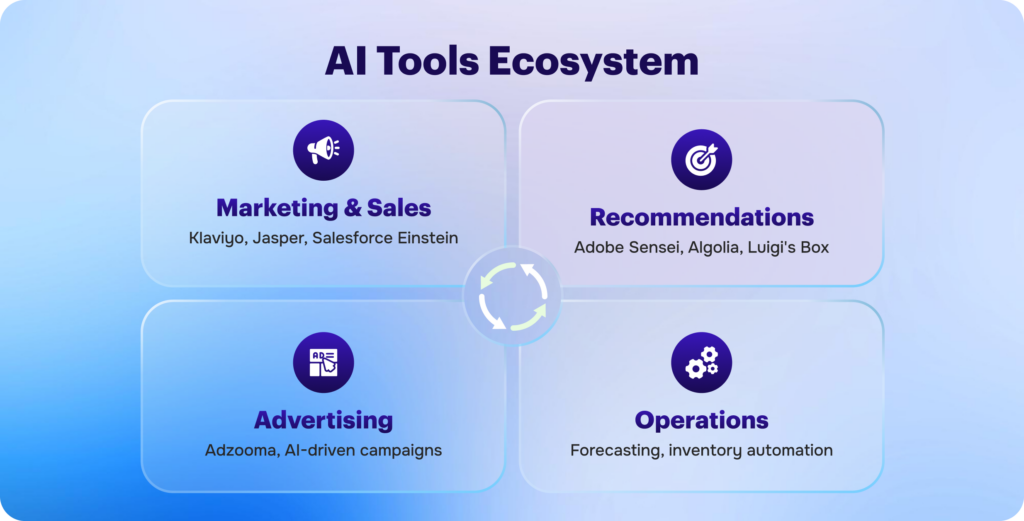
Best AI Tools for Marketing and Sales
The modern eCommerce teams, in their day-to-day activities, are powered by AI-tools that take over personalization, enhance content distribution and derive actionable insights from customer data. Such technologies that are exploiting machine learning, predictive analytics, and behavioral modeling are stacking up better segmentation, target precision, and cross-channel execution efficiency.
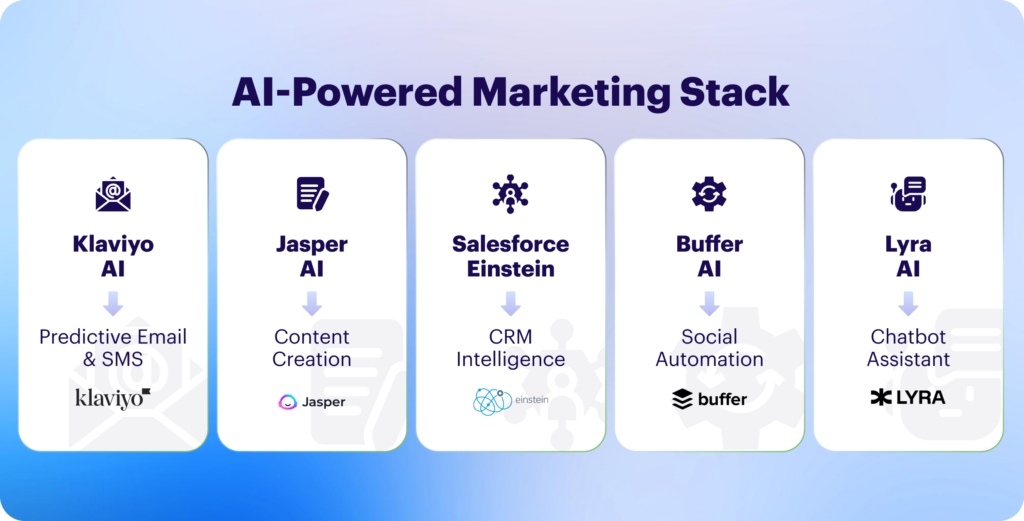
Lovable (AI Website & Funnel Builder)
Lovable helps eCommerce teams quickly create landing pages, marketing funnels, and campaign assets that are informed by user behavior data. It generates page layouts, improves copy, and suggests optimization ideas based on performance insights.
Klaviyo AI (Predictive Email & SMS Marketing)
Klaviyo’s AI features analyze purchase history, browsing behavior, and engagement patterns to predict metrics such as churn probability, next-order likelihood, and customer lifetime value. It helps marketers build accurate customer segments and automate lifecycle communication across email and SMS.
Jasper AI (Content Creation for eCommerce)
Jasper supports long-form content creation, ad copy, email campaigns, and brand-aligned messaging. It is widely used by marketing teams to reduce content production time and keep messaging consistent across channels.
Writer AI (Enterprise-Grade Brand Content AI)
Writer is designed for brands that need strict control over tone, accuracy, and brand language. It helps produce product descriptions, support content, documentation, and editorial assets while keeping everything compliant with internal guidelines.
Buffer AI Assistant (Social Media Content & Scheduling)
Buffer’s AI assistant helps generate post ideas, rewrite content, and analyze engagement patterns to suggest the best publishing times. It allows eCommerce brands to maintain a regular social presence without producing every post manually.
Salesforce Einstein (CRM & Sales AI Layer)
Einstein enhances Salesforce with predictive analytics, lead scoring, product recommendation algorithms, and automated customer service workflows. It supports merchandising, chatbots, and segmentation at enterprise scale.
Why These Tools Matter
Used together, these tools can enhance:
- content creation and distribution
- customer segmentation and lifecycle engagement
- predictive analytics for sales and retention
- cross-channel personalization
- automation of manual workflows
As a result, brands typically see:
- higher conversion rates
- reduced operational costs
- more consistent customer communication
- better use of first-party data
Assistant Chatbots
Chatbots are conversational AI eCommerce solutions with user interfaces that are powered by artificial intelligence and automatically interact with customers on the web, through messaging apps, and on commercial websites. In order to understand the user inquiries and to give appropriate replies, they utilize natural language processing, intent classification models, and occasionally, RAG.
In eCommerce and marketing, chatbots handle:
- 1-st level assistance (common questions, order tracking, and returns)
- product navigation and recommendations
- customer potential assessment and information recording
- help with payment and shopping cart process
Contemporary chatbots work together with various systems like CRM and ESPs, marketing eCommerce automation tools and eCommerce platforms, automating the whole process, updating user profiles, and personalizing the replies according to the user based on their actions and transactions. They reduce the cost of support, supercharge the response time, and keep the customers interacting through the entire journey.
Lyra AI is an example of such a system that learns from customer interactions on a continuous basis to improve its reactions and, thus, its effectiveness over time, with the shopping experience getting better and better with every visit. This model can deal with numerous questions like product suggestions, checking availability, and fixing problems, but all in an easy-going and user-friendly style.
Recommendation Engines
Recommendation systems use various approaches including machine learning, collaborative filtering, content-based modeling, and deep learning, among others, to deliver personalized AI product recommendations.
In order to determine the relevance of a product to a particular user and predict the likelihood of user interaction or purchase, these systems usually resort to massive datasets that include browsing activity, previous purchase history, product details, and real-time consumer signals.
What this means is that these engines can help you increase your average order value (AOV), conversion rate, and lifetime value (LTV) given that your store is already filtering product recommendations based on customer preferences.
Adobe Sensei extends the functionalities of Adobe Commerce and gives online retailers powerful tools for optimization and personalization, so it can be your ally in this process. It combines data analysis and GenAI to deliver not just personalized products but also automated catalog management via image tagging and analysis, and customizable content and copy, all of which are supported by image tagging and analysis.
AI-Driven Ads (AI Ads)
AI advertising uses machine learning and predictive analytics to automate campaign optimization across several channels, including Google, Meta, and programmatic ad networks. These systems use massive datasets, audience behavior, performance, bidding patterns, and competition signals to alter bids, fine-tune targeting, and develop high-converting content.
In performance marketing, AI ads support:
- Real-time bid optimization and budget reallocation.
- Audience segmentation and lookalike modeling
- Automatic creative variation testing (multivariate and A/B/n)
- Predictive modeling for ROAS and CAC
- Dynamic ad copy generation with NLP models
Similar AI eCommerce solutions with analytics platforms, CRMs, and eCommerce systems to bridge the gap between spend, behavior, and conversions. This enables advertising to self-optimize based on performance and long-term value rather than surface measurements.
For example, Adzooma centralizes cross-platform ad management and uses machine learning to diagnose underperforming campaigns, provide optimization solutions, and redistribute funds based on predictive performance insights.
AI in Operations: Forecasting and Automation
AI-driven operational forecasting starts with combining disparate datasets, such as transaction histories, traffic sources, campaign metadata, lead-time logs, performance data, and even external signals like weather or macroeconomic indicators, into a cohesive dataset.
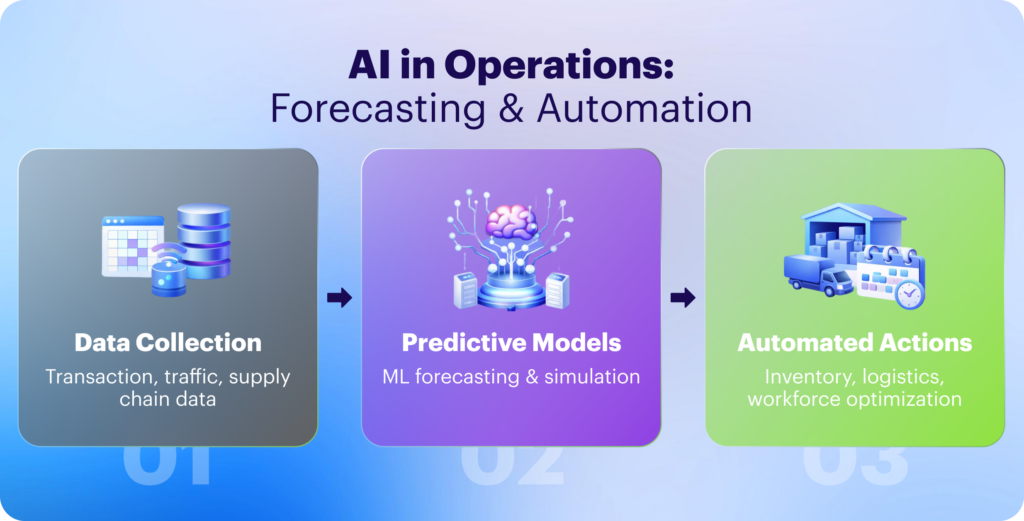
Advanced feature engineering then converts these raw data points into model-ready variables, capturing patterns like sales elasticity, demand volatility, and the temporal correlations between marketing activity and downstream operational strain. Read about it in detail.
Predictive Forecasting Models
AI-powered forecasting engines combine transactional data, historical demand trends, seasonality curves, traffic measurements, and supply chain signals into a single data layer. These systems use a combination of statistical time-series models (ARIMA, Holt-Winters) and machine learning techniques (XGBoost, LSTM networks, transformer-based sequence models) to capture non-linear trends, cross-SKU relationships, and rapid demand fluctuations.
ForecastPro, Zoho Inventory AI, and Microsoft Azure AutoML are platforms that can deploy these models on a large scale. They retrain to ensure accuracy and prevent drift, allowing for real-time modifications during promotions, traffic spikes, or supply shortages.
Scenario Simulation and Decision Support
After training, the forecasting layer performs counterfactual simulations to evaluate operational outcomes such as the impact of budget changes, supplier delays, pricing modifications, and inventory restrictions. These simulations calculate revenue effect, fulfillment burden, and risk probability, and input them directly into decision engines.
These outputs are used by operations teams to calibrate stock levels, change reorder points, optimize warehouse distribution, and fine-tune logistics routing based on expected throughput and lead time variations. AI platforms such as Anaplan, O9 Solutions, and SAP IBP offer simulation and decision-support capabilities.
Automation Across Inventory, Logistics, and Workflows
Automation activates when forecast outputs cross defined thresholds. See:
- in AI inventory management, it generates replenishment orders, redistributes goods between regional warehouses, and prevents stockouts and overstocking.
- in logistics, the system dynamically reroutes shipments, modifies carrier selection, and arranges pick-pack procedures based on expected demand.
- workforce operations also benefit from automated task prioritization, ticket deflection, and staffing suggestions based on predicted order volume, which are powered by engines like Zendesk AI and Freshworks Freddy AI.
When you integrate these technologies into your business model, you get an adaptable, self-correcting operational layer that transforms eCommerce operations from reactive to predictive.
Choosing the Right AI Stack for Your Store
The sheer amount of AI solutions available to eCommerce professionals today represents both a tremendous potential and a severe risk. As we have shown, best-in-class tools can transform anything from on-site search to fraud prevention. The natural impulse is to amass these powerful answers, resulting in a broad “toolbox” to face any situation.
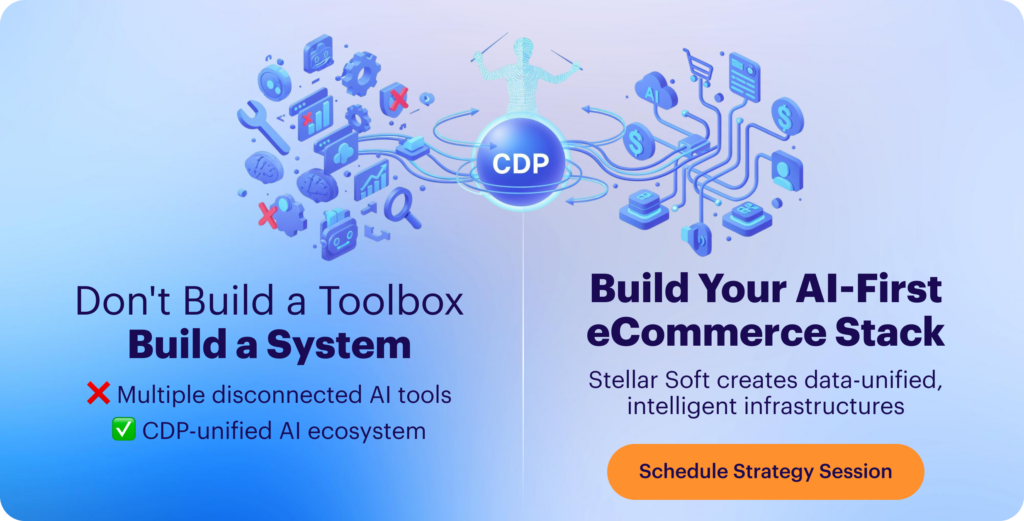
The most successful leaders are making a different decision. They understand that individual tools are only instruments; what they require is a conductor. They are basing their strategy on a core AI analytics eCommerce, a Customer Data Platform, which combines their data and orchestrates all activities. This is the approach to maximizing the ROI of any AI investment, and it distinguishes between establishing a collection of gadgets and building a true engine for growth.
Stellar Soft specializes in creating data-unified, future-proof eCommerce infrastructures that leverage AI for a competitive edge. Schedule a session and create your intelligence roadmap.
However, the situation is changing as digital interactions are getting more sophisticated, and CRO is no longer limited to small alterations, Thus brands in 2026 will incorporate AI personalization eCommerce and full-funnel strategies to improve every single aspect of the consumer journey.
Consumers of today have different ways of interacting with the companies, which makes it impossible to carry on with the static tests. The modern day CRO should be able to act on the fly, relying on AI-driven insights and micro-conversions to predict and shape user behavior. eCommerce companies that do not adapt to personalized campaigns will eventually lose considerable user engagement opportunities and get uncompetitive.
So, what are the 2026 CRO strategies? The main ones include AI taking real-time optimization, hyper-personalization delivering seamless experiences, and CRO influencing all interactions rather than only leading to conversions. Retailers that welcome this change will not only secure a competitive edge but also foster deeper customer relationships, resulting in improved engagement, increased sales, and customer loyalty in the long run.
How AI Personalization Works in Modern eCommerce
The process of AI personalization eCommerce understands the customer’s precise needs and tastes through the evaluation of his/her provided demographic and historical behavioral information like shopping and browsing habits, and interactions on social media. The most important personalization features are:
- customer behavior tracking across every touch point is done with behavioral tracking
- the modification of AI customer experience is through real-time adaptation according to the behavior of the customers
- client needs and preferences are predicted with the help of predictive recommendations
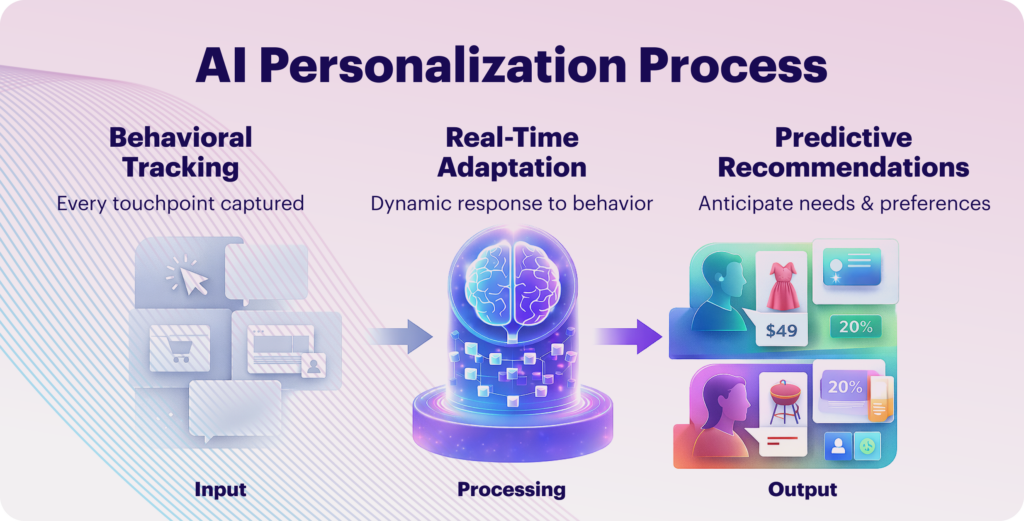
The technology can predict what they are curious about, through which channel they want to communicate with your business and at which stage of their perfect buying journey your next best touchpoint is.
The hyper-personalization concept goes beyond merely deploying static AI algorithms alongside pre-defined workflows. The AI that eCommerce companies are after would be the one capable of operating independently to serve their purpose in a wise and personalized manner to each and every consumer. Agentic AI is changing the landscape of personalized consumer experiences and making them truly one-to-one by giving autonomy, adaptability, and real-time optimization to business operations.
Benefits of AI-Powered Personalization for Conversions
Artificial Intelligence gives the possibility for eCommerce companies and sellers to rely less on basic trusting and more on real-time data, smart insights, and machine-made decisions. What do these new environments lead to? Shopping that is less time-consuming, more intelligent, and extremely customer-focused and oriented to making sales.
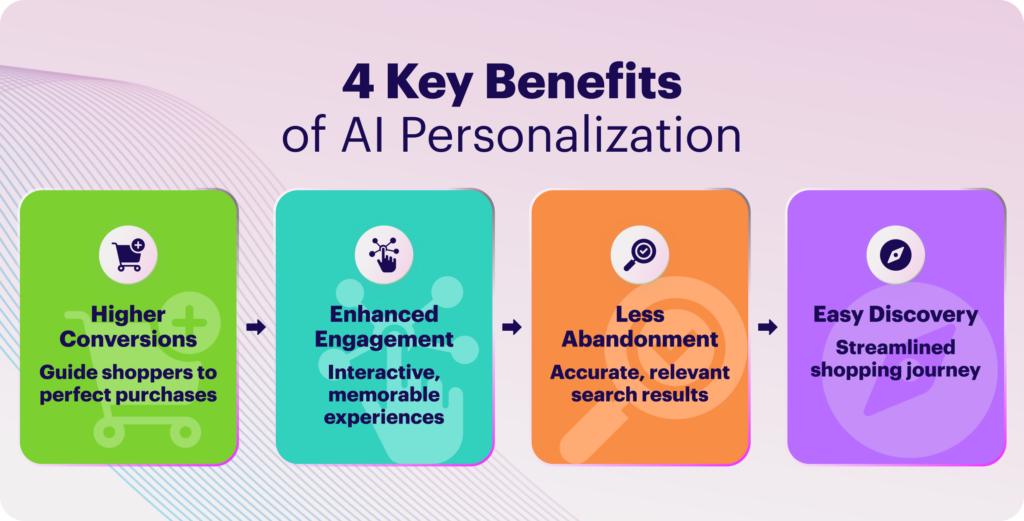
Increased Conversion Rates: Guiding Shoppers to the Perfect Purchase
Conversion rates are essential for the success of eCommerce. One of the reasons that AI-driven personalization is very important is that it makes AI customer experience very relevant for each shopper thus giving a direct impact on this measure. Customers visiting your site are usually introduced to many different types of products. Kids, if not properly guided, can get confused leading to dropping out. AI takes the role of a personal shopping assistant to support and relieve the situation.
Enhanced Customer Engagement: Creating Interactive and Memorable Experiences
Artificial intelligence aids retailers in providing dynamic and interactive shopping experiences that are not limited to merely showing products. AI-driven chatbots, for instance, can provide individual recommendations and give real-time responses to customer queries.
Consequently, the buying process becomes more lively and dynamic, which attracts customers to the site for a longer period.
Artificial intelligence can find opportunities to customize the message’s time and delivery by analyzing the customers’ behavior and preferences. For instance, a retailer might send a personalized e-mail containing a special discount to a customer who has shown interest in a particular category of products.
Reduced Search Abandonment: Delivering Accurate and Relevant Results
AI surpasses the traditional methods of matching keywords to understand what a customer is looking for through his or her search query. This implies that, no matter how complex or ambiguous the customer’s language is, AI will still be able to provide helpful results. AI also draws on past search activities and choices which it gradually enhances through time informing search results. This leads to the visibility of the most pertinent items to the customers even when they are not quite certain about shopping for something specific.
Streamlined Product Discovery: Simplifying the Shopping Journey
AI processes enormous amounts of product data, like characteristics, descriptions, and ratings, to discover the best-fitting products for each client. This accelerates the buying procedure, thereby facilitating customers in their search for the desired items. Individualized recommendations and search results bring the customers to the products that are most likely to attract them, thus, the time-consuming scrolling and searching becomes redundant.
Data and Predictive Models Behind Personalization
The use of AI in eCommerce personalization involves the integration of massive data gathering and predictive modeling of the highest order to develop and maintain continuous and highly personalized customer relations. It starts with:
- The combination of customer profile, comprising of demographic (age, gender, location, etc.) and psychographics (interests, behavior, etc.), transactional (purchases, browsing, etc.), and contextual data (location, device, time, etc.) into a unified feature store or customer data platform (CDP).
- Raw data undergoes various preprocessing steps like normalization, encoding, dealing with missing values, and feature extraction to be finally turned into structured inputs for modeling.
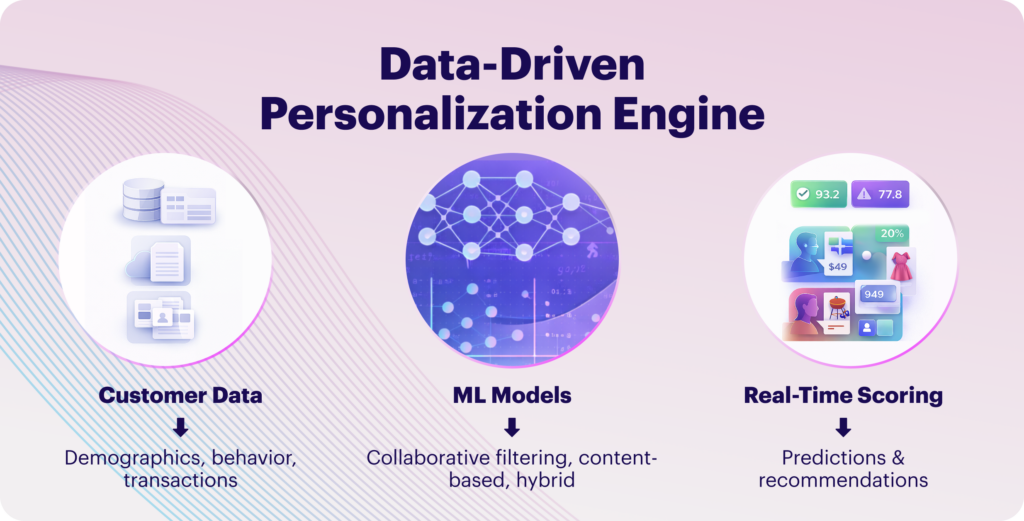
Personalization models utilize the methods of both, traditional statistics and machine learning together. User-item interactions reveal hidden preferences through filtering whereas content-based filtering recommends specialized or new goods based not only on product features and user profiles but also on user interests.
To deal with issues, hybrid models, for instance, make use of both approaches. Sequence models and transformer architectures based on temporal and contextual dependencies capture sessions, thus enabling real-time adaptive suggestions. On the other hand, graph-based models utilize graph neural networks for user relationship and interaction mapping, while reinforcement learning improves suggestions by treating interactions as reward-driven sequences.
The entire process involves feature engineering, model training, prediction scoring, and real-time adaptation, all of which are monitored by KPIs such as CTR, conversion rate, session length, and revenue per user. Hence, dynamic pricing AI and personalization is guaranteed to be responsive to customer behavior, which in turn leads to maximum engagement, higher average order value, and improved retention.
Tools for Implementing AI Personalization in 2026
Choosing the proper AI personalization eCommerce tool isn’t about chasing the latest technology; it’s about choosing the solution that best meets your business needs. Here are a few tools that might help brands rethink how personalization works across channels, journeys, and situations.
Yespo
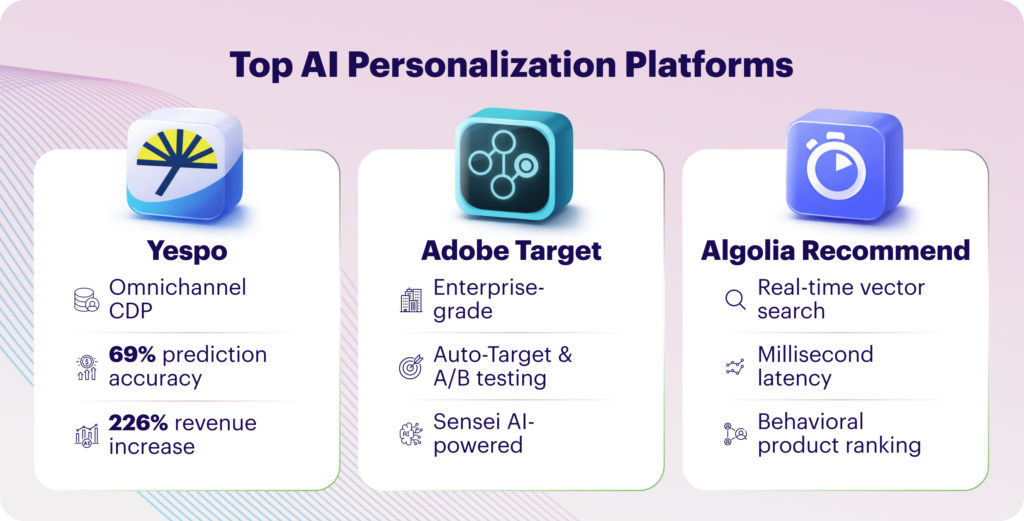
Yespo is an Omnichannel Customer Data Platform that offers ready-to-use solutions for online services, retail, and eCommerce that aim to increase sales and retain customers. Brands can personalize the consumer experience across nine channels by leveraging AI, product suggestions, behavioral triggers, and messaging, all without the need for developers.
Yespo consolidates all of a customer’s data into a single profile and makes it available for activation using predictive AI techniques.
Product Recommendations: Even with limited data, the algorithm can anticipate what customers will buy next with up to 69% accuracy. It also recommends new things that are useful to the consumer. When employed in site suggestion blocks, these algorithms increase revenues by up to 226%.
Predictive Segmentation: Artificial intelligence analyzes human behavior to identify clients who are most likely to make a purchase in the next 30 days. This keeps communication focused on people who are likely to buy and reduces expenses by up to 50% on expensive channels.
The platform provides nine channels for clients to connect (email, mobile push, online push, SMS, Viber, pop-ups, in-app, App Inbox, and Telegram bot), allowing you to completely tailor their experiences at every touchpoint.
Adobe Target
Adobe Target, part of Adobe Experience Cloud and powered by Adobe Sensei, is a platform for enterprise-grade personalization and experimentation. It enables businesses to automate, test, and scale personalized online, mobile, and email AI customer experience.
Auto-Target and Automated Personalization, like Dell’s global optimization, deliver dynamic content based on historical and real-time behavior. Ideal for organizations that require accurate testing and deep predictive analytics eCommerce integration, it blends predictive customization with robust A/B testing to adapt user journeys based on engagement data.
Algolia Recommend
Algolia Recommend is a vector-based system for real-time personalization that tailors search and personalized product recommendations by assessing user context with millisecond latency. It is used by firms such as Decathlon to tailor catalogs and rank products depending on behavior, providing speed, precision, and relevance on a large scale.
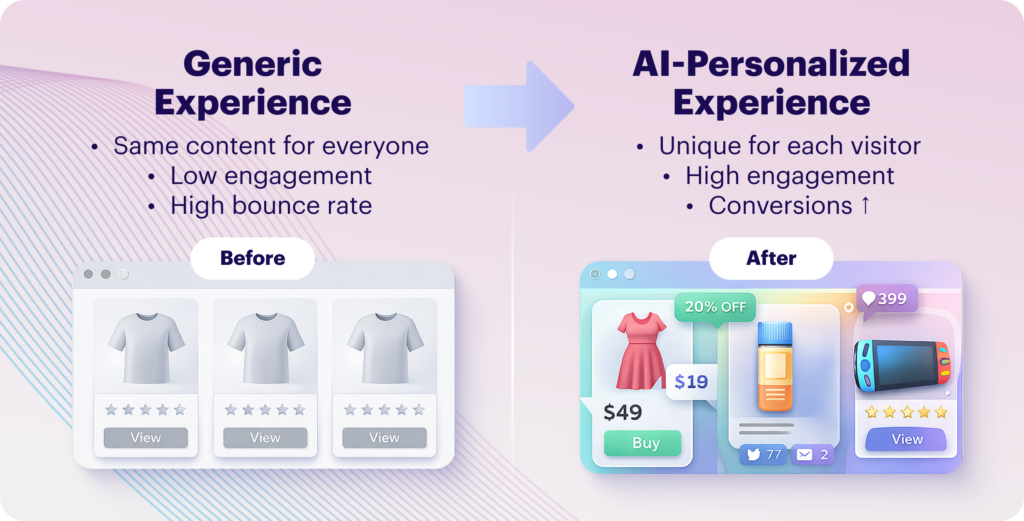
AI-powered personalization improves eCommerce by converting complex consumer data into actionable insights, allowing for real-time, one-on-one interactions that boost conversions, loyalty, and average order value. Solutions such as Yespo, Adobe Target, and Algolia Recommend demonstrate how predictive models, adaptive recommendations, and AI shopping behavior analysis make hyper-personalization scalable and quantifiable. Agencies who execute these techniques assist clients in achieving measurable business growth and a competitive advantage.
Partner with Stellar Soft to create and deploy AI personalization eCommerce strategies that yield measurable outcomes for your clients. We optimize trips, increase conversions, and maximize income potential.
The landscape for eCommerce platforms 2026 is a great opportunity for the youths to come up in the trade considering that online shoppers are now more than ever.
Your online store’s profitability will be affected by every move you make from selecting the product and platform to marketing techniques and providing customer support. In this eCommerce business guide, we are going to guide you step by step through the whole process of eCommerce firm launch in 2026 alongside the essential stages, challenges, and the most effective ways to compete in the market.
Why 2026 Is a Great Year to Start an eCommerce Business
In 2026, the decision to start an eCommerce business venture is an excellent decision because the trend of online shopping is going up. The facts are that running an internet business is cheaper than a brick-and-mortar store, it provides you with the possibility to sell worldwide, and all the activities can be done via your computer.
Besides, online selling gives you the choice of working full-time or part-time. It’s an attractive source of passive income, has the advantage of a flexible schedule, and allows you to choose any place with internet access as your office. The further the online purchasing rises, the bigger the quick growth opportunity is.
Steps to Build an Online Store from Scratch
The eCommerce market keeps growing, thus, you must consider how to differentiate yourself from others when everybody can apply digital marketing to their business. Even though the competition is tough, the door is still open for eCommerce businesses. This is the way you can take the first step.
Step 1: Research eCommerce Models and Decide What to Sell
The eCommerce industry is very big and competitive nowadays, so the analysis of your eCommerce business plan is a must. The categories are very basic and there are four of them.
Business-to-consumer (B2C): A widely used business model in which a company sells directly to the customers. The products sold under this model can range from foods to shoes. Examples of B2C companies are Amazon, Walmart, and Alibaba all of them present and sell many different brands in one place.
Business-to-business (B2B) models: They sell products or services to other businesses. Orders usually consist of repeat purchases. Examples of B2B models include Amazon Business, Alibaba, and Rakuten.
Customer-to-customer (C2C) marketplaces: These are platforms where customers can trade and sell their products and services to each other. Craigslist, Etsy, and eBay are examples of online consumer trading between customers.
Customer-to-business (C2B): This is where individual sales of goods and services to businesses occur. Upwork is one of the platforms for freelance hiring by companies that are known for going this way.
Identifying the specific market for your product starts with examining what product niche selection you want to sell, who is going to buy it, and how it is going to be distributed. When you start a business, you have all the power to make decisions, including the option of selling your own handmade products or sourcing generic ones. It is up to you to find what works best.
Step 2: Write an eCommerce Business Plan
Once the foundation for your company has been established, you can start an eCommerce business plan. This written document will illustrate your aims and approaches in the areas of finance, operations, and marketing. Besides, it will help you to arrange and lure potential investors.
A thorough research needs to be conducted to get the information about the current competitors and the market situation for your product or service. Identify your target audience and decide your tactics for reaching potential customers. Organize the details, that is, when, where, and in what ways you will be taking steps in the following months, including the logistics.
Step 3: Choose a Business Name and Start Building your Brand
Selecting a name for your company can be fun and at the same time it will need wise consideration. Besides a simple but one-of-a-kind name that can easily be understood for the type of product you are selling, you must also verify if the web domain, social media handles, and eCommerce legal setup name are available. Conduct your research to make sure that it will be understood well in every culture, especially if you plan to be a global player.
Brand development will come with the necessity of designing a logo that will be present on all types of packaging, website, and marketing material design. With time, you might want to bring in a designer to convert the essence of your brand into beautiful online visuals.
Step 4: Create your eCommerce Business Website
After this, the next step is to develop a website with full eCommerce functionality. When your site goes live, it becomes the digital face of your business – a place where visitors browse products, explore your brand, and complete purchases. As a result, the performance and usability of your website will directly influence your overall success.
The process begins with choosing a domain name that accurately reflects your brand. The next step is selecting an eCommerce platform that matches your technical requirements, growth plans, and preferred level of customization.
Businesses often choose all-in-one solutions (like Shopify), which provide built-in tools for inventory management, payments, and shipping.
However, companies that require deeper customization, advanced integrations, or enterprise-level performance frequently choose Magento (Adobe Commerce). It offers unmatched flexibility, robust B2C and B2B functionality, and the ability to fully tailor the store to complex business needs.
If you’re considering a custom Magento build, explore our capabilities here: Magento Custom Development Services.
After you select the right platform, you can proceed with creating and configuring your online store. This includes defining your layout, preparing wireframes, uploading product inventory, and writing product descriptions that convey your brand story and values.
Step 5: Source and Develop your Products or Services
A prototype of your website is the first step to adding products with names, descriptions, and pictures. Besides, there is a need to get your items, either by making them yourself or by buying them from a wholesaler.
In case you’re an artist, you must have enough stock for the first couple of months. It can mean preparing one garment from every color and size of your clothing line or 20 identical ceramic pots. The number really depends on how much labor you can put into this, as well as your marketing plan, which might include the amount of traffic you drive to launch an online store.
You would also have to consider logistics, such as branded packaging, warehousing, inventory management, and shipping.
Step 6: Launch and Market your eCommerce Business
Congratulations! After the decision to launch an online store, you can now start monitoring your metrics and key performance indicators (KPIs) gradually as the firm grows. Keep on trying different digital marketing methods to bring more visitors to your brand.
Besides managing inventory, logistics, and marketing, you will have to ensure that shipping and fulfillment are done successfully for each customer. It is wise to prepare contingency plans in case something goes wrong.
Common Mistakes First-Time Store Owners Make
New eCommerce founders often underestimate the operational and technical demands of running an online store. A few patterns show up repeatedly:
- choosing a platform based on price instead of requirements
- skipping early analytics setup, neglecting site architecture
- and launching without proper QA
Many also invest heavily in paid ads before fixing core issues like slow load times, unclear navigation, or missing product data, driving traffic to a system that can’t convert.
Another common pitfall is overbuilding including selecting complex features, custom plugins, or full-stack solutions before validating basic demand. Others do the opposite and depend entirely on out-of-the-box tools, only to face scalability issues months later. No backup process and poor inventory planning round out the list. These mistakes are avoidable with technical planning, realistic budgeting, and support from people who’ve built stores before.
Legal, Financial, and Marketing Essentials for Success
The decision to start an eCommerce business is a lucrative investment, especially if your brand resonates with a big number of customers. It also takes time: starting and profiting from an online business might take up to two years.
Here are key upfront costs and essentials to consider:
Licenses and Permits: Your legal documents, including business licenses, resale permits, and local permits, will be determined by your business entity type, state/location, and products sold. Fees range widely, usually from $50 to several hundred dollars.
eCommerce Platform, Domain Name, and Hosting: Shopify’s basic plans cost $29 per month, while regular subscriptions cost $79 per month. Open-source platforms, like Magento, are free to download but have hosting and development charges. Domains can cost anywhere from $1 to $50 per year, while hosting can range from a few dollars to $700 per month, depending on traffic and services.
Shipping and Fulfillment: Shipping rates vary according to product quantities, carrier services, and delivery speed. Some organizations completely outsource fulfillment to third-party logistics (3PL) providers so they may concentrate on operations and marketing.
Marketing and customer acquisition costs vary depending on the size of the firm and its stage of growth. Marketing accounts for 13.8% of overall budgets, with new eCommerce enterprises spending up to 30% to gain clients.
Insurance and Risk Management: Business insurance provides protection against liability, property damage, and cyber hazards. Based on your operations, you should consider general liability, product liability, and cyber insurance plans.
eCommerce Legal Setup: Depending on your items, you may need to follow safety, labeling, and consumer protection standards. If you’re selling worldwide, be mindful of customs, import and export legislation, and data protection regulations such as GDPR or CCPA.
If you’re ready to put your idea into action and want your store built on strong design rather than guesswork, Stellar Soft can help. We assist founders and growing organizations with validating platform selections, designing scalable storefronts, and implementing the backend systems they will rely on for years (inventory, connectors, payments, and automation).
If you’re ready to turn your company concept into an action to launch an online store, contact us right away. The appropriate technical basis will save you money, shorten build time, and prevent costly rebuilds later on. Before you invest in growth, let us first determine what your store requires.
All these numbers point out that the industry is on a steady upward UI trend in eCommerce and becoming slighter more competitive than the previous year. Yet, the competition in eCommerce has a particular character, as companies are trying hard to attract and keep their customers by offering them unique experiences.
Hence, UI and UX have become the key factors that determine the success or the failure of an eCommerce business. To put it in a nutshell, over the past years, the design of eCommerce sites has undergone a radical transformation, from mere online displays of products to breathtaking and engaging retail experiences. Technological progress, in conjunction with the enhanced significance of UI/UX design in eCommerce, mainly caused this shift.
How eCommerce UX Is Evolving in 2026
Witness eCommerce UX 2026 being greatly influenced by an approach that is centered on design thinking and puts most of the issues to be solved systematically while also putting the user first. We concentrate on paving the way to talk through and satisfy the complex needs of the customers, enlivening the interaction, and cultivating the users’ happiness to the fullest. The use of modular and interactive elements, the flexibility of multi-scheme layouts, and the ability of the retailers to display product information properly while simultaneously having a visually appealing interface is made possible by the platforms.
The modern eCommerce design that puts mobile usage first has become a must-have feature because mobile phones are the major type of device used for browsing the internet. UX methods are giving more and more importance to responsive designs, easy navigation, and mobile-friendly access to the catalogs. This includes adjusting the menus, making the interaction smoother, and using recognition technology for voice UX that not only makes the process easier but also increases access. All this is done in such a way that consumers can interact seamlessly with the products no matter where they are or what device they are using.
Customer Expectations and Behavior Changes
The development of eCommerce has simply raised the bar for the companies that consumers buy from. So, what are the requirements of shoppers? They want a flawless buying process that is designed for them. One that stays the same no matter what kind of device they are using for shopping or where they are in the payment transaction. A personalized eCommerce customer experience will make people 40% more likely to spend more than originally intended.
For illustration, GOAT is a sneaker digital marketplace where customers can create wish lists. They get a push notification from the app if the sneakers are on sale or the price goes down to the shopper’s preferred range. The company has been able to create a personalized experience that is mobile, commanding, and powering over 7 million users globally.
Shoppers Are Becoming Their Own Salespeople
Besides the online reviews, the consumers can get the information about the product and the company to investigate and contemplate prior to buying. This change in the clientele who are more aware of the market has led to an alteration of the role of salespersons in the organizations. The customers’ demands have gotten higher, and the companies need to change their tactics in order to meet them.
In the past, when digital media did not exist, the customers depended on the sales personnel to guide them through the purchasing decision. Now the customers are walking into the stores, whether physical or virtual, with the information needed to make a purchase.
Shoppers Have Greater Access to Products
Nowadays, shoppers have access to a lot of information and the internet gives them the privilege to buy items from any part of the world. Companies have stepped out of their domestic markets owing to new trade agreements and eCommerce technology and the consumer response has been positive. Global cross-border sales are expected to reach $4 trillion by 2027.
However, customers are very interested in getting products from other countries but at the same time, they have very high expectations concerning the eCommerce customer experience in their country. Cross-border shoppers expect that the websites of merchants would be in their own language and would accept their local currency and payment options.
Top UX Design Trends to Follow
The transformation of interfaces is not limited to presenting just simple recommendations. Giving an AI a chance on a product enables it to predict what the user wants accurately and then change layouts, content, and notifications according to behavior, context, and habits. The very purpose of this evolution is to make the digital things look more active than passive.
Netflix is one such application that epitomizes this approach. They have even more revolutionary changes in their foundational model in order to comprehend the user demand better and to predict the future behavior of the users. Netflix is not only suggesting series based on the behavioral data of the user but is also tailoring the images that would be seen by each user, showing exciting scenes to thrill seekers and tender moments to romance lovers.
Minimalism with Microinteractions
Minimalism is not a trend that is going to fade away; rather, it is a trend that is going to develop. In place of static simplicity, designers are adding quiet, intentional features to help with the engagement of the interfaces. Peaceful layouts mixed with tiny microinteractions that either confirm or direct attention are the new modern eCommerce design directions.
A microinteraction comprises four parts: the trigger (the event that starts it), rules (its manner of behaving), feedback (what the user sees/hears/feels), and loops and modes (its repetition or change over time). Think of it as mandatory for your design to consist of all these aspects.
Microinteractions are mainly utilized for functionality but also for the purpose of adding personality and pleasure to an eCommerce customer experience. They enable a more intuitive and enjoyable interface by offering real-time, context-sensitive responses to user activities (e.g., “like” animation). Therefore, go ahead and play with them!
Conversational and Multimodal Interfaces
Voice, chat, and gestures are getting increasingly natural, but not all situations require the same type of engagement. The finest experiences integrate them smartly:
- speak when it feels natural
- type when precision is needed
- interact visually when speed matters most
Multimodal design results in a more fluid, intuitive flow that considers the user’s context and environment.
Multimodal AI design automation improves accessibility, usability, and engagement for a wide spectrum of users, including individuals with special sensory needs. This adaptability results in smoother, more pleasurable experiences that drive adoption and differentiate products in crowded markets.
For example, in a smart workplace (such as a warehouse), an adaptive UI would switch to exclusively speech mode when the worker is handling fragile products to reduce distraction from visual or gesture UI. When the environment becomes noisy, the system may switch from voice and visuals to solely visual feedback to ensure usability.
Why UX Is the Key to Conversion in Modern eCommerce
In eCommerce, every detail is important. A customer’s decision to complete or abandon a purchase is influenced by intuitive navigation, appealing product descriptions, and an easy ordering process. As a result, it is worthwhile to invest time and resources in improving your eCommerce customer experience.
How can you collect information from your customers?
It starts with listening. The most useful insights usually come from real users and from observing how they behave across different touchpoints. You can gather this information in several practical ways:
- analyze website analytics to understand how people move through your store – which pages they visit most often, where they hesitate, and what ends up in their carts
- run surveys or short interviews to get personal feedback on what users enjoy, what frustrates them, and what they would change
- monitor online reviews and comments across platforms to see how shoppers describe your store compared to competitors
- organize small usability tests where participants complete tasks on your website while you observe their actions and note where they struggle
- keep feedback collection ongoing – check in with customers regularly, encourage suggestions, and treat negative comments as opportunities for improvement, while positive experiences help strengthen your reputation
When evaluating data, search for patterns and UI trends eCommerce. Which characteristics are the most popular? Which stages of the purchasing experience generate issues for customers? These insights will assist you in drawing conclusions and refining the UX to meet actual client needs.
eCommerce in 2026 will be defined by the combination of adaptive, data-driven interfaces and AI-powered customisation. Success is dependent on establishing UX frameworks that optimize user flows, reduce cognitive burden, and use behavioral analytics to predict consumer intent. Businesses that implement these techniques see measurable increases in engagement, conversion, and retention across all platforms and markets.
Are you ready to future-proof your eCommerce store and provide your customers with an unforgettable eCommerce customer experience? Explore Stellar Soft today to see how cutting-edge UX methods, AI-driven personalization, and mobile-first eCommerce may help change your online business. Begin optimizing your store for 2026, as outstanding UX is a quantitative advantage.
And 2026 looks just like one of those years. The major change that comes from the application of AI solutions across various domains and marketplaces is already seen by us in an unprecedented way.
The industry has been considering these eCommerce trends 2026 for a long time but now they have reached such a point that they can actually influence the big-scale strategy of the industry. And, boosted by the emergence of AI, they grow enormously fast, generating surprising results. Let’s talk about them.
What Are eCommerce Trends in 2026
We are going to have to get ready for a completely new category. This is now eCommerce trends 2026 that retail companies have to not only fight for customers’ attention but also for their algorithms’ preference, while at the same time, accepting the presence of robotic agents as part of the consumer experience.
A retail test will take place this year to see how well stores can adapt to the new situation. Our team has researched the industry in order to establish the key online retail trends that are going to transform the purchase process both online and offline. The following are some of them:
- Commerce through creator leading acquires the victory. Micro-influencers provide nearly 60% more engagement and superior trust than actors, and they ask for the ownership of the social media platforms that are transforming into shopping places.
- One-click checkout is now a must. The universal, Apple Pay-level checkout is predicted by 2026; the multi-step flows are progressively killing conversions.
- Fashion is now instant. The quick-commerce logistics are facilitating try-before-you-buy, almost-instant returns, and doorstep trials, thus, changing the fashion delivery expectation.
- Meet the customers everywhere. Brands apply AI-powered, real-time alerts through WhatsApp, SMS, RCS, email, and push notifications to guide users to perform actions wherever they are most active.
Here we see trust as the main connecting factor. What are the ways internet retailers can cope with the eCommerce innovation in the traffic acquisition route and at the same time opening up new ways to market themselves as allies?
Key Technology Shifts
The typical online search process can be compared to yelling into a barren space. You input a couple of words, hope your fingers are crossed, and trust the algorithm understands it. But these are no longer the stumbling blocks for many buyers. The whole thing about eCommerce being powered by artificial intelligence is that the latter is so good at grasping and inferring people’s needs even when they are not fully aware of them.
First of all, AI-based discovery definitely has a great impact on the consumers’ way of browsing and deciding on the purchased items through comparison. A survey states that an overwhelming majority of customers are in favor of the use of generative AI in their shopping experience, and 58% are now replacing traditional search engines with AI tools for suggestions compared to just 25% in 2023. This points to a great transformation in the way people conduct their purchase research.
Agentic & AI Commerce
LLMs like ChatGPT can perform all the tasks: recommending pieces of goods, comparing their features, and carrying out payments in the same window. Though this might sound like a piece of fiction, the acceptance curve is already very steep. As indicated by the most recent TechRadar survey, more than 33% of U.S consumers would let AI do the buying for them, and almost a third have already used ChatGPT to help them in making decisions.
The instant checkout feature allows customers to buy Walmart items. “We are running towards a more enjoyable and convenient future,” announced Walmart’s CEO Doug McMillon.
This provides a totally different sales channel for brands. Certainly, this eCommerce innovation brings up critical issues like security, consent, and how to keep human interaction when machines take over the whole processing of transactions. However, the power of the system is undeniable; AI is now our helper in shopping, but soon it will be customers’ agents.
Conversational & Voice Commerce
Consumers are making purchases with the help of voice assistants, smart speakers, and chat interfaces that are part of apps and websites. About 35% of U.S. people aged 12 and above are reported to own a smart speaker, which they don’t just use for playing music. It has been discovered that voice searches are longer, more natural, and quicker.
The companies that will power through the coming eCommerce innovation are those who will adapt their marketing approach to the actual way of spoken language. It furthermore requires designing for fast and smooth interactions, optimizing the website for speed, and using voice-friendly metadata to support the search engines in finding the right results.
In 2024, the world market for voice commerce was around $50 billion and is projected to reach $150 billion by 2030. That growth will come from all consumers rather than only tech-savvy ones.
Headless Commerce Architecture
Headless commerce gives such freedom and flexibility. It separates the front end from the back end, similar to separating the brain from the face. The design can be done by one team while another team keeps the system logic unchanged below. The main advantage is agility and seamless interaction across all channels. Search, personalization, and analytics are some of the integrators. These have come together to create a modular asset wherein the parts are connected via APIs.
The marketplace sees it as a gigantic but effective chaos. What it means is that the players are able to do A/B testing and bring up marketplaces by regions. They are also able to roll out AI eCommerce personalization. The company will not be required to rework the engine. The use of stable frameworks like Next.js and Remix will allow fast development. API-first setups will make sure that all parts of the puzzle fit together correctly.
Businesses that have adopted headless commerce have claimed a faster time to market for new features as well as a much lower cost for managing the omnichannel experience. At Stellar Soft, we consider that combining both gives us a lot of benefits. Wholesaler and headless commerce dovetail to form a dynamic architecture that twists, changes, and re-constructs without losing the beat.
How All of These Trends Affect eCommerce?
We unify discovery, trade, and agency into algorithmic strata that are placed in between customers and brands. Today, digital assistance and AI-powered search layers are shifting standard query traffic and will increasingly bring products to the forefront even during casual or abstract conversations, thus forcing sellers to compete for algorithms as much as for visibility.
Prior to the discussion about the cold data, there were some interesting patterns that we discovered. Please refer to the online retail trends table:
| Trend | What’s changing | eCommerce impact | Why it matters |
| Zero-Party Data Infrastructure | Explicit preference capture via quizzes, consent-driven profiles, and on-device storage | Replaces third-party tracking; improves personalization accuracy | Privacy regulation and signal loss force brands to rely on voluntarily shared data |
| Dynamic Pricing via Real-Time Demand Signals | ML models ingest inventory velocity, local demand, and competitor data | Prices adjust continuously at SKU and region level | Static pricing underperforms in volatile demand environments |
| Product Data Standardization (PIM 2.0) | Structured, machine-readable product data optimized for AI agents | Improves discoverability in AI search and agentic commerce | Poor data hygiene makes products invisible to AI systems |
| Subscription-to-Usage Hybrid Models | Billing shifts from fixed subscriptions to consumption-based pricing | Higher retention and perceived fairness | Customers resist rigid commitments in uncertain economies |
| Post-Purchase Experience Optimization | AI-driven returns routing, automated refunds, predictive support | Reduced churn; lower support costs | Post-purchase friction now impacts lifetime value more than acquisition |
| Autonomous Inventory Forecasting | AI predicts demand at micro-market level | Lower stockouts and overstock | Human-led forecasting fails at fragmented scale |
In 2026, the eCommerce sector very much becomes an ecosystem driven by data and AI in such a way that personalization, fulfillment, and engagement will be dominated by real-time and machine-interpretable signals. The value will be transformed from acquisition to retention and operational efficiency that will require structured product data, consumption-based models, and post-purchase effort to work at scale.
Practical Illustration of Such eCommerce Brands
By means of the headless system, the said companies will not only get direct consumer preferences through test and verified profiles but also pass the likes and dislikes to the AI models for on-device recommendations, and with the help of real-time demand signals, continuously and dynamically change prices for each SKU and area. One actual case of headless commerce leveraging the online retail trends mentioned in the table is:
- Sephora adopted structured product data management (PIM 2.0) throughout their headless system, which made possible AI-driven visual search, emotion-sensitive recommendations, and subscription-to-usage beauty kits. Automation of post-purchase processes lowers returns friction, while retail media networks utilize first-party data to conduct cross-sell campaigns effectively.
- ASOS is operating autonomous inventory forecasting and modular APIs to align global stock with local demand, change prices in real-time, and facilitate try-before-you-buy logistics. Their headless frontend provides the ability to quickly perform A/B testing of regional storefronts and individualized experiences without affecting the commerce engine.
These brands are a perfect representation of how headless commerce is the foundation for the emergence of zero-party data, dynamic pricing, subscriptions, RMNs, and self-forecasting.
Final Thoughts
The future of eCommerce will showcase a mix of AI, data architecture, and algorithmic mediation as the main force, with success leaning on the machine-interpretable systems that are more adaptive and less on the traditional marketing. The whole stack from zero-party data and edge personalization to dynamic pricing and autonomous inventory is not only becoming more real-time but also context-aware, thus allowing brands to enhance customer engagement and fulfillment.
Stellar Soft is providing custom headless and integrated eCommerce development solutions that are helping companies to catch and secure these online retail trends quickly and turning technological difficulties into a competitive advantage.
FAQs
What are the key eCommerce trends in 2026?
AI-driven discovery, agentic commerce, emotion-aware recommendations, voice commerce, headless architectures, and real-time personalization are eCommerce trends 2026 reshaping the industry.
Why is headless commerce important?
It decouples frontend and backend, enabling modular, API-first systems that support rapid experimentation, omnichannel personalization, and scalable feature deployment.
How does AI change eCommerce?
AI eCommerce infers intent, predicts demand, personalizes recommendations, and can transact on behalf of users, shifting value from traffic acquisition to retention and operational efficiency.
How can businesses implement these strategies?
Solutions like Stellar Soft provide headless, AI-integrated commerce stacks that turn real-time data, personalization, and automation into scalable competitive advantages.
What type of business are you? The eCommerce realm is very competitive and the digital stores that attract the most customers are the ones that get the company’s support. The technology has to be such that it does not create any hassles in daily operations.
Building a platform can either be through a cloud-based solution or a custom one. In this article, we will analyze custom eCommerce vs SaaS, their pros and cons, and we will give you some tips on choosing the one that will best fit your company’s particular requirements.
What is a SaaS eCommerce Platform?
SaaS is an acronym that stands for Software as a Service, and it also implies that you are not required to develop the whole platform from scratch. The SaaS eCommerce option comes with a site creator (like WordPress, Shopify, Bubble, or Wix), and grants you the ability to create your online shop. Moreover, the SaaS-based approach gives you the benefit of having third-party support, except if you go for a ready-made eCommerce solution.
Its distinctive features:
- Ready-to-use design layouts. Pre-built theme alternatives that require minimal branding or customization.
- Managed hosting environment. The platform provider manages server operations and does all routine system maintenance.
- Integrated payment processing. Built-in payment mechanisms that require some setup.
- Automated platform updates. Continuous feature and performance upgrades are supplied without user participation.
This is a very normal entrance for non-tech companies. With the assistance of pre-made tools, a business owner can launch a store without any programming. The fast track allows companies to get into the market and validate their propositions very soon.
The platforms are very attractive to new businesses due to their subscription-based pricing model, which guarantees constant expenditure. For merchants with small ranges, the SaaS model eliminates the major parts of traditional eCommerce app development, in addition, it offers a straightforward way to create a digital presence that lasts for years.
What is Custom eCommerce Development?
Custom eCommerce app development, as opposed to plug-and-play SaaS platforms, means creating an online store that is custom-made to meet the specific company’s goals. For this, either you can code from scratch or do a complete modification of open-source systems. If you want to know more about the development process, take a look at our eCommerce development services.
Its key features:
- Unrestricted UI/UX customization. You can customize every visual element and interaction pattern without regard to pre-defined limits.
- Features that are unique to the business. Functionality designed specifically to replicate your operational procedures.
- Complete control over the source code. Any system component can be adjusted, extended, or rebuilt with complete flexibility.
- Data architecture that is tailored to your needs. A database model that is specifically designed to meet your organization’s information needs.
Custom eCommerce development is particularly advantageous when a business surpasses its basic retail needs. A custom-made solution is in tune with your model and industry norms, thereby making it certain that every process, interface, and checkout step is in line with your strategic goals.
Platforms built exactly for your purpose will grow in capacity just like you do, by adding new markets, features, or integrations, thus avoiding the performance limitations typically found in packaged SaaS technologies. Since the architecture is composed only of the components necessary, there is a significant increase in speed and efficiency.
Moreover, the tailormade installations come with better security and simpler compliance with regulations such as GDPR, CCPA, and other regional standards.
Where Do Two of These Methods Connect
An entrepreneur using a SaaS eCommerce platform could quickly set up a boutique store to sell a select number of curated items within a few days by taking advantage of the pre-built templates and already integrated payment gateways. It simplifies the process of testing market demand or seasonal campaigns, and small development or sales teams can work effectively without being highly technical skilled.
Although custom platform development has its ups and downs, it is still necessary for businesses with unique workflows or operating in several countries. Think of a case of a fashion brand that requires the setting up of multiple regional storefronts, a dynamic pricing engine, and AI-based personalization. It is possible to incorporate sophisticated logistics systems or try various checkout flows that SaaS has no capacity to accommodate.
| Possibility | SaaS eCommerce platform | Custom eCommerce development | Ideal entrepreneur |
| Quick Market Testing | Launch a seasonal gift shop in days | Would require full development first | Lean startups, pop-up stores, or test concepts |
| Advanced Personalization | Limited to platform add-ons | Build AI-driven product recommendations | Brands seeking unique experiences or repeat-customer focus |
| Global or Complex Operations | Multi-currency/storefront options within constraints | Fully flexible, multi-region, multi-warehouse setups | Enterprises, expanding businesses, or niche international markets |
| Experimentation & Custom Features | Use pre-built modules or apps | Create new features like dynamic subscriptions or complex bundles | Businesses with unique workflows or proprietary sales models |
Ultimately, the selection of the most suitable custom eCommerce vs SaaS method relies on the degree of your requirements’ flexibility or specificity. A beginner in business might opt for the no-risk, quick-deployment methods of SaaS, while a business that is enlarging or has particular needs might go for a custom-made product in order to stand out, refine operations, and grow without being restricted by the eCommerce platform.
Use Cases for Startups
The pre-built themes, integrated payments, and platform-managed hosting allow startups that have limited products or small teams to quickly launch stores, thus severely cutting down the time to market and the initial technical investment. Early validation of product-market fit is a must for startups, and SaaS eCommerce makes it possible for the founders to be testing pricing, messaging, and customer acquisition before they apply the major engineering resources (e.g., faster prototype cycles lower the opportunity cost).
Seasonal or Pop-Up Shops
Temporary or seasonal business entrepreneurs get a lot of advantages from SaaS platforms that can go up and down according to the time of the year, thus preventing infrastructure overhead and costly provisioning. Since SaaS solutions manage traffic spikes and provide elastic resource allocation automatically, the merchants will be able to cater to the needs of holiday campaigns, festival markets, or flash sales without having to put extra money into capacity that will not be used for the most part of the year.
Multi-Concept Testing
SaaS solutions are perfect for entrepreneurs trying out different business ideas or product lines at the same time because each store can be very quickly created, duplicated, or closed without much development effort. It is a part of the lean experimentation model, where hypothesis, MVP launch, learning, and iteration take place in rapid cycles, leading to quicker detection of usable models and a shorter time-to-insights for all ventures.
High-Growth Brands
Aggressive growth businesses quite frequently surpass the restrictions of the first-mentioned platforms and need custom features like multi-region storefronts, AI-driven personalization, sophisticated inventory management, or custom checkout flows that no off-the-shelf solutions can cover. The custom platform development provides architecture that is both performance and scalability optimized at the enterprise level. For example, decoupled microservices that can manage millions of SKUs and worldwide traffic patterns.
Complex Product Workflows
Brands that provide bundles, subscriptions, or customizable products are able to adopt specific checkout flows, pricing rules and third-party integrations that are tailored to their operational processes and customer expectations. Commerce architecture research indicates that higher conversion and retention rates are positively correlated with simplified, context-aware workflows. A custom platform does away with the limitations of standard checkout and catalog logic, thus improving the user experience and creating customer value in the long run.
Accelerate Growth with Expert Shopify Development Support
The decision to invest in a dedicated platform is in fact a more cost-efficient one, which can be made sooner or later to easily avoid expensive migration and downtime in the future. By hiring the right Shopify development team, you will not face any long delays in getting a fully-customized, secure and scalable online shop.
Partnering with professional eCommerce developers makes it possible to realize the full potential of your project through an accelerated development process, fewer mistakes being made, and the assurance that your platform is being optimized for efficient operation, security measures, and conversion enhancement. What is the output? The capability to introduce products quicker and an online presence which is both future-proof and adaptable to your business.
Final Thoughts
Whether to go with a SaaS or a custom eCommerce platform is a matter that completely depends on your business model, your resources and your vision for the future. SaaS applications provide quicker and easier access, while custom-made software guarantees highest flexibility and performance in case of very large sales.
Want professional guidance to raise your customized online store idea to the next level? It does not matter if you are building a completely new platform or just improving an already existing one; the Stellar Soft team will work with you closely to come up with a solution that will not only meet your needs but also fit perfectly with your strategic goals. Contact us now to get a no-cost consultation with our top-notch industry experts.
FAQs
What is a SaaS eCommerce platform?
A SaaS eCommerce platform provides a ready-made online store with pre-built templates, hosting, payment integration, and automated updates, allowing entrepreneurs to launch quickly without coding.
What is custom eCommerce development?
Custom platform eCommerce development builds a fully tailored online store with unique features, complete control over code, and architecture optimized for complex workflows and growth.
Which businesses benefit most from SaaS platforms?
Startups, seasonal shops, and entrepreneurs testing multiple concepts benefit from SaaS platforms due to low setup time, predictable eCommerce costs, and minimal technical overhead.
Who should consider custom eCommerce development?
High-growth brands, enterprises, and businesses with complex workflows or multi-region operations benefit from custom platform development for scalability, advanced personalization, and full operational control.
Can SaaS platforms handle advanced features like AI personalization or dynamic pricing?
SaaS platforms are generally limited to pre-built add-ons, whereas custom development allows integration of advanced AI, complex bundles, and workflow-specific features.
How does pricing differ between SaaS and custom eCommerce?
SaaS platforms typically charge subscription fees with predictable eCommerce costs, while custom eCommerce involves higher upfront development expenses but offers long-term scalability and flexibility.
Which option is faster to launch?
SaaS platforms enable near-immediate store deployment, while custom development requires longer planning and engineering time to build a tailored solution.
Is migrating from SaaS to custom possible later?
Yes, but migration can be costly and complex, making it more efficient to assess long-term needs before choosing SaaS or custom platform solutions
Some people expect high figures that go along with large data streams and tailored models. The others only want to release a functional product with the least amount of money possible. The reality is somewhere in the middle of these two scenarios. At our AI development company, we have worked on both small and large AI apps and integrations.
In this article, we will discuss the determinants of AI software pricing, the expectations at various budget levels, and how to make wise decisions that will not only suit your idea but also your finances.
AI App Development Breakdown
The process of estimating the AI software pricing gives rise to the need of using the AI-specific cost drivers from industry projections side by side with traditional software effort estimation models from software engineering research. Software cost estimation work stresses that precise cost prediction is still a challenge but also a necessity for project success. Therefore, researchers have concentrated on furthering the effort models through the use of machine learning, neural networks, and hybrid methods that promise to enhance accuracy over traditional models, such as fuzzy logic frameworks.
| Cost component | What it involves | Typical range (USD) | Why it matters |
| Planning & Requirements | Scoping, use case mapping, feasibility | $5,000 – $15,000 | Foundation for accurate effort estimation |
| UI/UX Design | Interaction design and wireframing | $8,000 – $20,000 | Critical for adoption and usability |
| AI Model Development | Model selection, dataset prep, training | $15,000 – $100,000+ | Major cost driver; complexity scales with custom AI |
| Backend Development | APIs, database, compute infrastructure | $10,000 – $30,000+ | Supports AI logic and app stability |
| Frontend Development | UI implementation and integration | $8,000 – $25,000+ | Visual presentation of AI results |
| API & Integrations | Third‑party AI APIs, services | $3,000 – $12,000 | Reduces custom development but adds runtime costs |
| Testing & QA | Functional and AI model validation | $5,000 – $20,000+ | Ensures reliability and performance |
| Deployment & Ops | Hosting, monitoring, cloud setup | $2,000 – $15,000+ | Smooth go‑live and scaling |
| Maintenance & Updates | Model retraining, fixes, feature updates | 15-25% of dev cost annually | Keeps AI relevant and accurate |
Industry research focusing on AI applications specifically recommends a broad AI software pricing range since the factors that affect the cost of the project are significantly different. The use of basic AI features such as simple chatbots or light predictive modeling is predicted to cost around $10,000 to $20,000, while very advanced applications that involve custom model training, real-time processing, multimodal AI, and deep integration can easily cross the hundreds of thousands of dollars range.
The principles of cost estimation recognize that the project size, team effort, model complexity, data preparation, and integration effort are the main factors affecting total cost, which is in agreement with parametric and ML-based estimation research. The ML development cost consists of not only the original model training but also the latter stages including validation and maintenance. This agrees with the findings that the prediction of accurate effort and allocation of resources is reinforced by AI models.
What Factors Drive the Associated Costs
It is obvious that an app powered by artificial intelligence can vary greatly from one company to another, therefore there is no standard price for all. When designing a new construction or considering a budget for 2026, make sure to take the main factors that impact the cost into account.
Your Project Difficulty
The main factor is the difficulty in using the software. For instance, it may take three months to build an AI chatbot and more than one year to make a predictive analytics tool. The price range for basic AI applications is from $20,000 to $50,000, while advanced solutions are often priced at $100,000 and more. The reason is mainly their larger number of features and wider applicability.
The Volume of Data
An AI model is to take a large scale of data for its make and enhancement. The performance is dependent on the number and the quality of the provided data. This dependence, in turn, directly impacts the final cost. Whether it is your in-house team or an external vendor, one of them has to do the complete data gathering, cleaning, and labeling process, and this exertion takes up a large part of the total budget.
Stack & Infrastructure
The price for smart applications development is determined by the technology employed. Utilization of ready-to-use models, like OpenAI’s or Hugging Face’s, can save a lot of time and money in the process of development. Making personalized models using resources like TensorFlow or PyTorch will increase the cost significantly. In general, it could lead to the quick rise of a budget of $300,000 or even more.
Integration & System Dependencies
In case you resort to AI integration services for perfection of your current business processes, the total cost will always be on the rise. It rises in accordance with the integration complexity. If your AI model interacts with a traditional system that has outdated code, then integration could be quite challenging and expensive as opposed to a modern API-first approach.
Team Seniority
The cost of a well-trained AI application development company is higher than that of a team that is new to the field. But, the specialized development team could bring the best and reduce the total cost through their experience. They know which design features should be simple rather than complicated, which workflows can be overlooked, and what risks have to be disclosed.
AI App Development Process
Creating an AI application is a process that may require a few hours or even weeks, months or more, based on numerous factors (for instance, the quality and availability of data, use of new or custom code, and app complexity). Below are some of the necessary steps:
Discovery & Strategy
The development of an AI-enabled application is at the first stage to which this leads. In this stage, you work on setting your company’s objectives, creating user personas, designing architecture, and performing risk assessment. At this point, you already have a proposal of the initial scope and a rough estimate of the AI app development cost 2026. We are now in a position to identify the areas where AI technology can help you realize your goals.
UI/UX Design & Development
This is the next big milestone, as UI/UX design literally changes the concept to something observable and testable. It precedes the actual programming work, so everything has to be set up properly.
You will get rough screen layouts through wireframing and prototyping services during this stage, and then a complete visual design will follow. This phase determines the product’s look and touch. Additionally, it is important to see the system reaction on screen, how the recommendations are made and how the user is kept in control when AI is implemented. These aspects usually impact the customer’s trust and usage of the feature.
App Development
The principal stage is the one which consumes most of the budget. It consists of the frontend, backend, and AI integration. The software product development unit consists of making either a mobile or web application, linking external APIs, and combining AI parts (models, prompts, and data flows).
They also incorporate fundamental features like login, user categories, dashboards, and an admin interface for the team to manage content and settings. Upon completion of this phase, the app acts as a complete unit and is then subjected to proper testing.
Testing and QA
At that stage, the developers check whether the software meets its requirements and whether it has good performance in real-world situations. They conduct functional tests on each feature to ensure they work as expected. Regular UI/UX checks are carried out to confirm that the screens are neat and user-friendly. Load testing with the aim of figuring out the performance of the system under heavy use and security review is also being done.
For the AI functions, the testers measure the accuracy of the models, keep track of drift over time, and monitor the responses or predictions for any strange behavior. The concept is quite simple: find the problems before your customers do.
Maintenance & Improvement
Release and testing are not the last steps of the process; the work is going on even after the launch. After the launch, the team fixes bugs that might occur during the real-world use and updates libraries and integrations. They retrain models with the new data and adjust the processes or screens depending on the customers’ interactions with the product. Besides, a basic performance and security monitoring system would be required along with an easy way to collect and use customer feedback.
MVP vs Enterprise Solutions
A Minimum Viable Product (MVP) is about the concept being validated in a very short time with a few features and a small amount of development investment. The main intention is to verify the market fit, the user base, or the feasibility without having to construct the entire infrastructure. Most of the time, MVP AI applications work with pre-trained models, small datasets, and easy-to-use workflows, thus choosing speed and cost-effectiveness over robustness, scalability, or enterprise-grade integrations. MVPs are good for experimentation and getting early feedback, they often need redevelopment to become production-ready.
They need solid infrastructure, top security, legal compliance with the specific industry’s standards, connection with other company systems and a cloud capable of expansion that is used by the business. The performance of the enterprise apps depends on thorough testing, constant checking, and model retraining that will not stop. The costs for development are higher and the time is longer, these applications provide organizations with measurable ROI.
Final Thoughts
The AI application development in 2026 is a smart investment that can bring business growth, enhance operations, and provide a competitive edge. The ML development cost differs immensely according to the project outline, level of difficulty, data requirement, and system integration but by having a clear understanding of the different stages of the project from planning and design to deployment and maintenance companies can set their budget more precisely and also determine the features that yield real value.
Team up with Stellar Soft to make your AI development come to life. Our knowledgeable professionals among whom you find strategists, UI/UX designers, and backend integrators. Get in touch with us today and let’s start creating your state-of-the-art AI application.
FAQs
What is the typical cost range for AI app development in 2026?
AI app development cost 2026 starts around $20,000-$50,000, while complex enterprise-level solutions can exceed $100,000+.
Which factors most influence AI app development costs?
Project complexity, data volume, tech stack, system integrations, and team seniority are the primary cost drivers.
How long does it take to develop an AI app?
Development can range from a few weeks for MVPs to over a year for full-scale enterprise solutions.
Why is AI model development the most expensive component?
Training, dataset preparation, and custom model complexity scale directly with time, computing resources, and expertise.
Can pre-trained AI models reduce development costs?
Yes, leveraging pre-trained models like OpenAI or Hugging Face can significantly lower time and cost compared to building custom models.
It is very important to be aware of the total costs that are not only monthly subscription fees but also transaction fees and add-ons, so as not to experience unpleasant surprises that might eat up your profit.
The Shopify pricing plan denotes the varied subscription plans and fees that Shopify makes available to help you in building, managing, and growing your online business. It is important to note that the correct plan not only fits your financial plan but also comes with the required tools and assistance for you to win the eCommerce market that is characteristically competitive these days.
Shopify Plans Explained
Shopify pricing comprehension is very important for your company because it has a direct impact on profitability, future growth, and management effectiveness.
The decision regarding the right pricing plan and strategy ensures that you are not charged extra for the functions that you do not need and at the same time, you have the needed tools to easily expand your shop.
Starter Plan
The initial package is priced at $5 a month, which is wonderful for firms that aim to sell fast and with no hassles. The Starter package allows selling through social networks, chat apps, or a mere online shop.
Key Features:
- Selling using social media and messaging apps. The Starter Plan excels at enabling direct sales via platforms like Instagram, Facebook, TikTok, and WhatsApp.
- Mobile Point of Sale (POS). It contains the Shopify POS Lite app, which is used for in-person sales and order processing.
- Limited store customization. While it provides a basic web business, customization options are restricted when doing a Shopify plans comparison.
- Link-in-Bio functionality. It allows you to create a “link in bio” page with tools like Linktree, consolidating several product URLs in one location for social media profiles.
In-person transaction costs come to 5%, on the other hand, online ones are 5% plus an additional 30 cents. Most appropriate for beginner sellers who want to test the waters or sell through DMs, WhatsApp, Instagram, or TikTok.
Retail Plan
The Retail package is available at a price of $89 every month and it is suitable for the companies that have brick-and-mortar stores and need very good point-of-sale (POS) features.
Key Features:
- Retail support is available around the clock. Shopify offers specialist assistance to Retail plan members.
- Log in to an unlimited number of POS staff accounts. You can create an unlimited number of staff accounts within the POS system to properly manage your crew.
- Pickup in-store. Manage and fulfill store pickup orders right from your Shopify POS.
- Manage orders in the POS. View orders in one location in POS, making it simple for employees to track, process, and fulfill orders.
For in-person transactions, the costs are 2.6% and 10 cents, whereas online transactions are 2.9% and 30 cents cost. The latter option is more appropriate for physical retail stores or businesses with a combination of online and offline sales.
Basic Plan
The Basic plan costs $39 per month (or $29 per month for annual invoicing), which is ideal for new online stores that need a complete eCommerce website with simple functionalities.
Key Features:
- Online store. A fully functional online store with a customized theme editor that lets you create your brand’s online appearance.
- Unlimited bandwidth. There are no data transmission constraints, so your store can manage traffic without trouble.
- Two staff accounts. Allows you to add team members and control access to the Shopify admin.
- Support is available 24/7. Contact Shopify’s support team via chat.
- Abandoned cart recovery. Automatically sends emails to customers who leave things in their cart, allowing you to recoup lost revenue.
For transactions made in person, the fees amount to 2.6% plus 10 cents, but for online transactions, the fees are 2.9% plus 30 cents. The option is most appropriate for startups in the online world that need a complete eCommerce platform.
Grow Plan
The Grow plan (earlier known as Shopify Plan) with a price of $105 monthly (or $79 per month with annual billing) is targeted at the growing companies which need more sophisticated features and a cheaper Shopify cost per transaction.
Key Features:
- Staff accounts. The Grow plan provides for up to five staff accounts, up from two on the Basic plan.
- Reporting. The Grow plan includes typical reports that allow you to track business performance in a variety of categories, including sales, goods, and customers.
- Support is available 24/7. Contact Shopify’s support team via chat.
- Abandoned cart recovery. Helps companies recover purchases by sending automated emails to clients who have abandoned their carts.
- Gift cards, discounts, and abandoned cart recovery. These features can help you improve sales.
- Inventory distributed across multiple locations. The option to track inventory across various locations is provided.
The charges for transactions made in person are 2.5% plus 10 cents, whereas the charges for online transactions are 2.7% plus 30 cents. This option is suitable for companies that are experiencing steady growth and they require more employees, data, and customers thus they are willing to pay higher prices.
Advanced Plan
The Advanced plan is available for a Shopify cost of $399 per month (or $299 per month when billed yearly), and it is designed for those already in operation who have complex requirements and larger sales figures.
Key Features:
- There are up to 15 staff accounts. Allows other team members to access and administer the store.
- Unlimited bandwidth and products. Handles enormous traffic and enables an infinite number of goods.
- Carrier-calculated shipping. Carrier-calculated shipping enables you to interface with a third-party shipping service, providing your customers with up-to-date shipping rates and alternatives when they make an order on your site.
- Markets. The Advanced plan includes three markets, with the option to expand to up to fifty markets for an extra fee.
- Support is available 24/7. Contact Shopify’s support team via chat.
The fees for in-person transactions are 2.4% along with an additional charge of 10 cents, whereas, the fees for online transactions are 2.5% together with 30 cents. Theoretically, such conditions are suitable for companies dealing with high-volume orders, international shipping, or needing advanced reporting.
Shopify Plus
Shopify Plus pricing begins at $2300 a month based on a twelve-month subscription and thus it is an ideal choice for high-volume retailers and large businesses at the very top level..
Key Features:
- Checkout options are customizable. Shopify Plus enables more detailed customization of the checkout process, including the ability to alter the checkout.liquid file.
- Staff accounts are unlimited. Manage your store with limitless staff accounts, which are perfect for large teams.
- B2B and wholesale functionality. Shopify Plus has built-in tools for wholesale and B2B sales, which simplifies the process for businesses selling to other businesses.
- Priority support is available around the clock. Shopify Plus users receive priority service, including 24-hour phone help.
- Advanced reporting and analytics. Access customisable reports and detailed analytics to track shop performance and make data-driven decisions.
- Continue reading. For a more in-depth understanding, see our Shopify Analytics and Shopify vs Google Analytics guides.
Transaction Fees: In addition to your processor fees, you are also required to pay Shopify an amount equal to 0.20% of each transaction which is used to cover security and compliance costs.
Strong Points of Each Shopify Plan

A Shopify plans comparison is tailored around different merchant needs. The Starter Plan is perfect for social and mobile selling with no setup required. Retail plan highlights POS and staff management for physical stores. Basic gives a full-fledged online store option along with unlimited products and abandoned cart recovery.
| Plan | Focus | Ideal for | Key benefit |
| Starter | Social & Mobile Sales | New entrepreneurs | Quick selling via social apps |
| Retail | In-store POS | Brick-and-mortar stores | Unlimited staff, pickup orders |
| Basic | Full online store | Early-stage online stores | Unlimited products, cart recovery |
| Grow | Scaling & analytics | Growing businesses | Multi-location inventory, discounts |
| Advanced | High-volume operations | Established stores | Shipping & reporting features |
| Shopify Plus | Enterprise customization | Large-scale/B2B merchants | Custom checkout, priority support |
Grow is offering businesses that are planning to grow multi-location inventory, discounts and analytics. Advanced has come up with shipping and reporting options for the stores with high volume of sales. Shopify Plus is giving its customers that need enterprise-level services customization, B2B features, and a fast track to support.
Who Should Choose What
The Starter Plan ($5/month) is the most recommended option for start-ups or those mainly selling on social media. This plan will give you all the necessary features if your business revolves around social media, messaging, or a very basic online store: selling on social media, mobile POS, and link in bio.
The Basic and Grow plans are designed for online businesses that want to expand. The Basic plan is ideal for beginner online stores that want to be operational and utilize abandoned cart recovery. On the other hand, the Grow plan is for businesses that are growing and they require more staff accounts, multi-location inventory, and better transaction fees, hence it is ideal for expanding businesses.
The Advanced Plan ($399/month) and Shopify Plus ($2,300+/month) are the best options for retailers who are already in the market or have high sales volume. The latter option of Shopify Plus provides all the necessary features for big merchants with unlimited staffing, B2B and wholesale sales, checkout modifications, and high-priority 24/7 support, thus making them ready for large-scale operations.
Final Thoughts
Choosing the right Shopify plan is a critical step to guaranteeing a full benefit from the service in terms of price, characteristics, and future potential growth. The starter plan should be enough for new, social-first businesses to sell their products fast. Advanced or Shopify Plus would be the choice for well-established retailers and corporations who want high-volume, global sales, B2B features, and complete customizability.
Here at Stellar Soft, we specialize in Shopify Plus development, and we support high-volume and enterprise clients in personalizing their stores, enhancing their checkout, and implementing B2B workflows without any hassles. Do you want to grow your business using Shopify Plus? Contact Stellar Soft immediately and let us execute a Shopify setup that can expand with you.
FAQs
Who should use Shopify Plus?
Enterprise-level merchants, high-volume retailers, and B2B businesses needing advanced features and customization.
What are the key benefits of Shopify Plus?
Customizable checkout, unlimited staff accounts, B2B/wholesale features, priority 24/7 support, and advanced reporting.
How much does Shopify Plus cost?
Shopify pricing starts at $2,300/month for a 1-year term, plus 0.20% per transaction for Shopify fees.
Can Shopify Plus handle international sales?
Yes, it supports multiple markets, currencies, and shipping options for global operations.
Does Shopify Plus include priority support?
Yes, subscribers get 24/7 phone and chat support with dedicated account management.
The value of the worldwide online retail market was approximately $5.2 trillion in 2021. According to Statista, the amount will increase by 56% in the next few years, reaching $8.1 trillion by 2026.
To operate your business, you will need to create an online store. Magento and Shopify are two well-liked options while searching for the best eCommerce platform. Although the operation of both platforms is comparable, their features and target markets differ greatly.
The distinctions between Shopify vs Magento 2026 will be examined in this post, along with how each eCommerce platform might assist you in beginning an online business. We’ll divide up our study according to a number of important criteria, such as pricing, main features, customizability, and simplicity of use.
Overview of Both Platforms
The target user base and degree of customization are the primary distinctions between Shopify and Magento. Magento is an open-source platform designed for big businesses with complicated requirements that is very adaptable. Conversely, Shopify is a hosted platform designed for small and medium-sized enterprises that is easier to use.
What is Magento?
A self-hosted eCommerce platform with powerful features for launching an online business is called Magento Open Source. Enterprise-level businesses and users who desire total control and customization for their websites will find it suitable.
The platform’s module-based architecture allows for the expansion of eCommerce store functionality. By creating or selecting from the thousands of Magento extensions available on the market, site owners can create online stores and add a variety of eCommerce features.
What is Shopify?
The homepage of Shopify, another well-known company eCommerce platform
Shopify is a well-known eCommerce platform that serves both online and offline businesses. Its point-of-sale capabilities provide a flexible way to facilitate offline transactions in physical storefronts and pop-up shops.
With the help of this platform’s many capabilities, you may create a fully functional online business that can manage branding, marketing campaigns, and online transactions. Installing plugins from the Shopify App Store makes it simple for Shopify users to grow their online store.
Key Features
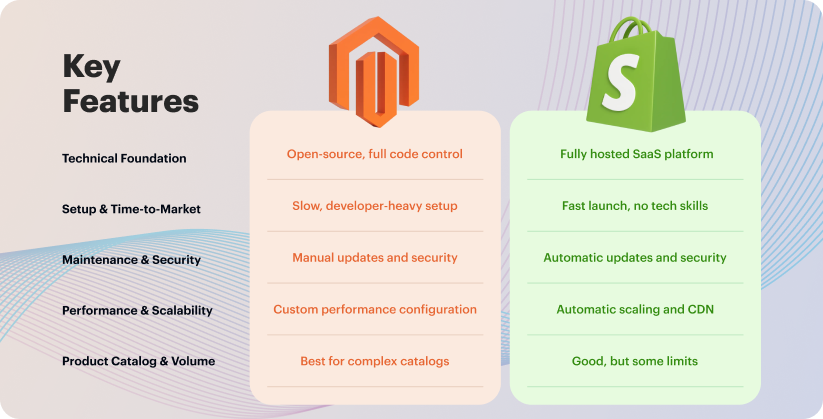
Knowing the architecture and usability of eCommerce platforms comparison is essential when selecting one. The speed at which you can open your store, its ease of management, and the degree of control you will have as your brand expands are all determined by these two factors. Shopify and Magento both have sophisticated features, but their foundations are very different.
Technical Foundation
One significant distinction between Shopify vs Magento 2026 is the way each platform is developed and hosted. Because Magento is open-source, brands have complete control over their code, hosting, and personalization. Deep customisation and interaction with intricate business processes are made possible by this flexibility.
Shopify pros and cons are in charge of everything, including hosting and upgrades. Without having to worry about servers, patches, or downtime, merchants just log in, set up their store, and begin selling.
Magento: Cloud-Hosted Model
Businesses can choose between self-hosting and cloud hosting with Magento.
- In a self-hosted configuration, you put up your server, select your own hosting company, and manually control security, scalability, and performance.
- Adobe takes care of cloud infrastructure with Adobe Commerce Cloud, delivering open-source customization options along with scalability, backups, and monitoring.
For brands with a dedicated technical team or agency support, this option is perfect. It gives you total flexibility to change the platform at the code level, integrate it with ERP or CRM systems, and create an audience-specific digital experience.
Shopify: Fully Hosted SaaS Model
Shopify adopts an entirely different approach. Being a fully hosted SaaS platform, it takes care of all the backend tasks, such as hosting, uptime, SSL certificates, and updates. This means that instead of concentrating on technical setup, business owners may fully concentrate on products, marketing, and sales.
Shopify provides quick load times, integrated Content Delivery Network (CDN) performance, and almost 100% availability because it is cloud-based. However, restricted flexibility is the trade-off. In contrast to Magento’s open-source ecosystem, Shopify requires merchants to operate within its framework, which limits backend alterations.
Initial Setup and Time-to-Market
The speed at which you may launch your store is one of the main distinctions between Shopify and Magento.
- You may begin using Shopify in a matter of hours. It is ideal for firms who wish to launch rapidly because of its pre-built templates, drag-and-drop editor, and integrated hosting. Setup is simple even for non-technical people.
- In contrast, Magento requires more preparation and time. Setup entails setting servers, installing extensions, creating layouts, and guaranteeing performance readiness because it is completely customizable. The end product is a highly customized store that satisfies intricate specifications, even though it takes longer.
Magento wins in control and accuracy, while Shopify pros and cons win in ease of use.
Maintenance, Updates, and Security
In terms of daily management, this is where the platforms diverge the most.
- Unless they use the Adobe Commerce Cloud, which automates some of these operations, Magento provides merchants complete control over updates, fixes, and security monitoring. Although this method offers flexibility, it necessitates technical supervision or a development partner to maintain the site’s security and optimization.
- Everything is automated by Shopify. Security fixes are applied promptly, updates roll out smoothly, and businesses never have to worry about server maintenance or downtime. Shopify is a low-maintenance option for busy store owners because it also handles SSL certificates and PCI compliance.
Therefore, Shopify serves customers who desire a hands-off, worry-free experience, but Magento appeals to brands that want to control every detail.
Performance and Traffic Management
Magento provides a great deal of control over optimizing performance. To manage large spikes in traffic, brands might adjust server resources, use CDNs, and modify caching techniques. Additionally, cloud scalability, automatic load balancing, and performance monitoring tools are integrated into Adobe Commerce Cloud for merchants. Because of this, Magento is perfect for companies that want complete control over their store’s performance and anticipate complicated, busy conditions..
In eCommerce platforms comparison, Shopify’s completely hosted cloud architecture makes performance management easier. Global CDN delivery, improved caching, and a network that easily scales during sales peaks or big campaigns are all automatic benefits for every Shopify site. Shopify takes care of scaling in the background, so merchants don’t need to configure or keep an eye on anything.
Product Catalog and Transaction Volume
Businesses must effectively handle an increasing number of items, variations, and transactions as they expand.
- Magento is great at managing intricate and sizable catalogs. When properly tuned, it can handle hundreds of SKUs, sophisticated product features, and unique pricing rules without sacrificing performance. Because of this, it is a great option for merchants with a variety of categories and product configurations, B2B establishments, and enterprise-level brands.
- Despite its reputation for simplicity, Shopify has significantly improved its ability to manage massive inventories, particularly with Shopify Plus. Custom product structures and variant possibilities are nevertheless subject to certain practical restrictions. Magento continues to be more flexible for firms with large catalogs or complex pricing structures.
Both platforms are capable of handling high-volume sales in terms of transaction volume. Magento enables sophisticated caching and database optimization for better performance during traffic spikes, whereas Shopify’s cloud servers automatically scale during occasions like flash sales.
Pricing Comparison
The platform’s TCO profile is essentially shaped by the basic differences in how you pay for it. By combining infrastructure, security, and maintenance into a single, recurring price, subscription models provide financial predictability. While Open-Source systems move the cost from licensing to a substantial investment in self-managed development and maintenance, licensing models include a high annual software cost. The decision establishes whether your charge will be a flexible capital expenditure or a set operating cost.
| Cost Component | Shopify | Magento |
| Platform Model | Subscription-Based. You pay a predictable monthly rate that grants access to the platform, software updates, and core features. Costs are clear and stable. | Licensing/Open-Source. The core Open Source version has no software cost, but you assume all responsibility. The Enterprise version requires a significant annual license. |
| Hosting & Infrastructure | Managed and Included. Shopify takes care of all server performance, security, global Content Delivery Network (CDN), and automated scaling for peak traffic. | Self-Managed. The merchant is responsible for sourcing, paying for, and managing their own high-performance cloud hosting and servers. This requires dedicated technical oversight. |
| Maintenance & Upgrades | Automatic. Security patches, platform updates, and compliance are handled by the platform, requiring no merchant intervention or additional investment. | Manual and Resource-Intensive. Requires dedicated developer time to apply all security patches, manage complex upgrades, and maintain system health. |
In order to determine ROI, it is necessary to go beyond the first cost reductions and assess which platform has the capacity to generate income and the least amount of overall friction over time. It entails measuring how well the features — or the capacity to add them — translate into business expansion, such as simplified inventory control and decreased maintenance time.
Use Cases
Shopify is perfect for rapidly expanding businesses that appreciate scalability, speed, and ease of use. Teams can concentrate on sales and marketing since its fully hosted SaaS approach removes technical maintenance. Global expansion, multi-store administration, and high-traffic performance are all included with Shopify Plus. Hydrogen and Oxygen can be used by developers for headless builds, allowing for simple omnichannel experiences and sophisticated customisation.
Magento is suitable for big or complicated companies that require extensive system integration and customisation. Large catalogs, sophisticated pricing, and unique workflows connected to ERP, PIM, or CRM systems are all supported by its open-source design. According to the Magento review 2026, this platform is the preferred option for brands that value versatility over simplicity since it provides complete control, scalability, and precision for multi-market or B2B operations, making it ideal for businesses with internal technical teams.
At Stellar Soft, we have found that the decision between Shopify and Magento largely depends on a brand’s future strategy. Throughout our headless constructions, we have witnessed particular strengths and shortcomings of both platforms. Read about this Shopify case study, where we partnered with a fashion store to revitalize their site performance.
Ready to Scale with the Right Platform?
Stellar Soft assists companies in creating eCommerce systems that are quicker, more intelligent, and more robust, whether they are building a custom Magento solution or optimizing their Shopify store. From headless builds and API integrations to data-driven automation, our team of qualified engineers and integration experts transforms challenging processes into flawless digital experiences.
Join together with Stellar Soft now to transform technology into your next competitive edge and future-proof your commerce strategy. Reach out.
Your crew will burn out if you hire too slowly. Both result in slowed growth, decreased production, and missed deadlines. Without the long-term commitments of traditional hiring, Shopify staff augmentation allows you to access specialists when you need them.
This strategy maintains your team competitive, adaptable, and prepared for whatever comes next, whether you’re growing your company or introducing a new product. This tutorial explains how to successfully use staff augmentation so you may get the desired outcomes without any hassles.
Why Staff Augmentation Works for Scaling Shopify Brands?
Shopify brands can increase technical capabilities with staff augmentation without incurring the fixed expenditures of full-time staffing. Brands frequently encounter talent gaps in React-based frameworks (Hydrogen, Next.js), CI/CD automation, and API integration as headless commerce architectures and API-driven ecosystems become more complicated. Faster iteration, better time-to-market, and lower technological debt are made possible by augmenting remote eCommerce teams with specialist developers, QA engineers, and DevOps experts.
According to a recent market analysis, the worldwide IT staff augmentation market is expected to grow at a 13.2% CAGR through 2035, from USD 383.5 billion in 2025 to USD 434.1 billion in 2026. In order to take advantage of distant knowledge and hybrid team structures, 70% of firms intend to increase the usage of staff augmentation by 2026. Staff augmentation minimizes operational friction while bridging the skill gap for increasing eCommerce scaling in operations, whether it be through storefront deployment, headless commerce migration, or performance optimization.
What is staff augmentation?
A sophisticated way of expressing, “Hey, we need extra hands, but we’re not looking to commit forever,” is staff augmentation. This can be thought of as a flexible hiring approach that allows you to temporarily add qualified individuals to your team without having to deal with the difficulties of full-time employment.
Traditional employment methods need a significant investment, upkeep, and long-term expenses. What about Shopify staff augmentation, though? Can be compared to making a reservation for a luxury rental. You don’t have to worry about long-term obligations since you get exactly what you need, when you need it.
Technology advances quickly. You’ll need a React developer someday. A cloud specialist comes next. By replacing talent gaps without the stress of hurried hiring or layoffs, staff augmentation keeps you flexible.
How is it augmented?
In order to fill skill gaps and provide additional support, companies looking to supplement their workforce employ remote, specialized knowledge. Shopify stores can save expenses and overcome local shortages by employing expertise from around the world. However, effective project management and adaptable communication are necessary for managing time zones and teamwork. From onboarding to integration, a methodical strategy guarantees that additional employees contribute seamlessly without interfering with procedures.
Shopify staff augmentation services, as opposed to traditional employment, enable companies to quickly adjust to shifting needs without incurring long-term expenses. When done correctly, it maintains teams competitive, productive, and prepared to take on new challenges with the appropriate knowledge at the appropriate moment.
Benefits for Shopify stores
By offering flexibility, cost effectiveness, and access to specialized skills, staff augmentation for Shopify brands can completely change your company. Let’s talk about the advantages of staff augmentation for your company.
Accelerated Development Velocity
Shopify brands can advance from concept to launch more quickly by adding expert developers to their remote eCommerce teams. For instance, when revamping a Hydrogen shop, internal teams can concentrate on brand styling and content integration while enhanced front-end engineers address the component structure. Development is accelerated by this parallel workflow without sacrificing stability or quality.
Flexible Scaling and Cost Efficiency
Organizations powered by Shopify usually encounter varying loads of work, such as getting ready for Black Friday or exploring new markets. By staff augmentation, these companies can promptly enhance their tech capacity at the peak of demand and then do eCommerce scaling down as soon as the campaign is over. A student of Shopify Plus may recruit additional backend developers to make certain that in the case of a sale, the checkout performance is at its peak.
Access to Specialized Expertise
Shopify’s ecosystem (API layers, and headless builds) development requires in-depth technical knowledge for some skills like GraphQL optimization or edge deployment on Oxygen. The integration of new talent into the team gives brands the chance to cooperate with experts who have previously assisted other big retailers in solving these issues, which in turn guarantees them smooth integrations and solid, efficient codebases.
Enhanced QA and Platform Reliability
If intensive testing is not conducted, the linking of various platforms, like the connection of Shopify to the inventory APIs, bespoke applications, and ERP systems, might result in an unstable situation. To ensure stability across the stores, the enlarged QA teams can build load simulations, automated regression suites, and continuous testing pipelines. For example, the QA experts can check the transaction consistency and API responses in a staging environment prior to the launch of the new subscription model.
Faster Transformation and Experimentation
The rapid exchange of concepts is essential for eCommerce innovation cycles, particularly in situations where new UX patterns are being tested, AI-based personalization is being deployed, or local shops are being set up. Data engineers along with augmented developers can collaborate on prototyping of new features and still keep other processes running smoothly. The augmented crew can carry out experiments on AI-based suggestions or payment methods, and concurrently, the crew will be observing the production.
How to get started?
A methodical approach to Shopify staff augmentation guarantees that you can easily acquire the appropriate people, optimizing productivity and long-term value without interruptions. This is the detailed procedure.
Identify your goals
Determine your team’s short-term and long-term needs based on project requirements and evaluate any skill gaps before hiring.
Think about teamwork, financial limitations, and both hard and soft talents. Finding the proper talent and positioning them for success is ensured by a clear path.
Select the right partner
Selecting the appropriate staffing partner is crucial. Your unique issues and personnel requirements will be better understood by a staff augmentation business with industry experience. Give preference to those who have a solid track record in your field because a bad fit can slow things down rather than accelerate them.
Examine their hiring speed, contract flexibility, and candidate screening procedure in addition to experience. Make sure they abide by contractual responsibilities and employment laws.
Many platforms impose additional fees on approved candidates, which increases expenses for small and medium-sized enterprises. Through our tech stack, Stellar Soft guarantees that you will find the ideal professionals for your needs in a timely manner by providing well screened talent with individualized support and rapid matching.
Hire and onboard the augmented staff
The foundation for success is laid during onboarding. Make new hires feel like they belong by introducing them to company values, objectives, and procedures. Provide them clear expectations, documentation, and tools so they can contribute right away.
Hire Shopify developers, share project details, documentation, and tools so they can start contributing right away. Use Slack, stand-ups, and check-ins to maintain smooth operations, and designate a point of contact for advice.
To promote cooperation and a feeling of community, include the increased personnel in team meetings and conversations. Effective onboarding lays the groundwork for long-term success and productivity.
Evaluate and adjust
For staff augmentation to be effective, it must be evaluated on a regular basis. Regular check-ins ensure productivity and seamless teamwork by identifying problems early. Projects are kept on schedule by monitoring performance and deadlines.
Compare expenses, effectiveness, and overall impact to determine ROI. If the results are not satisfactory, modify your strategy by reevaluating job expectations, enhancing communication, or optimizing onboarding. A proactive approach guarantees that Shopify staff augmentation will continue to be a valued resource for your company.
How Stellar Soft connects you with expert talent?
You get direct access to elite talent at affordable prices with Stellar Soft. We match you with thoroughly vetted individuals who are prepared to make an impact, saving you the trouble of searching for trustworthy freelancers or paying a premium for typical staffing organizations.
Here’s why it functions:
- Only vetted talent: No hiring of unfit candidates or guessing. The screening procedure used by Stellar Soft guarantees that you collaborate with the best experts in a variety of fields.
- Worldwide savings: Hire Shopify developers from around the world while making significant cost reductions.
- Adaptable choices: Stellar Soft provides models that meet your needs, whether you require a committed team for continuous work or a freelancer for a brief job.
Get in touch with Stellar Soft for a free consultation if you need assistance locating eCommerce talent!