Each change should be instrumented, A/B tested when possible, and associated with a defined KPI so that execution converts to predictable lift.
Start by mapping customer journeys to the metrics that matter: visits, add-to-cart, checkout starts, and completed transactions. This mapping is the foundation for prioritising engineering and marketing workstreams and for producing repeatable eCommerce growth tips.
What Is an eCommerce Growth Strategy?
An eCommerce growth strategy is a cross-functional plan that increases revenue per visitor, average order value, and customer lifetime value through technical and marketing interventions. It integrates acquisition, conversion optimization, retention, and operational scaling into a single roadmap.
The strategy must define data ownership, experiment design rules, and rollback controls to prevent local optimisations from harming global outcomes. Those governance artifacts convert tactical experiments into long-term capability.
Customer Acquisition Strategies
Customer acquisition for scalable merchants requires diversified channels and deterministic instrumentation. Channels should be evaluated not only by CPA but by downstream conversion cohorts and returns on fulfilment cost.
Tactical acquisition channels include paid search, programmatic display, affiliate partnerships, social commerce, and content SEO with clear attribution tagging. Each channel should feed the canonical analytics pipeline so that LTV-by-cohort calculations are accurate and actionable.
- Prioritise channels with high initial match to product-market fit and demonstrable path to repeat purchase.
- Use short-term budget experiments to validate creative and audience segments, then scale winners via automated bidding and budget reallocation.
Close the acquisition plan by formalising a channel scorecard that covers CAC, conversion rate, return rate, and fulfilment cost per order. This scorecard becomes the control dashboard for scaling decisions and integrates with eCommerce consulting engagements.
Conversion Rate Optimization Techniques
Conversion rate optimization (CRO) is a systems discipline combining UX engineering, pre-ranking and ranking models, and front-end performance. Improvements to pre-ranking and retrieval layers have produced statistically significant CVR gains in production experiments, validating investment in model-driven search and ranking.
Focus work on three domains: page performance, relevance (search & recommendations), and checkout friction. Improve page speed metrics and ensure search/prerank models prioritise high-probability SKUs for queries; this approach reduces time-to-add and increases the conversion funnel throughput.
| Domain | Primary KPI | Typical Optimization Action |
| Page performance | Time to Interactive (TTI) / LCP | Code-splitting, responsive images, CDN rules |
| Relevance & search | Click-to-Add rate, CTR-to-cart | Pre-ranking models, query rewriting |
| Checkout flow | Completed checkout rate | Form reduction, payment local methods, tokenized UX |
After implementing the table actions, validate with cohort A/B tests and real user monitoring to avoid regressions. For specialist help on CRO pipelines and experiment design, integrate technical work with targeted CRO services.
Retention and Lifetime Value Growth
Retention growth depends on predictability of replenishment cycles, relevance of post-purchase messaging, and operational reliability of fulfilment. A high-performing retention stack includes lifecycle email/SMS, product return minimisation, and replenishment alerts tailored to usage patterns.
Retention programs should be driven by models that identify high-LTV cohorts and upstream signals that predict repurchase propensity. Maintain deterministic fallbacks and confidence thresholds for model-driven outreach to prevent over-personalisation and customer fatigue.
- Segment customers by repeat purchase cadence, AOV, and return frequency, then apply tailored flows for reactivation and cross-sell.
- Use controlled experiments to measure incremental LTV lift from specific retention flows rather than assuming correlation equals causation.
Close retention work with a quarterly LTV forecast and a list of prioritized interventions that tie directly to expected revenue delta. This closes the loop between retention experiments and financial planning.
Scaling eCommerce Operations
Scaling eCommerce operations is an engineering and process problem: capacity planning, resilient microservice design, and automated observability are fundamental. Architect for graceful degradation so that non-critical services do not block the transaction path, and implement autoscaling with circuit breakers for dependent systems.
Synchronous dependencies in fulfilment, tax, and payments commonly produce scaling bottlenecks; mitigate them by introducing asynchronous queuing and idempotent retry semantics. Monitoring must include business-level alerts (e.g., checkout failures per minute) in addition to system metrics.
| Operational Area | Scale Risk | Recommended Pattern |
| Payment gateway | High | Retry queues, tokenization, multi-gateway failover |
| Inventory sync | Medium-High | Event-driven inventory updates, eventual consistency |
| Search & recommendations | High | Pre-ranking caches, feature-store for realtime serving |
After table implementation, perform load tests that simulate realistic traffic mixes and validate scaling patterns at 2-3x expected peak. The operational patterns above are the practical backbone of any eCommerce scaling strategies.
Technical Stack and Data Governance
A reliable stack separates feature computation, training, and serving while maintaining a canonical customer profile. Feature drift and untracked third-party signals are primary causes of model regressions in production. Build a lightweight feature store and enforce model monitoring for drift and latency.
Enforce access controls and an experiment registry so that product changes are traceable to releases and model versions. This governance prevents accidental exposure of stale models in high-value touchpoints and preserves the integrity of the eCommerce sales strategy.
Research Narrative: Evidence-Based Practices
Recent empirical work shows that multimodal and LLM-augmented recommendation systems can improve engagement when integrated with rigorous evaluation frameworks. These systems increase candidate relevance but require latency-aware serving and fallbacks to deterministic rules when confidence is low.
Analysis of traffic source to conversion pathways highlights device and channel differences; mobile sessions often demand different creative and reduced checkout steps to achieve parity with desktop CVR. Use these findings to structure device-specific experiments and to justify technical investments in mobile UX and payment methods.
Implementation Roadmap and Priorities
Start with a technical audit that benchmarks performance, search relevance, checkout drop-off, and fulfilment latency. The audit should produce a prioritised backlog of engineering tasks mapped to expected revenue delta and implementation effort.
Phase the roadmap into three-month sprints with clear acceptance criteria and rollback plans. Include one sprint dedicated to observability and end-to-end experiment tracking so future improvements are measurable and auditable.
Conclusion
Translate the roadmap into measurable sprint goals: a performance sprint (reduce LCP/TTI), a relevance sprint (improve pre-ranking and search), and a checkout sprint (reduce form fields and tokenise payments). Each sprint must end with an A/B test or cohort analysis that assesses business impact.
For structured support, pair internal teams with external eCommerce consulting when governance, experimentation frameworks, or rapid execution are needed.
If you require an audit, a prioritized technical roadmap, or execution support for performance, CRO, or scaling, contact Stellar Soft for a technical assessment. Our engagement will produce a sprint-level plan that converts diagnostics into measurable revenue improvements. For targeted conversion engineering, explore our CRO services to accelerate lift.
FAQs
What is an eCommerce growth strategy?
An eCommerce growth strategy is a cross-discipline plan that aligns acquisition, conversion optimisation, retention, and operations to measurable revenue targets. It defines data ownership, experimentation rules, and technical guardrails so experiments produce predictable business outcomes.
How to scale an eCommerce business?
Scale by removing single points of failure and by introducing asynchronous patterns for non-critical workloads. Implement autoscaling for compute, multi-gateway payment failover, and a feature store for model serving; validate designs with load testing and business-level SLI thresholds.
Which strategies increase online sales fastest?
The fastest wins typically come from reducing technical friction: improving page speed, refining search relevance, and streamlining checkout. Combine those immediate fixes with targeted acquisition experiments and a short-term personalization rollout on high-impact pages.
These functions range from basic infrastructure support to advanced software engineering. Organizations that outsource IT services aim to optimize capability, cost structure, and innovation throughput.
The technical landscape of IT outsourcing has shifted from purely cost‑driven motives to strategic architectural engagement models. This evolution emphasizes governance frameworks, relational contracts, and shared innovation outcomes. Contemporary research also frames IT outsourcing as a conduit for transformational value, not just operational efficiency.
In practice, the selection of an IT outsourcing company influences system design, development cadence, and risk exposure. Firms must balance resource access, compliance, and communication overhead while aligning contractual terms to desired intellectual property and continuity requirements.
What Are IT Outsourcing Services
IT outsourcing services encompass the delegation of information technology functions to external partners. These services include software development, infrastructure management, IT support, cloud operations, cybersecurity, and data services. The scope can range from component delivery to full solution operational governance.
In technical terms, outsourcing decouples the execution layer from the core enterprise command chain. This decoupling permits an organization to leverage external domain expertise and specialist tooling without expanding internal headcount or capital expenditure.
The academic view on outsourcing success factors highlights human, cultural, and knowledge transfer variables as determinants of outsourcing project performance. For example, research on the human factor in outsourcing underscores the impact of customer motivation and vendor willingness on knowledge transfer and project outcomes.
Types of IT Outsourcing Models
This section parses the primary outsourcing models by geographic, engagement, and contractual characteristics. Classification affects management overhead, cost structure, and delivery cadence.
Offshore vs Nearshore vs Onshore
The geographic dimension of outsourcing is a first‑order decision variable. Each geographic model entails trade‑offs between labor cost, time zone alignment, language proficiency, and regulatory compliance.
Table 1: Geographic outsourcing models
| Model | Time Zone Proximity | Cost Range | Communication Overhead | Best For |
| Onshore | High | High | Low | Sensitive systems, compliance |
| Nearshore | Medium | Medium | Medium | Agile collaboration |
| Offshore | Low | Low | High | Large scale execution |
In practice:
- Onshore outsourcing involves vendors within the same country or region, minimizing linguistic and legal friction.
- Nearshore outsourcing situates teams in adjacent countries with overlapping business hours.
- Offshore outsourcing extends to distant regions with divergent time zones and is typically selected for cost efficiency and scalability.
Each model requires distinct coordination protocols to manage latency in communication and software integration cycles. It is also common to assemble hybrid outsourcing portfolios that blend these geographic models based on project complexity and delivery risk profiles.
Dedicated Teams vs Project-Based Outsourcing
Two distinct engagement models dominate IT outsourcing: dedicated teams and project‑based outsourcing.
Table 2: Engagement‑based outsourcing models
| Engagement Type | Control Level | Resource Allocation | Flexibility | Suitable Project Type |
| Dedicated Team | High | Long‑term | High | Ongoing delivery, evolving scope |
| Project Based | Medium | Fixed | Moderate | Well‑defined deliverables |
In practice:
- A dedicated development team operates as an extension of the client’s engineering unit, maintaining continuity across product roadmaps. This model is suited for long‑term strategic initiatives where iterative delivery and deep domain knowledge are essential.
- Project‑based outsourcing is output‑oriented with predefined scopes, milestones, and discrete deliverables. This model is optimal where requirements are stable and bounded.
Linking to this, organizations that elect dedicated teams should establish explicit coordination layers and version control interfaces to synchronize continuous delivery with internal product benchmarks.
Key Benefits of IT Outsourcing
Outsourcing IT functions brings quantifiable and strategic benefits. These derive from both labor market dynamics and structural operational optimization.
- Access to a broader global talent pool enables organizations to engage specialists in cloud computing, cybersecurity, AI, and enterprise platforms.
- Cost containment arises from labor arbitrage and the avoidance of fixed overhead for internal resource expansion.
Beyond these, IT outsourcing services offer scalability. Teams can scale up or down dynamically aligned with sprint cycles, feature backlogs, or seasonal demand spikes.
Outsourcing can also increase organizational flexibility; evidence suggests that IT outsourcing configurations influence IT infrastructure adaptability, improving responsiveness to environmental change.
Outsourcing partnerships often embed domain‑specific tooling and processes that internal teams may not possess, enabling rapid integration of best practices without prolonged learning curves.
Common Challenges and How to Avoid Them
Communication barriers, including time zone misalignment, cultural differences, and linguistic nuances, increase coordination overhead. Misaligned contractual incentives can lead to scope drift and quality degradation. To mitigate these, organizations should implement structured governance frameworks, such as the eSourcing Capability Model (eSCM), to balance client and provider responsibilities systematically.
Moreover, designating seasoned product owners with clear technical specifications and acceptance criteria reduces ambiguity in deliverables. Finally, continuous integration/continuous deployment (CI/CD) pipelines and standardized reporting protocols ensure visibility into incremental progress and early defect detection.
How to Choose the Right IT Outsourcing Company
Selecting an IT outsourcing company is a technical decision that affects delivery reliability and operational interoperability.
Key criteria include:
- Domain expertise: Evaluate provider experience in specific technology stacks and architectural frameworks.
- Process maturity: Assess governance structures, security standards (e.g., ISO/IEC compliance), and quality assurance protocols.
A structured evaluation rubric should weigh technical competence, contractual flexibility, change management capability, and security posture. Firms should solicit references, audit case histories, and conduct technical due diligence.
Companies must review engagement models against internal capability matrices to ensure that outsourced teams augment rather than displace essential in‑house competencies.
IT Outsourcing Trends in 2026
In 2026, IT outsourcing providers are expected to integrate advanced automation, AI‑assisted delivery pipelines, and hybrid sourcing strategies. Outsourcing firms increasingly leverage AI to streamline project management, optimize resource allocation, and enhance predictive defect analysis.
The shift toward “smart outsourcing,” which integrates AI augmentation with human‑driven decision frameworks, is gaining traction. Research indicates that such models can improve flexibility and human capital integration while preserving organizational values.
At the same time, hybrid geographically distributed teams will blur the lines between onshore, nearshore, and offshore engagements, requiring sophisticated tooling for asynchronous collaboration and real‑time analytics.
Regulatory shifts and cyber risk environments will also shape provider selection criteria. Organizations should prioritize partners with robust compliance architectures and secure software delivery lifecycles to manage data sovereignty and breach risks.
Conclusion
This analysis delineates the structural frameworks, technical trade‑offs, and strategic imperatives of IT outsourcing services. By understanding geographic and engagement models, pros and cons, and provider evaluation criteria, technical leaders can architect outsourcing solutions that scale and innovate. Incorporating rigorous governance protocols and aligning contractual terms with architectural outcomes will mitigate risk and enhance delivery predictability.
If your organization seeks to optimize capability, reduce operational overhead, or build resilient engineering teams, partnering with a specialized IT outsourcing company is a calculated strategy. Explore how outsourcing services can accelerate your roadmap: learn more about our IT staff augmentation services or initiate a tailored engagement with a dedicated development team at Stellar Soft.
FAQs
What are IT outsourcing services?
IT outsourcing services are external technical services delivered by third parties, covering software engineering, infrastructure support, cloud operations, cybersecurity, and systems maintenance.
What types of IT outsourcing exist?
IT outsourcing commonly includes geographic models (onshore, nearshore, offshore) and engagement structures (dedicated teams, project‑based contracts). Each model balances cost, control, and communication overhead differently.
What are the benefits of IT outsourcing?
Benefits include access to broader expertise, cost optimization, scalability, and operational focus. Outsourcing also embeds best practices and tooling that internal teams might lack.
How to choose an IT outsourcing company?
Selection criteria should include technical expertise, process maturity, security governance, cultural alignment, and contractual flexibility. Firms should conduct systematic vendor evaluations and technical audits.
Is IT outsourcing cost‑effective in 2026?
Yes. Cost effectiveness depends on scope, geographic model, and internal capability. Modern outsourcing blends AI automation and specialist delivery, improving ROI when aligned with rigorous governance and integration standards.
Most stores begin on established eCommerce platforms such as Shopify or Magento. The both platform providers offer a fast route to market and handle core operations reliably.
However, as traffic, order volume, and catalog size increase, their default configurations may start to show limitations. In case your online retail site is considering an expansion, the effort must be anticipating hindrances or might have already been facing them in the long run.
Stellar Soft was asked a number of times similarly, so we thought that it was the right time to release this technical paper. This article will help you deal with the situation where traffic, orders, and product catalog are all growing big, which might lead to your website’s slowness or complicate your daily operations. To put it briefly, scalability is the most important factor.
What is Scalability?
‘Scalability’ in eCommerce refers to the capability of the platform to grow along with the business. For example, a Shopify store may scale traffic automatically during sales campaigns, while Magento allows deeper control over catalog size and backend logic. However, both require architectural decisions to scale efficiently beyond default setups.
A scalable eCommerce platform is like a well-trained store in terms of operations. The platform will scale up your business. The process will involve traffic, amount of orders, and product catalog growing. A scalable eCommerce platform made by professional developers helps you to expand your business without slowdowns or crashes – whether you are launching new features, serving more customers, or connecting with third-party services.
Where Shopify and Magento Might Go Short
Both platforms can be scaled, but their native scalability is just the beginning. The challenges that arise as businesses grow are not just about severing traffic but also about integrating different systems, the complexity of operation as well as custom logic. Compare:
- Magento grants a lot of freedom in customization and is able to go as high as enterprise-level but only when it is combined with custom architecture, performance tuning, and dedicated development. If you do not have the right infrastructure and code that is optimized for it, then scalability will only be theoretical and not practical.
- Shopify has an effortless scaling process for both traffic and checkout, however, its closed SaaS model does not allow for much flexibility at the backend. When brands need custom workflows, advanced integrations, or headless experiences, custom development is the only way to stretch the capabilities of Shopify beyond its defaults.
In practice, though, both platforms are only able to scale efficiently when they are coupled with custom development either to push the boundaries of the platform, to integrate third-party systems or to move towards headless and composable commerce architectures.
Shopify Limitations at Scale
Shopify’s design favors quick roll-out and easy management, but on the other hand, it also has to live with the limitations of its closed SaaS model. Backend processing, checkout procedures, and system-wide adjustments have to be within the limits set by Shopify’s APIs and the theme layer. Consequently, intricate business logic, for example, multi-warehouse inventory, pricing customized per client, advanced B2B workflows, or routing orders according to specific needs, cannot be implemented without relying on third-party services.
Magento Limitations at Scale
Magento allows for a high degree of personalization and grants complete control over backend processes, but the extent to which it can be scalable hinges on the architecture decisions made during the implementation. Initially, Magento’s monolithic design and heavy database load can be a drawback when a large catalog, many concurrent users, and several integrations with third-party solutions are all present. With no custom architecture, like service decoupling, optimized indexing, and distributed caching, Magento stores risk performance degradation, longer deployment, and unstable behavior during peak load times.
Custom Development Is Mandatory to Convert Scalability
At this stage, scaling requires architectural decisions that go beyond native platform features and demand custom development expertise. When the custom foundation is robust, your business will not only flourish but also experience growth without any hassles. This is actually eCommerce architecture in the technical sense; it means the arrangement and system of your shop. Let’s dissect the main parts of this layout so that you can understand the interaction of the components even though you may not be a techie at all.
System Decoupling and Process Isolation
Isolation is a crucial factor in Scalable eCommerce systems. This means there is a separation of critical processes such as changes in stock, handling of orders, adjustments in prices and processing of customer data. In case these processes are very closely tied together, then any change or an increase in one point can lead to a system-wide instability.
Custom development makes it possible to intentionally decouple by means of service-oriented design and communication through APIs. This guarantees that every single component is able to scale, evolve or even break down without affecting the whole operation, which is a must-have condition for growth to be sustained.
Data Flow Control and Operational Predictability
Real-time synchronization must be maintained between orders, stock changes, customers, and third-party systems. The workflows that are inherent to the platform often hide the data flow and the places of congestion, which makes it easier to deal with the situation rather than preventing it.
Custom development enables explicit definition and control of data flows. This visibility leads to predictable system behavior during the peak time, accurate forecasting, and communication of the right architectural decisions. All this is the groundwork for performance optimization and sophisticated delivery models.
Performance Optimization
Holding on to speed and performance is undoubtedly one of the most challenging things in the process of scaling, particularly when the store is getting a lot of traffic. Based on experience and statistics, if your website takes more than a couple of seconds to open, then customers will probably bounce and won’t come back.
Preventing this situation is possible, however, we recommend spending on performance optimization technologies right from the start rather than wasting both time and money on unsuccessful attempts later. Below are some of the essential tools:
- Content Delivery Networks (CDNs) are networks of servers throughout the world that keep copies of your website. When a customer visits your store, the CDN distributes content from the server nearest to them, allowing your site to load faster no matter where they are.
- Load Balancers. When a large number of users visit your website at the same time, traffic must be distributed to prevent the servers from becoming overloaded. Load balancers distribute traffic evenly across numerous servers, reducing slowdowns or failures during peak hours.
Making sure that your custom website can manage a lot of visitors at the same time without compromising on speed and convenience for the customers is very important. A fast website is essential for expanding your business because not only does it chase away potential customers but it also leads to less transactions and tarnishes the reputation of your brand.
Headless Commerce Architecture
Headless eCommerce allows for the separation of the frontend and backend system. Thus, the teams can design and change the user interface without the need to access the commerce logic. This setup that is very similar to modular enables the usage of different frontends to get connected to the same backend services through APIs integrations.
Headless eCommerce when separating the “brain” from the “face” of your store allows faster deployment of new features, seamless integration with AI-driven recommendation engines, and flexible experimentation without the need to disrupt core operations. Ecom brands that are going the route of headless commerce are reaping the benefits of low development cost and high scalability.

Tech Stack You Might Need
A multi-tiered technology stack is necessary for modern eCommerce to provide scalable, quick, and flexible online experiences. It implies the process that decides what components you will use, how they will be connected, and how they will be scaled together. If there is no custom architecture, then these layers are separated and treated as disorganized tools.
Support for hosting, storage, and computation is given by cloud platforms like AWS, Google Cloud, and Microsoft Azure, which also enable seamless scaling of stores and the incorporation of advanced services like AI personalization, analytics, and edge computing.
| Layer | Technologies | eCommerce impact | Why it matters |
| Cloud Platforms | AWS, Google Cloud, Microsoft Azure | Scalable hosting, storage, AI/analytics integration | Supports growth and high-traffic spikes without downtime |
| eCommerce Architecture | Microservices, Headless Commerce | Modular, flexible frontend/backend separation | Enables omnichannel experiences and rapid feature deployment |
| Backend | Node.js, Python, Go, .NET | Handles business logic, API services, integrations | Ensures reliable processing and extensibility |
| Frontend | React (Next.js), Vue.js (Nuxt.js) | Dynamic, fast-loading UI | Improves user experience and conversion |
| Databases | PostgreSQL, MySQL, Aurora, MongoDB Atlas, Redis | Efficient data storage and retrieval | Supports personalization, analytics, and real-time features |
| CDN | Cloudflare, AWS CloudFront, Fastly | Low-latency content delivery worldwide | Maintains speed and reliability globally |
| DevOps | Kubernetes, Docker, Terraform | Deployment, orchestration, infrastructure management | Automates scaling and reduces operational complexity |
The separation of the microservices and headless eCommerce into different parts allows the frontend and backend to have their own interfaces and logic, which in turn allows the independent operation of multiple storefronts and sharing of core services. Business logic, API integration services, and even Third-party systems integration are all conducted in the backend by employing Node.js, Python, Go, or .NET, whereas the frontend is powered by either React (Next.js) or Vue.js (Nuxt.js) for quick-loading, and dynamic interfaces.
Databases such as PostgreSQL, MySQL, Amazon Aurora, MongoDB Atlas, and Redis use efficient methods to handle both structured and unstructured data. CDNs (Cloudflare, AWS CloudFront, and Fastly) guarantee the content will be delivered globally with low latency, while DevOps tools such as Kubernetes, Docker, and Terraform lead the way in automating the entire process of deployment, orchestration, and infrastructure management.
Common Mistakes to Avoid When Scaling Your Store
Consumer preferences change over time, and this is the reason why your eCommerce strategy should also change. Therefore, do not just sit back when your new ecosystem is already working. But again, be flexible with Composable Commerce to quickly change and roll out new things that will please the customers. The reason is that eventually, the demands will change. Making it a point not to commit these errors will help you ascend to the heights of eCommerce success.
Overlooking Customer-Centricity
The technical factors should not be your main focus and thus, the very core of eCommerce, which is your customers, should not be forgotten. Offer topnotch customer experience in terms of smoothness and personalization instead of internal procedures or tech selections. Be always guided by the outside-in viewpoint and allow the tech stack to your customers, not the other way round. Keep in mind that it is the customers who are the ones that determine your success.
Not Using Microservices
Your ecosystem must have each of its parts with clearly defined functions. If microservices eCommerce are underused because of the unnecessary functions that they perform (which is not their original design), it will not only be complex but also ineffective. Maintain the separation and keep the focus on the best results.
Not Catering for the Entire Journey
Just like long loading times, an inconvenient checkout process can result in shoppers leaving their carts behind. This has always been the case since eCommerce started, and it is still the case today. However, it is also very important to make the whole purchasing process easy, which includes delivery, communication, and returns. If the customer is satisfied and interested, they will come back.

Conclusion
Scaling an eCommerce platform to 2026 requires creating a quick and easy to use, and data-driven ecosystem that will be able to change along with the customers’ different behaviors, incorporate the very latest in AI technology, and improve the entire process right from the backend to the frontend user experience. Headless eCommerce, microservices architecture, and a state-of-the-art technology stack are the means of exercising this flexibility, while the use of cloud computing, content delivery networks, and DevOps tools will guarantee performance and uptime at a large scale.
In case your business is looking to convert scalability into a competitive edge, Stellar Soft has got your back with its custom solutions that combine headless commerce, cloud facilities, and AI-powered tools thus allowing you to create a robust, adaptable, and high-throughput eCommerce platform that expands along with your goals. Join forces with Stellar Soft and safeguard your online shop from obsolescence today.
FAQs
What is a scalable eCommerce platform?
A scalable eCommerce platform can handle increased traffic, orders, and product catalog growth without slowing down or crashing.
Why is headless commerce important for scaling?
Headless eCommerce separates the frontend from the backend, enabling faster feature deployment, flexible experimentation, and seamless omnichannel experiences.
Which tech stack components are essential for growth?
Key components include cloud platforms, microservices eCommerce, backend frameworks, frontend frameworks, databases, CDNs, and DevOps tools.
How does performance optimization impact scalability?
Tools like CDNs and load balancers ensure fast, reliable site performance during high traffic periods, directly affecting conversions and user retention.
An impressive storefront is not only a treat for the eyes. It should take the visitors smoothly from entrance to payment, reflect the personality of your brand, and work well on every device.
The firm specialists know how to build up the high-performing and conversion-friendly Shopify stores, no matter if you are a startup seeking a small and strong web design agency for Shopify Plus. Such companies who deal with Shopify Plus transformation and customized Shopify stores can assist you in executing your eCommerce plan.
However, the question is, with the number of agencies out there, how do you go about choosing the best Shopify development company that really understands your business needs? The selection of a top Shopify partner agency or among the best Shopify agencies may change everything.
Why Hire a Shopify Web Design Agency?
Shopify is the perfect solution for creating an online store even for someone who has never done it before, but a huge gap exists between a working site and a selling one. This is the point where the value of a Shopify web design company or Shopify web development agency is revealed.
A Shopify web design studio brings together industry know-how, creative ideas, and technical skills to make a store that is not only visually appealing but also very high-performing. Here are some reasons why working with a leading Shopify development service can be advantageous:
1. They Work Strategically
An excellent agency is not just limited to visual design. They possess a deep knowledge of customer behavior, Shopify UX/UI, user experience (UX), and conversion rate optimization. Every part of the website such as colors, layout, and navigation is made to change visitors into customers.
2. They Know Shopify Inside & Out
Shopify web design agencies in the USA are very much aware of the total workings of the platform. They have even mastered all its features and functionalities. Nothing is beyond their expertise, such as component customization, Shopify app building, Shopify integrations, speed optimization, or mobile friendliness. They build stores that not only function properly but also follow the golden rules of eCommerce. If you need more advanced features, a Shopify Plus development agency or Shopify Plus experts can provide you with maximum support.
A Shopify web design firm will not only take care of your website’s current but also of the future needs, making it scalable and easy to manage as your company grows.
3. You’ll Save Time (and Money)
Let us be truthful, DIY might really take up a lot of time. The best Shopify designers in the USA provide you with their advanced tools, skilled personnel, and knowledge so that you can create your store in no time and with minimal problems.
4. They Solve Real Business Problems
The leading Shopify web design agencies in the USA are asking not just what you need but also the reason behind it. They focus on solving real business problems like increasing sales, keeping customers, and adding new products to the mainline. The professional Shopify partner will devise solutions that meet your needs exactly.
The Shopify website design studio will also ensure your online store is adaptable to the future, expandable, and easy to handle as your company grows.
How to Choose Agency That Works for You
Each agency listed brings something different to the table. Some agencies are working only on custom designs, while others spend time on upping the brand, looking after their stores, etc. Therefore, instead of going for the label “biggest” or “coolest”, try to find a partner that has the same objectives, budget, and ways of working as you. Rate the table by the criteria given below:
| What to evaluate | What to look for | Why it matters |
| Store goals & scope | Clear alignment with your goals (custom theme, Shopify Plus, B2B, SEO, apps, international sales) | Prevents overpaying for features you don’t need or underbuilding for future growth |
| Shopify experience | Documented Shopify projects, real case studies, Shopify Plus experience if needed | Reduces delivery risk and ensures platform-specific best practices |
| Portfolio relevance | Case studies in your niche or with similar complexity, not just big-brand logos | Shows problem-solving ability, not marketing fame |
| Custom development skills | Theme customization, mobile optimization, backend logic, third-party integrations | Enables performance, scalability, and non-standard business logic |
| Shopify partner tier | Registered/Select for small builds; Plus/Premier for complex or enterprise stores | Indicates depth of experience and access to advanced Shopify support |
| Pricing transparency | Itemized estimates, clear scope, defined deliverables, no vague “packages” | Prevents budget creep and post-launch surprises |
| Communication process | Clear points of contact, fast responses, strategic feedback – not just execution | Keeps the project on track and avoids costly misunderstandings |
| Post-launch support | SEO, migrations, maintenance, CRO, analytics, and performance monitoring | Ensures stability, growth, and ROI after launch |
In the process of choosing a Shopify web design studio, consider their portfolio, experience in the industry, and capability to fulfill your particular business goals as the main criteria.
The Repertoire of Shopify Web Design Agencies
Stellar Soft
At Stellar Soft, we regard ourselves as a comprehensive Shopify web design agency that concentrates on generating online stores that captivate the eye and are able to sell too. Combining strategic design and eCommerce functionality, not only will every layout, color choice, and interaction be pleasant but also meet a business goal. Our Shopify stores will be providing flawless experiences across all devices with an emphasis on usability.
We pay equal attention to technical excellence that is hidden behind the scenes. We ensure that every design decision is in accordance with Shopify’s system, checkout flows, and scalable development practices. By applying UX best practices, clean code, and SEO-friendly structures, we provide stores that are robust, maintainable, and future-ready.
At Stellar Soft, we put the same amount of importance on both creative impact and technical reliability, thus, your Shopify store will expand together with your business while offering an outstanding shopping experience to customers right from day one.
Electric Eye
Electric Eye is a studio that mainly focuses on design and development for Shopify and works mainly with brands that want a strong visual identity connected with dependable Shopify execution. The agency puts its main focus on custom themes, redesigning stores, moving from one platform to another, and integrating apps, thus placing itself right between artful design and pragmatic Shopify implementation.
Amasty
Amasty is a Magento ecosystem development company and product vendor as well. The company has an impressive assortment of Adobe Commerce extensions and is also a giant in performing large-scale, technically complicated customizations.
Amasty has the core competencies in performance tuning, advanced checkout and catalog capabilities, B2B functionalities, and extensive third-party system integrations, thus, it is a vendor to rely on for Magento-based stores with big-time technical requirements of an enterprise level.
Quickfire Digital
Quickfire Digital is an agency based in the UK that specializes in Shopify Plus. It has a strong focus on B2B eCommerce and performance-driven builds. Speed, clean code, and iterative delivery are the key principles of the agency. They also incorporate conversion rate optimization into their development sprints rather than considering it as a post-launch activity. This way of working enables clients to launch quicker and at the same time improve their performance, so Quickfire Digital is very well suited for Shopify Plus merchants who aim at growth.
Cake Agency
Cake Agency, an eCommerce agency in the UK, was established by retail experts and dedicated mostly to Shopify and Shopify Plus. This agency unites the different services of strategy, development, migration, and growth with those of marketing, branding, and consultancy customized for ambitious DTC and B2C brands. Cake’s retail-driven viewpoints reflect throughout its activities whereby aligning tech-savvy Shopify practices with commercial growth goals instead of merely design-oriented results.
Charle Agency
Charle Agency, a Shopify studio located in London, is known for its combination of creative design and B2B Shopify expertise. The agency has set up more than 150 Shopify stores along with supplying brands which have created a significant amount of GMV. Its data-driven approach and agglomeration of CRO and the design process is a natural fit for consumer brands wanting to expand their DTC and wholesale channels at the same time.
Conclusion
Selecting the proper Shopify designers USA will not be overwhelming at all. Regardless of whether you are merely launching your very first store or considering giving your existing website a completely new and fresh appearance, collaborating with the right professionals can mean a lot.
Not only will the agency of your choice make your shop visually appealing, but they will also assist it in being more efficient, thus increasing the number of visitors and the team to grow with you. The agencies we highlighted above are doing outstanding work in 2026 and aiding both large and small brands in creating unforgettable stores with higher sales.
As consumer behaviors transform continually, having a team that understands everything from design to strategy will be your store’s advantage. Wondering how a web design makeover would affect your store? Let us talk it through and discover what is feasible.
FAQs
What does a Shopify web design agency do?
They build stores that are visually appealing, user-friendly, and optimized for conversions, integrating design, functionality, and eCommerce best practices.
Why hire a Shopify agency instead of DIY?
Shopify web design agencies in the USA bring expertise, save time, ensure technical accuracy, and help you build a store that performs, not just looks good.
What’s the difference between Shopify and Shopify Plus agencies?
Shopify Plus agencies handle advanced features, high-volume stores, custom solutions, and scalable growth for enterprise-level clients.
How do I choose the right agency for my store?
Look at their Shopify experience, portfolio, custom development skills, partner tier, pricing transparency, communication, and post-launch support.
Can agencies help with SEO, marketing, and post-launch support?
Yes. Many agencies offer SEO, email campaigns, analytics, ongoing maintenance, and marketing services to ensure your store remains robust, visible, and profitable.
A lot of online forums are there where eCommerce traders and marketers can share their thoughts, assist each other, and develop together.
If you have an inquiry about advertising, or if you are considering content marketing for your brand, or looking for a new app to integrate into your store, just post your question in one (or more) of the eCommerce groups provided below. Surely, many friendly people will come forward and help you.
What Are Communities?
Shopify communities are digital ecosystems constituted by merchants, partners, and developers using that specific platform and sharing their concerns, needs, and practices to learn the correct applications for the development and scaling of their eCommerce businesses. They are open on the official Shopify forums, Facebook groups, Reddit, and various other platforms, thus offering peer-to-peer problem-solving, industry insights, and networking opportunities.
The Most Active Shopify Communities Right Now
Meeting new individuals from various professions, swapping experiences, getting to know effective practices, receiving tips in a cordial environment, and being informed about the latest eCommerce news are some of the benefits of being present in the Shopify communities. You will be getting insights related to your online store’s speed optimization, integration, and migration much quicker than if you were to search for information elsewhere.
1. Shopify Community
Among all platforms of communication related to Shopify, the Shopify Community is the one that is officially recognized and thus, it is the most important. By creating an account, users are allowed to interact with brands, manufacturers, and partners, thereby acquiring access to a multitude of skills and support.
All the participants can pose inquiries as well as share their thoughts on such issues as the design, applications, and marketing of eCommerce. The community, which comprises more than 20 sub-discussion boards, is teeming with activities and thus, offers a vibrant atmosphere for making connections and gaining knowledge.
2. Shopify Beginner
If you are just starting with Shopify, we suggest that you become a member of our Facebook group for Shopify Beginners. The community is for people who are beginners in Shopify’s world. It is a wonderful place to inquire and share skills with other novices of Shopify.
3. Shopify Experts & Newbies
Shopify Experts and Newbies are part of the eCommerce community and their omission makes the list incomplete.
It does not matter if you are a novice or experienced in operating a Shopify store; continuous learning is highly advocated. There will never be a time when there are no questions about your business and its growth potential.
In case you require help, do not hesitate to tell your stories and ask your questions in the group. With 189k members, there is always one who will be ready to assist!
4. Shopify Plus Community
This is the place for you to network with fellow Shopify Plus merchants, ask for suggestions and share ideas on how to run a successful enterprise, and get notified about the latest features and improvements of Shopify Plus.
It is highly recommended that the community Shopify Plus merchants participate and avail all the good things the community offers. To start, all you need to do is to send a request to join the group, and one of our moderators will approve your request.
After joining, let the community know who you are and start interacting with the other members. We are very eager to hear from you.
5. Shopify Store Owners, Experts, and Developers
The title of this group conveys its meaning perfectly: it is a place for everyone who finds Shopify interesting, from store owners to specialists and developers. It is a great place to give and take knowledge, discover new friends among the Shopify lovers, and broaden your understanding of the software.
6. Shopify Product Community
The Shopify Product Community is a live and energetic LinkedIn community that already counts more than 9,200 members. The forum is a perfect place to interact with other Shopify merchants, discover product insights and receive advice, and get first-hand information on the latest news and changes regarding Shopify.
7. Shopify (Subreddit)
Shopify (subreddit) is a great Shopify community (subreddit) for everyone who wants to get the most out of their experience. The community is composed of Shopify experts who are always ready to help and answer questions. In addition, there are many great Shopify resources available, so you can be sure to find what you need.
Nevertheless, the overwhelming number of people in the community may mean that your questions will take a while to get answered. Conversely, you will certainly get a lot of professional tips.
8. Review My Shopify Store (Subreddit)
In order to receive authentic feedback about your Shopify store, the Review My Shopify subreddit would be a good place to look at. The group of Shopify experts and lovers offers very good assistance in providing uncoloured opinions on your website.
However, the subreddit can be rude, so you have to be careful. On the other hand, if you take the negative remarks positively, you will get the chance to use them as a stepping stone to great improvements in your Shopify store.
9. Women on Shopify
A place like this offers a supportive and educational climate for women who run eCommerce businesses on Shopify, transactions helpful, and advice sharing regardless of where you are in your eCommerce journey. Joining the community can make you feel supported, allow you to share your experiences, and help you determine the next move, no matter your eCommerce stage.
10. The Shopify Club
This group encompasses different kinds of knowledge that could potentially provide solutions to your queries on Shopify. The team, consisting of a highly valued pool of experts from Shopify, Facebook, Instagram, etc., is probably the greatest asset for any hopeful Shopify seller.
11. Shopify 101
The community for Shopify is very beneficial in acquiring knowledge on Shopify, eCommerce, and digital marketing. On every Tuesday, Thursday, and Friday at 7 a.m. PST Shopify community members are facilitated with full discussions, they can ask questions and give their opinions along with advice.
12. Shopify eCommerce Group
The Shopify eCommerce community is an informal Facebook community where eCommerce professionals who work with Shopify share their knowledge and experiences. It has more than 29k members as of now.
Help is available on various subjects related to the Shopify platform like using the main software, different apps, and advising on increasing sales through conversion optimization.
You are not obliged to become a member in order to read the posts, which means that you can check if they are of any use to you before deciding to participate in the community.
13. Shopify Entrepreneurs
Shopify Entrepreneurs is an unofficial private Facebook group that connects people from different fields of eCommerce who are using Shopify. The membership count is already exceeding 106k when this text is being written.
Shopify store administrators, store proprietors, and skilled service providers like marketing, design, and development also make up the entire population here, which can be considered a very diverse mix.
Thus, it is a good place to ask for opinions on Shopify stores, but keep in mind that each post has to be approved by moderators first. Not every post turns out to be accepted.
14. Triple Whale
Triple Whale, an eCommerce operating system that comes with a price, provides a private Slack channel connecting more than 1,200 marketers and eCommerce. The tool, which works with Shopify, will provide you with better data to support your marketing objectives and expand your online business. The site requires a subscription, and there is a range of pricing plans starting from $100 a month.
Why Should You Join the Shopify Community?
There are numerous reasons why you might consider becoming a part of the Shopify community. For instance, you might be a beginner on Shopify and looking for guidance and project ideas. Alternatively, you might simply want to connect with people who share your passion for eCommerce. Anyway, the reason for your joining doesn’t matter; there are already a lot of great ones that can help you.
| Benefits of Joining Shopify Communities | |
| Connecting With Like-Minded People | One of the best things about the Shopify community is that it allows you to connect with like-minded people. This is a great way to make friends, learn from others, and get inspired. |
| Access to Experts | When you join a Shopify community, you’ll have access to a group of like-minded individuals who are passionate about eCommerce. You can tap into this wealth of knowledge and expertise to get advice and feedback on your business. |
| Learning from Other Businesses | You can save time and money by not making the same mistakes that other businesses have already made. You can also find out about new and different ways to grow your own business. |
| Getting Feedback and Advice | You can get feedback and tips from other Shopify merchants, which is a great reason to join a Shopify community. When you run a business, getting honest feedback from people who understand your business can be hard. |
| Finding Collaborators and Partners | A Shopify community is a great way to meet other Shopify business owners and make connections. |
It is possible for you to find people that will help you with different things like marketing, product development, and so on. Besides, you should also consider looking for business partners and collaborators since they can be a great help during the growth phase of your company.
How to Find the Right Shopify Community?
You can find multiple Shopify communities present online. Thus, the question arises, how to determine the one that fits you and your business best? The following are some aspects that you should take into account when choosing a community:
- Size of the community. A smaller group may be more intimate and conducive to networking, yet a larger community may have more resources and support.
- Location of the community. If you have a storefront, consider a community in your city or region. If you own an internet store, you may have additional options for where to be.
- The community’s main focus. Some Shopify forums focus on broad eCommerce discussions, while others concentrate on specific issues such as dropshipping or marketing.
Consider what you want from the Shopify community and use that as a guideline.
Final Thoughts
The fast development of your eCommerce business will be made possible by the right Shopify community, where you will be able to meet members with similar oaths, mentors, and specialists who will be sharing practical tips, sharing their experiences, and giving you insights that you can directly apply. If you are a newbie or a veteran running an established store, the mentioned communities grant you support, networking opportunities, and feedback that can save time, cut errors, and spark new tactics.
Look into the Shopify resources, become a member of those that correspond with your aspirations, and begin to engage the sooner you are to the unlocking of your tips, support, and collaborations that can make your business grow quicker.
FAQs
What are Shopify communities?
Shopify communities are online networks where merchants, developers, and partners share advice, resources, and support for eCommerce growth.
Why should I join a Shopify community?
Joining gives you access to experts, peer feedback, collaboration opportunities, and insights to grow your store efficiently.
Are Shopify communities only for beginners?
No, they cater to all levels, from new store owners to Shopify Plus enterprises and developers.
How do I choose the right community?
Consider community size, focus, location, and level of engagement to match your business needs.
Do these communities cost money to join?
Some are free, like Reddit and Facebook groups, while others, such as Partner League or Triple Whale, have membership fees.
One main factor is the new role of digital commerce, along with the rise of emerging markets and premium products. What were the main causes of this growth? Besides the new trends like the need for natural and organic products and the requirement of new market segments, the main growth engine was eCommerce expansion.
Thus, is it the same thing to have or not to have a great Shopify beauty store experience? We looked at ten of the biggest Shopify beauty store examples and found some brilliant surprises that might be inspiring for you. Go on and examine the variety of beauty store designs.
What is Good UX?
User experience (UX) is a term that encompasses a user’s complete interaction and satisfaction with a website or application, and it comprises all aspects from visual design to usability. Good beauty eCommerce UX is not only about keeping things visually appealing; it is about offering uninterrupted and delightful experiences that attract consumers and make them come back for more.
Realizing the elements that build up strong UX is the first step towards designing digital experiences that are liked and appreciated by users. Below are some main features of good UX.
Usability & Accessibility
Usability concerns the ease, efficiency, and satisfaction with which the user can interact with a product or system. A good User Experience ensures that users can achieve their goals with little resistance.
Accessibility assures that products are usable by individuals with a spectrum of ability and limitations. Giving precedence to accessibility not only opens up a larger user market but also contributes to the increase in user satisfaction.
Good Shopify beauty store examples can be seen in websites that have clear navigation, user-friendly interfaces, and simple forms. These design solutions allow users to quickly retrieve information and perform tasks effortlessly.
Consistency in Design
A consistent design attracts users’ trust and appreciation. Users are less intimidated if the UI elements behave in a consistent manner. One of the most prominent forms of visual consistency is having the same palette, typeface, and styling all over the website. On the contrary, functional consistency allows different user actions to yield similar outputs thus making the user’s adaptation period shorter.
User-Centered Design Process
The approach to the design focused on the user’s needs and tastes over the entire process, thus guaranteeing that the final product was in line with the user’s expectations.
Phases of the Design Process:
- User research was done to find out the needs and problems.
- Personas and scenarios were developed.
- Prototypes were made and feedback was gathered.
- Designs were modified according to the feedback from consumers.
Engaging people leads to designs that are more relevant and effective, as well as higher user satisfaction and lower costs for re-designs.
Aesthetic Appeal
The attractiveness of the design makes the user more inclined to accept the product and even to consider it as more useful. A beauty eCommerce UX draws the customer into using the product more.
At the same time, the role of aesthetics is very important, but they should not be at the expense of the function. A design that is nice to the eyes has to be rational and easy to operate as well.
Beautiful and functional designs are characterized by simplicity in layouts, colors that are in harmony, and content that is clearly presented.
Feedback & Interaction
It is very important to collect customer feedback in order to get a better understanding of user experiences and pinpoint development areas. The product receives improvements and optimizations through the feedback collected.
Types of feedback mechanisms:
- Surveys and questionnaires
- Usability testing sessions
- In-app feedback forms
Different ways of communicating with the user, like animation, micro-interaction, and responsive design, turn the user on and also the navigation becomes easier thus the overall UX is improved.
By concentrating on these characteristics, you will create a user experience that not only satisfies but even exceeds user expectations, which will result in greater customer retention and satisfaction.
UX Patterns That Work
Recognizing the right moment to use a design pattern is essential for both product design and user experience. The only circumstance that justifies the utilization of design patterns is when there is an evident usability reason. In case there are no user interface problems, a design pattern is not necessary.
Do not use a design pattern just because it is present in a rival product or you think it is the right thing to do. For instance, does your online design need a breadcrumb? It might be necessary in eCommerce to let users go back to a product category or to inform them about their position in the checkout process. However, for most other sites, it merely contributes to the information that needs to be understood by the visitors.
Data Input & Output
One of the primary interactions between the user and the product is data entry and output. In such cases, the user furnishes the information, and the system either outputs the data or performs an action.
A great date picker for the user experience is one that has already been implemented in various websites and applications. Most date pickers, even though they look slightly different, have roughly the same overall appearance, with month/year showing in the header, days and weekends, and lots of dates.
The user clicking on a date makes it visible as one of the choices. To finish, there is a call-to-action (and sometimes a cancel button) which the user can press when they have completed their task and are ready to leave.
Content Structuring
Did you know, most portfolios show their works with a similar block style consisting of image thumbnails? Or is it that admin interfaces display a navigation panel on the left and content on the right?
Adopting these basic content structures and UI patterns might make it easier for people to explore a new digital product or website. The aim here is to minimize the hurdles (like getting accustomed to a new interface) and to deliver an uninterrupted and blissful user experience.
Navigation
The use of familiar UI patterns allows the users to navigate and understand a website or a digital product more easily. Desktop and mobile user interfaces have different distinct navigation patterns for each.
For instance, on a desktop site or app, the main site or app usage is at the top of the screen or to the left. On a mobile app, the main navigation bar is at the bottom, where it is very easy to reach with the thumb.
An infinite, or continuous scroll navigation is the design style, which is usually seen in apps like Instagram and Pinterest. Every time a user scrolls down, new content is shown up by the system, thus it is a very recognizable and user-friendly design pattern since it does not require clicking on next or using pagination to see more content which can be quite annoying.
Incentivization
Incentivization UX patterns are strategies employed in the design to influence the users’ behavior and they also help to build the relationship between the user and the product.
The designers are creating layouts that through the application of positive reinforcement, cognitive approach, gamification, and other rewards will attract the audience.
Let’s say, gamification is one of the prompts that tell a user to invite someone to the competition in order to get a reward. A UI pattern will be there to show the user the points they have gotten so far and along with that will be the call to action to invite a new friend to get more points.
Inspiring UX Layouts
Activism with Skincare Rituals
California-based Youth To The People concentrates on superfood-infused skincare and social awareness. It not only sells products but also has created a large platform for diversity and eco-friendliness. The brand’s visuals merge human activism and neat design, thus becoming one of the most driven by purpose Shopify cosmetics stores. Its growth includes working with charities and beyond borders via direct-to-consumer and retail partnerships.
Personalized Products at Massive Scale
Function of Beauty, which started in 2015, went on to change the haircare world with their data-driven customization and personalized haircare. With a staggering 20 million different formula combinations, it changed the perception of power and creativity in the beauty industry from the customer’s point of view. The company’s Shopify beauty and haircare store is a reflection of its identity, marrying science with fun, color, and individuality.
Breaking Taboos via Empathy
With their focus on transparency and representation, The Honey Pot turned women’s hygiene into a different ball game. Founded by Bea Dixon, it has already established itself as one of the most trusted Shopify cosmetics stores in the wellness sector. By practicing their open and empowering philosophy, the brand got the media’s attention and the community’s trust, leading to a massive DTC growth in North America.
Gamified Wellness in Supplements
Bears With Benefits, a company based in Germany, turned vitamins and collagen into trendy lifestyle accessory products. The brand’s ability to blend practicality with aesthetics opened up the international market for it through Europe’s beauty shopping sites. The company’s happy communication style, soft-colored logo, and wellness tricks made it famous as one of the most cheerful supplement manufacturers on the web.
Editorial Content with Seamless Commerce
Gwyneth Paltrow set up Goop, which later became a major player in the wellness and beauty market starting as a lifestyle newsletter. Its Shopify store with beauty products is a wonderful mixture of storytelling, trade, and culture. The site’s effortless blending of write-ups and buyable items has raised a bar in the realm of content-based eCommerce.
Personalized Bundles as a Focal Point
Kosas uses a very simple and clean design with a white background for the entire width of the website to advertise their beauty products. At the same time, the Shade Finder Quiz is one of the options offered on the menu, and “See it in Action” video reels are available on the product pages to assist customers in selecting the right product. The “Build-Your-Own Kit” option is available for customers who want to have a fun time creating their own bundles. The video shopping section is accessible on the settings page under the “Explore fav looks” heading.
Minimalist Luxury in Digital Format
Hailey Bieber is the creator of Rhode Skin, which follows the path of modern luxury with a simple and sober approach. It was introduced in 2022 and quickly achieved the status of one of the most visited Shopify cosmetics stores for minimalist skincare. The range is intentionally short, highlighting the aspects of quality, transparency in formulation and visual harmony.
Product Recommendations & Incentives
Cocokind offers various incentives to boost sales, the most attractive of which are 8% off subscriptions with free shipping, “Save on Sets” bundles at 15% to 25% off, and a routine builder quiz for personalized recommendations. Product pages stimulate upselling through “Make it a Set” bundle options, “After applying…” next-step product recommendations, and related product pairings.
Transparency as a Visual Identity
The Ordinary, one of the brands under the DECIEM’s minimalist empire, gained popularity just by spotlighting ingredient transparency and science-based claims. Its motto, “Clinical formulations with integrity,” was a revelation to the modern consumers regarding skincare qualifications. The website of the brand is a very clear demonstration of this way of thinking, also being a reference for the Shopify based cosmetic companies that put learning before selling.
Biophilic Design Focused on Pale
In a clean design, with green as an accent color, Pixi Beauty presents its skincare and beauty products. To boost sales, it has a three-tiered offer system that includes: free Deluxe Samples with each purchase, a free Tonic To-Go on orders of $65 or more, and free shipping for orders above $35. The site navigation is easy and intuitive with the following sections:- Best Sellers, New, Skincare, Makeup, Bundles, Discover, and a Skin Quiz tool for personalized results.
Conclusion
The most successful beauty shops on Shopify are the ones that consider user experience as a part of their growth system and not just a visual layer. UX quality is becoming very important in determining conversion, retention, and long-term brand equity as the beauty market continues expanding through eCommerce.
If you are in the process of creating or enhancing a Shopify beauty store, make sure to evaluate your UX using these Shopify beauty store examples, like we did in LGFG Fashion House and COTE&CIEL. Figure out areas where clarity, personalization, or incentives could decrease friction and increase confidence. Keep moving forward by making small fixes and reaching out to Stellar Soft UX design experts.
FAQs
What drives growth in the global beauty industry?
eCommerce expansion, emerging markets, premiumization, and rising demand for natural and organic products are the main drivers.
What defines good UX for a Shopify beauty store?
Good beauty eCommerce UX ensures seamless, intuitive, and enjoyable interactions that guide users from discovery to purchase efficiently.
Why is usability and accessibility important?
They allow all users, including those with disabilities, to navigate and complete tasks effortlessly, broadening audience reach.
How does consistency in design affect UX?
Consistent visuals and functionality build trust and familiarity, making navigation intuitive and reducing user errors.
Choosing between WooCommerce vs Shopify is one of the major decisions in particular.
Even if you are a developer or an agency, the choice of eCommerce platform that would be ideal for your client is going to affect the client’s business growth, the site’s ability to handle more traffic and the overall user experience to a huge extent.
The two most well-known eCommerce platforms, WooCommerce (which accounts for 9.2% of all websites on the internet) and Shopify (which accounts for 4.5% of all websites on the internet), are.
What is WooCommerce?
WooCommerce is a free and open-source WordPress plugin that lets you instantly modify the entire online shop to your liking. W3Techs reports that presently the content management system providing the highest percentage (over 61) of websites is WordPress.
The logical conclusion is that a plugin for WordPress would be equally popular considering the popularity of WordPress. WooCommerce is the top-rated eCommerce platform globally leaving all Shopify’s rivals far behind. It is a good choice for small and medium businesses that already use WordPress and are looking for a budget-friendly and adaptable solution for an online store which can be tailored according to their needs.
What is Shopify?
Shopify has gained immense popularity as an eCommerce platform due to its intuitive interface and neat, aesthetically pleasing themes and designs. The platform also offers a wide range of tools and technologies which basically cover everything you need for a successful online store and might include artificial intelligence (AI) and third-party apps.
It is perfect for companies with plans for huge growth, as well as those doing the sales in brick-and-mortar stores. So before you choose between Shopify and WooCommerce think about the pros and cons of Shopify as follows:
What Are the Associated Costs?
From a strictly initial investment point of view, WooCommerce seems to be less expensive since the primary plugin comes at no cost. Nevertheless, that “free” at the beginning hides a modular cost structure where the various elements like hosting, security, themes, and extensions are billed separately. As your store expands, these variable costs could rapidly accumulate, particularly if you require professional plugins, managed hosting, or continuous technical support. Below is a table showing the eCommerce platform comparison:
| Factor | WooCommerce | Shopify |
| 1. Platform model | Open-source WordPress plugin | Fully hosted SaaS platform |
| 2. Platform base cost | Free plugin | From $29/month (billed yearly) |
| 3. Hosting | Self-hosted (~$120/year, varies by provider) | Included in the plan |
| 4. Infrastructure management | Merchant or agency-managed | Fully managed by Shopify |
| 5. Domain name | ~$15/year | ~$15/year |
| 6. Themes & design | Free-$100+ (one-time or recurring) | Free-$350 (one-time) |
| 7. Apps & extensions | Paid per feature (one-time or recurring) | Paid monthly per app |
| 8. Security & compliance | Self-managed or paid services | Included (PCI, updates, patches) |
| 9. Maintenance & updates | Manual or agency-handled | Automatic |
| 10. Customization flexibility | Very high (full code access) | Moderate (API-driven, platform limits) |
| 11. Performance optimization | Depends on hosting & configuration | Built-in and platform-optimized |
| 12. Scalability model | Scales via hosting, caching, plugins | Scales via plan tiers |
| 13. Operational complexity | Higher; requires technical oversight | Lower; minimal technical overhead |
| 14. Time-to-market | Slower setup for complex stores | Faster launch out of the box |
| 15. Enterprise option | Custom stack required | Shopify Plus (~$2,300/month) |
Shopify offers a higher initial cost but a more certain cost structure. The subscription covers hosting, security, performance optimization, and basic eCommerce functionality. However, Shopify’s pricing is a trade-off between flexibility and operational simplicity, with fewer maintenance costs, while app fees and transaction costs can raise the monthly expenses.
Payment Methods and Transaction Fees
Each system contains its own payment gateways that cut costs but they also provide alternative gateways so that you can offer your customers the greatest flexibility possible.
WooCommerce
Using WooPayments, which is the only fully integrated payment method of WooCommerce, costs nothing to set up. Any transaction made using a credit or debit card from the USA will incur a charge of 2.9% plus $0.30. Other alternatives for payments are Stripe, PayPal, Square, Amazon Pay, and others.
Shopify
Your monthly fee for Shopify Payments is part of your total Shopify plan. Like, to WooCommerce, for every domestic transaction, you pay usually 2.9% + $0.30 (the charges in both cases are for credit card transactions and not for the merchants).
WooCommerce or Shopify won’t collect your% from the processing fee. Actually, Shopify lets customers use more than 100 more payment options at the time of the checkout, for example, PayPal, Stripe, Amazon Pay, and Apple Pay.
How Both Platforms Handle Scalability
Both systems depend on add-ons and plugins to deliver the complete set of additional features and functionalities that an eCommerce store requires. These external connections can cover various functions like SEO, shipping, and measuring.
WooCommerce
WordPress-based WooCommerce offers not only a number of commercial plugins, but also a collection of more than 60,000 free plugins.
A WooCommerce add-on is available for functional enhancements that cover lead generation, SEO, performance optimization, social network integration, payment methods, etc.
Shopify
Shopify’s powerful API and excellent app store enable you to get a variety of third-party add-ons for your online business. (Shopify Bundles, which allows you to bundle the best-selling products at a discount thus increasing average order value (AOV), is the one that we really love! You can integrate any functionality from the hundreds of apps that are offered in the marketplace, like lead generation, discounts, countdowns, product reviews, SEO, and more.
Looking to Migrate From One Platform to Another?
A lot of brands make up their minds to change their eCommerce platform from Shopify to WooCommerce, or the other way round, eventually. For a few, it is not just about WooCommerce but about making the call as to whether they want to have their site on WordPress or Shopify.
eCommerce platform comparison on the migration process from WooCommerce to Shopify and reverse are provided by both platforms. No matter the scenario, a significant amount of data through comma-separated values (CSV) files will have to be imported and exported. If you’re moving to WooCommerce, besides, you must get a hosting plan and install WordPress.
Final Thoughts
It is not a matter of which platform is “better” when comparing WooCommerce vs Shopify but rather a question of which one fits your business model, growth stage, and internal capabilities. WooCommerce encourages adaptability and technical mastery, while Shopify guarantees speed, reliability, and ease of operation. Choosing the wrong one will not result in an immediate failure, but it will gradually slow you down as the complexity, traffic, and expectations grow.
At Stellar Soft, we make platform selection and migration a strategic rather than an emotional process. We assist brands in evaluating actual limitations, future scale, and operational risks before they make a decision on WooCommerce, Shopify or Shopify Plus. No matter if you’re launching, redesigning or replatforming, we concentrate on long-term performance rather than short-term convenience.
FAQs
Is WooCommerce cheaper than Shopify?
Upfront, yes. Long-term, not always. WooCommerce’s costs grow with hosting, plugins, and maintenance, while Shopify offers more predictable monthly pricing.
Which platform is better for scaling?
Shopify generally scales more smoothly due to managed hosting and infrastructure. WooCommerce can scale well but requires stronger technical oversight.
Can I migrate from WooCommerce to Shopify (or vice versa)?
Yes. Both platforms support migrations, but data structure, SEO preservation, and downtime risk require careful planning.
Which platform is better for non-technical teams?
Shopify. It minimizes maintenance and technical overhead, making it easier for marketing and operations teams to manage independently.
Does Stellar Soft handle eCommerce migrations?
Yes. We handle full WooCommerce ↔ Shopify migrations, including data integrity, SEO protection, and post-launch optimization.
Every team or function has been involved in anything from rewriting emails to doing extensive assessments. Today’s definition of B2C AI success is being redefined by product managers who view AI as a true execution partner, regardless of whether they are developing for consumers or enterprises.
We’ll examine AI development case studies in which top B2C platforms are utilizing AI to shorten development times and increase conversion rates and pipeline growth in this blog article. We’ll look at the platforms and tools leading this change, industry trends and expert opinions, and the strategies and best practices used by prosperous businesses.
Background of the B2C Projects
Artificial intelligence (AI) development tools are transforming the coding and deployment phase. Vibe coding has made it possible for even non-programmers to write code, while skilled developers can use AI technologies to boost their output. AI copilots, who function as virtual pair programmers, are now included in contemporary IDEs to include generative AI into eCommerce development. This is effective automated software development.
You may construct full functions, finish code, and identify possible logical flaws with the aid of AI software tools like GitHub Copilot. All from a prompt in natural language. This improved development cycle reduces frequent errors and increases efficiency. Teams should be aware of errors in AI development, though, as these might lead to inefficiencies or ethical issues in the software.
Large language models (LLMs) can be fine-tuned by teams working on particular domains to meet the requirements of domain-specific jobs. Working with professional eCommerce development services guarantees that these AI-driven applications are developed and implemented effectively, while LLMs handle creating compliance-friendly code or optimizing performance for edge devices.
During the implementation phase, eCommerce projects encounter a number of particular difficulties, such as:
- Taking care of privacy issues and guaranteeing excellent data quality
- Connecting our platform to their current eCommerce automation and CRM capabilities
In order to overcome these obstacles and reach B2C AI success, a data quality framework must be created to guarantee correct and trustworthy data inputs. Use APIs to link the platform to their current infrastructure.
Initial constraints
The smaller system takes a fast time to deploy and has a lesser risk of failure. Even simple SaaS-based stores experience problems. Some might be blamed on the implementation agency; others might be blamed on the store owner. It differs.
Currently, there is a price for issues that arise during deployment in eCommerce. How much? Well, that depends. While some might just drain your time, others might be costing your company millions. It is better to be prepared and foresee them.
Restricted scalability management
Your site might slow down due to heavy traffic, and this could further hamper conversion rates if a proper infrastructure is not in place. Marketing campaigns, seasonal peaks, or product launches may all pose scalability challenges in this respect.
High turnover in the project team
Simultaneous efforts on a project create hindrance toward the smooth progress of its operations so is the establishment of internet retailers. The good way to say this is that your projects can never proceed if your team members keep switching every month. A newly hired developer must have to get acquainted with the project, what has been done so far, and your expectations every time a change is experienced due to this constant turnover.
Inconsistencies in system testing
We praise your courage while understanding the consequences of placing your store into production without testing. Such an approach is useless. Bugs will be there; other things would just stop working, or an outright crash of the platform may take place. System testing is one of the most important areas of implementation. Unfortunately, more often than not, we miss this. On our way through the road, we begin to ask why things don’t work.
Timeline expectations
One of the main factors influencing the timetable is the intricacy of your eCommerce website. It can take three to six months to create a simple eCommerce site using a standard template and little customisation. A more intricate website with unique features, integrations, and sophisticated functionalities, however, may cause the timetable to increase to six, twelve, or even more months.
Backend Development
Backend development, which takes eight to twelve weeks, involves databases, server-side logic, and APIs. Important elements include:
- Setting up your database’s structure and tables is known as database design and setup, and it usually takes two to three weeks.
- Writing the code for server-side logic, which manages data processing and business logic, can take three to five weeks.
And last, API development. Creating and integrating APIs for various features typically takes 3 to 4 weeks.
Frontend Development
The process of turning designs into a working interface takes six to ten weeks. Included at this stage are:
- Coding with HTML, CSS, and JavaScript: This process takes three to five weeks and involves creating the site’s interactive features and visual elements.
- Ensuring that the user interface and user experience design are appropriately represented in the code is known as UI/UX implementation, and it typically takes two to three weeks.
It typically takes one to two weeks for testing, debugging, and locating and resolving frontend problems.
Integration of AI into the Dev Cycle
AI is a vital component of contemporary development. Finding more efficient building methods is essential due to developer productivity gaps, stringent project deadlines, code quality and bugs, security, and intense market competition. All of these technical issues in software development can be resolved with AI. The technology is being used by even the leading providers of IT project management consulting services to expedite important software development activities.
Software development that incorporates AI upholds high standards and satisfies all requirements by:
- Automating routine activities
- Increasing the cycles of testing and coding
- Making feedback loops available in real time
This aids companies in refocusing their attention from physical work to strategic innovation that has a significant impact on the globe. AI speeds up the process, resulting in fewer developer hours overall and significant cost savings on software development. Professional engineers reduced development time managing technical aspects and more time resolving user issues.
Predictive QA models identify possible regressions prior to release, while AI-driven test generators generate unit and integration tests based on code analysis. Build logs are examined by ML monitoring systems to find irregularities and suggest improvements. Using CI/CD pipelines coupled with AI software tools, teams may apply real-time feedback loops and adjust LLMs to match outputs with standards or compliance needs.
Implementation workflow
Scalability entails being aware of how AI may affect their current development process and technological stack. It entails dealing with the issues that will come up, like data reliance, AI-generated code maintainability and debugging, and security threats.
Businesses ought to think about drafting a plan for implementing AI in software development. This roadmap outlines how to manage data privacy, regulatory compliance, and security in this new mode of operation, as well as how to upskill their developers to become platform engineers.
Without having to make significant investments in internal infrastructure, outsourcing enables companies to access specialized eCommerce automation knowledge. Because outsourcing firms frequently have firsthand knowledge of the newest frameworks and tools, businesses can benefit from innovative solutions without having to navigate a challenging learning curve. In short, it speeds up creativity.
Practical Examples
Leaders in global eCommerce are using AI into their development processes and producing quantifiable results. Walmart reduced the amount of time spent on manual quality assurance by 40% and shortened the release cycles for upgrades to their digital storefronts from two weeks to three days by implementing testing and code review AI software tools.
Developer velocity increased by 35% and post-release defects decreased as a result of eBay’s integration of AI-powered code intelligence throughout its repositories, which automatically identified superfluous functionality and optimized legacy modules.
Beyond eCommerce, here are two well-known instances of leading businesses that successfully incorporated AI into their operations:
- Microsoft: Reduced lengthy testing cycles and streamlined quality assurance by integrating AI into QA processes.
- Sigma Solve: To integrate AI-assisted deployment and predictive analytics, they collaborated with a logistics software company. They thereby increased delivery speed by 25% and decreased operational errors by 40%.
AI’s influence on software development is growing as the use of AI-assisted development keeps growing. Many businesses began looking to hire ChatGPT developers when the trend gained traction, but ChatGPT is not the only application of AI in the future.
Emerging AI-driven technologies are now poised to advance the sector by providing new instruments and techniques that improve accuracy and productivity.
Key Takeaways
This AI development case study shows how incorporating AI into the B2C development lifecycle may improve scalability, compliance, and code quality while reducing manual coding and testing overhead and delivery delays by up to about 30%. Intelligent CI/CD pipelines, AI copilots, automated testing, and predictive QA are just a few examples of how forward-thinking eCommerce teams are changing the definition of high-performing, safe, and quick development.
Our specialty at Stellar Soft is creating AI-augmented development environments that help companies cut expenses, scale more intelligently, and reduced development time to market.
Let’s discuss how we can assist your team in utilizing AI to build more effectively. To begin, get in touch with Stellar Soft right now.
In 2025, it outlines how companies draw in, win over, and keep consumers. The ideas underpinning these technologies, which range from AI bots performing tasks to massive language models driving consumer interactions, are influencing how companies expand.
eCommerce executives should focus more on comprehending these AI ideas than on technical expertise. It’s a strategic realization. Teams that just experiment with AI in eCommerce are rapidly falling behind those who create AI-driven infrastructures. Understanding the basics enables brands to customize experiences, modify consumer journeys, and maintain competitiveness.
More than just the AI eCommerce trends 2025 are broken down in this article, along with their practical applications. Whether you’re interested in automating marketing, improving customer service, or creating scalable coding workflows, these ideas are the cornerstone of the upcoming expansion.
Current State of AI in eCommerce
Even while AI is widely seen as being essential to the future of eCommerce, the majority of businesses have only just begun to implement it. According to a recent analysis by the Harvard Business Review Analytic Services:
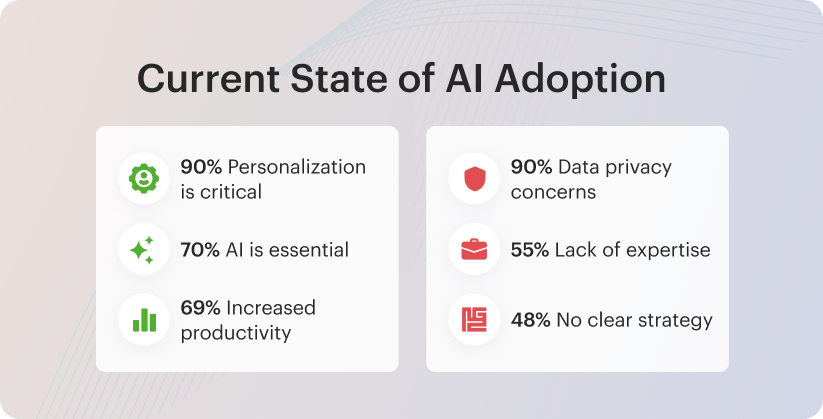
- Personalized experiences are now crucial, according to 90% of eCommerce executives.
- 70% of people think it’s crucial to use AI in eCommerce.
- 69% of companies that now use AI report increased productivity and speed.
But the study also identifies important obstacles to adoption:
- 55% say that one of the biggest challenges is data privacy.
- 49% of organizations suffer from a lack of AI knowledge.
- 48% are unable to grow AI initiatives because they do not have a clear AI strategy.
These difficulties highlight the disconnect between goals and implementation, which will widen as AI in eCommerce transforms the market.
Key AI trends shaping 2025
AI eCommerce trends 2025 has nearly always been in the news, in part because of how it is portrayed in the media and in part because of the hype around it. According to reports, the technology is contributing to a 15% rise in retailer revenues. This implies that there is a large body of research and publications that show how it has grown. Read in-depth about the main themes in AI.
Fundamental Trends
Supply chain optimization is one of the most significant short-term uses of AI in retail. Data science-powered AI-driven predictive models are anticipated to improve demand forecasting, inventory management, and customer happiness while streamlining operations. These developments may result in improved customer experiences for businesses that have invested in CRM and marketing automation by facilitating a more smooth transition between marketing initiatives and product availability.
AI-Assisted Coding
Apart from integrating AI with operations, teams now also apply AI directly to software development. Coding AI tools, like GitHub Copilot and CodeWhisperer, enhance the speed of coding, providing optimization suggestions and reducing the chances of human error. This ensures development speed and gives businesses an initial competitive edge in adopting AI-driven methods
Machine Learning (ML)
The foundation of artificial intelligence is ML algorithms, which allows systems to learn from past data and forecast future events. Features like recommendation engines (such as “Customers who bought this also bought…” on Amazon) are powered by machine learning in the eCommerce industry. Businesses looking for predictive analytics in consumer behavior are increasingly expected to use machine learning.
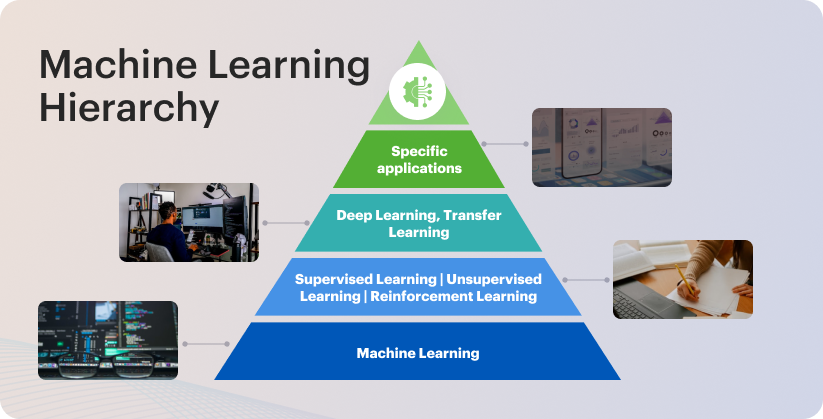
Deep Learning
Deep learning is a branch of machine learning that processes complicated input, like voice or images, using multi-layered neural networks. Deep learning is used by retailers such as ASOS and Zalando to increase the accuracy of visual searches and automate product categorization.
Supervised Learning
Labeled data with known results is used to train a model. A fraud detection system educated on previous transactions classified as “legit” or “fraud,” for instance. To lower chargebacks, Shopify businesses employ supervised models in fraud analysis apps.
Unsupervised Learning
Algorithms that analyze unlabeled data for patterns. This is used in AI retail to segment customers and find hidden groups like “one-time discount hunters” or “high-value repeat buyers.” Advanced customisation techniques are driven by unsupervised learning.
Reinforcement Learning
Trial-and-error learning with incentives for wise choices. This is the idea behind dynamic pricing engines, which change prices in response to inventory, demand, or rivals’ prices. Two well-known adopters are Uber and airline platforms.
Transfer Learning
AI speeds up learning in one area by reusing knowledge from another, rather than starting from blank when building a model. For instance, time and computation can be saved by fine-tuning a vision model that was trained on general objects to recognize particular fashion items.
Training Data & Datasets
The quality of the data is crucial. Recommendations will be prejudiced if a dataset is biased (for example, underrepresenting a demographic). As an illustration of the significance of openness in training sources, Stability AI was criticized for using biased datasets in Stable Diffusion.
Architectural Trends
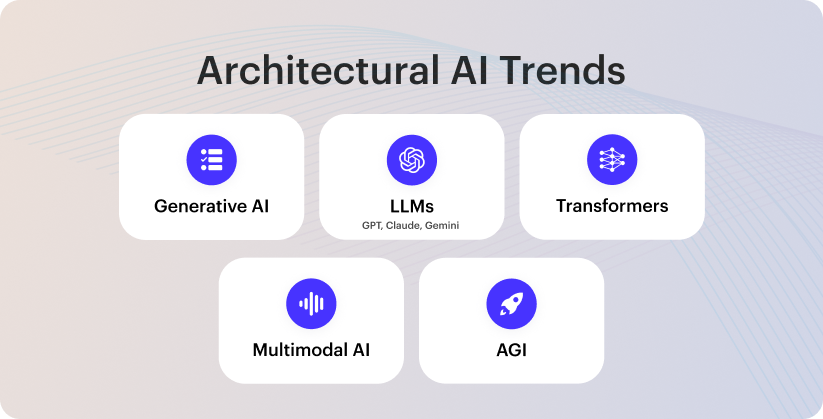
It will take more than simply technological advancements to increase confidence in AI. Governments and private businesses will probably need to work together to develop moral guidelines and legal frameworks that take these dangers into account. Some problems might go away as AI models get better and costs come down, while others will need systemic fixes.
Generative AI
New content is produced by generative models. AI-generated ad graphics, product descriptions, and even 3D materials are being tested by brands. Customers collaborated to produce artwork as part of Coca-Cola’s Real Magic campaign using generative AI.
Large Language Models (LLMs)
GPT-4, Gemini, and Claude from Anthropic are examples of massive models that can compose copy, respond to inquiries, and help with customer support. LLM AI shopping tools like Sidekick AI, which assist merchants in managing their stores, have already been incorporated into Shopify.
Transformers
It was the architecture that enabled LLMs. Transformers, which were first presented in Google’s “Attention is All You Need” paper in 2017, are the reason why modern models are able to interpret lengthy client questions with contextual correctness.
Multimodal AI
Text, image, video, and audio input are all processed simultaneously by these models. TikTok and Pinterest are early adopters that use both textual and visual data to propose content. This drives “search by image” functions for eCommerce (e.g., upload a shoe photo → find comparable products).
Artificial General Intelligence (AGI)
AGI, which is still theoretical, would refer to an AI system that can perform every intellectual task that a person can. Companies like OpenAI and DeepMind are aggressively working toward this horizon, even though it is not yet here. AGI is less important to AI retail leaders now, but monitoring its development helps with long-term strategic planning.
How businesses benefit from AI adoption
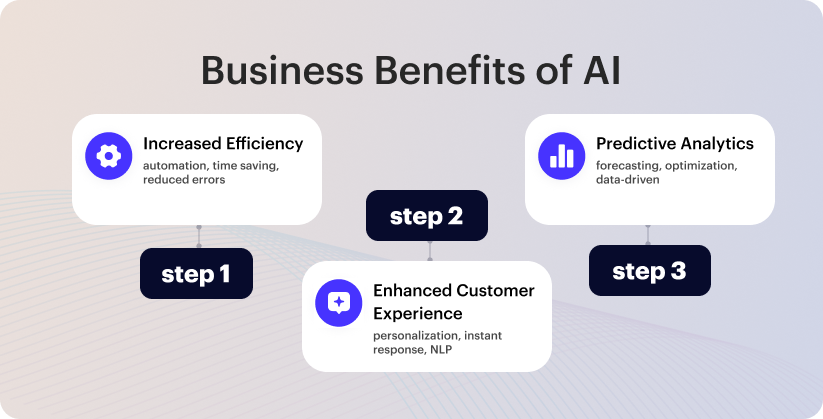
The broad applications and advantages of AI in eCommerce development doesn’t stop at automating repetitive tasks (e.g., generating code drafts or snippets, extracting data), personalizing customer targeting and message conveyance, etc. These are even more specialized applications of AI that are already being used by numerous companies.
Increased Efficiency
AI increases efficiency in a variety of corporate operations by automating repetitive tasks. For instance, data entry takes a lot of time and is not the most efficient use of a qualified professional’s time. It’s also vulnerable to human error when done by hand. When data in one system changes, AI shopping tools can automatically update the data in connected systems and receive notifications.
Even handwritten documents can be scanned by certain AI-enabled devices, which can then store the content for editing. Some contemporary electronic health record (EHR) systems used by healthcare organizations have this feature. For the benefit of the patient, medical professionals, and insurance companies, AI makes sure that both digital and handwritten records are consolidated in one location.
Enhanced Customer Experience
Regardless of the type of question they have, customers expect businesses to remain open around-the-clock. But it’s not always feasible to respond to every question right away. Here’s where AI can be useful. Many client inquiries can be handled by chatbots and automated emails because of natural language processing (NLP) and natural language generation (NLG).
By responding to every social media comment in real time, brands can elevate their customer service to a new level. By using NLG, AI can also quickly respond to emails or messages and provide a highly customized experience.
Predictive Analytics
A subfield of advanced analytics known as predictive analytics makes use of statistical algorithms, machine learning methods, and historical data to determine the probability of future events. By making it possible to swiftly and precisely analyze big datasets and spot intricate patterns that human analysts might overlook, artificial intelligence (AI) improves predictive analytics. This gives companies the confidence to predict market shifts, foresee trends, and make data-driven decisions.
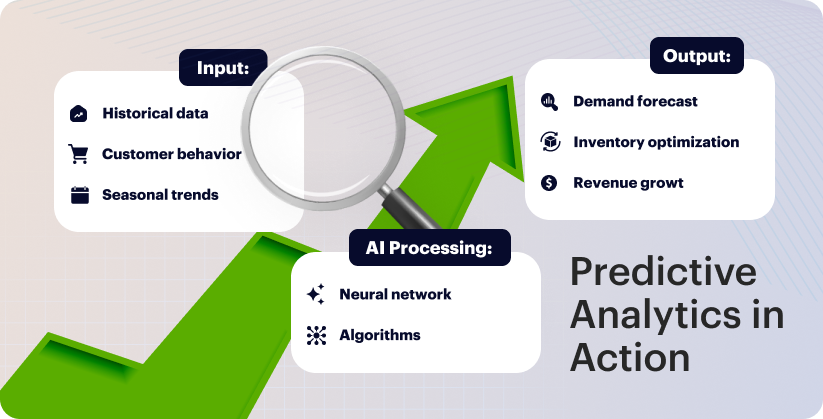
Think about a retail business that uses predictive analytics to control inventories. Artificial intelligence is able to forecast which products will be in great demand in the coming months by examining past sales data, consumer preferences, and outside variables like seasonal trends. By doing this, the business can minimize overstock and stockouts by optimizing stock levels. As a result, the business can lower expenses related to excess inventory, boost revenues, and enhance customer satisfaction by always having the proper products accessible.
Final Thoughts on Implementation
AI helps brands to move more quickly, customize more deeply, and function more intelligently. Examples of this include predictive analytics, intelligent automation, and huge language models that are changing the way developers work over commercial websites or software. The future phase of digital commerce, when intelligent algorithms inform every interaction, recommendation, and workflow, will be led by the companies that successfully convert AI principles into workable, scalable solutions.

Stellar Soft assists AI retail industry leaders in transforming these cutting-edge AI capabilities into practical applications. Our proficiency in data-driven programming, scalable automation, and AI integration guarantees that your store is not only staying up to date with innovations, but also establishing new benchmarks with initial AI-supported coding.
Are you prepared to adapt your eCommerce development approach to the AI era? Transform your digital operations into intelligent, growth-ready ecosystems by partnering with Stellar Soft. To begin creating the future of your internet business, get in touch with us right now.

To give your clients an experience that will serve as a catalyst for the expansion of your company, you must select the best eCommerce platform. Shopify has several features configurable to your company’s particular needs. However, backend customization is limited to some degree. To resolve it, you have to add extensions through apps, or launch your store on platforms like Magento or WooCommerce that offer more flexibility in this regard.
We’re offering five tried-and-true Shopify development methods in this blog post to help you grow your scalable Shopify architecture business and increase sales. These insights will position your store for long-term success, from conversion advice and professional growth tools to social media marketing and client retention tricks.
The Importance of Scalability in eCommerce
eCommerce websites that are scalable may handle growing traffic numbers to satisfy changing business requirements without seeing a decline in performance optimization.
Smooth expansion and efficient handling of heavy traffic during peak hours depend on this capability. By putting the needs of the consumer first and anticipating spikes in online demand, scalability also promotes the expansion of eCommerce.
There are noticeable spikes in traffic during events like Black Friday and flash sales. Given that global eCommerce sales are predicted to reach over $8.09 trillion in total sales by 2028, robust scalability is crucial [2]. Without it, platforms may face server outages, higher bounce rates, and lost income. Effective scalability prevents transaction issues and maintains customer happiness.
Challenges of Scaling Shopify Stores
Businesses have a number of obstacles that may impede their expansion as eCommerce develops and becomes more competitive, scaling Shopify store. Overcoming scalability challenges is essential to success. The top six obstacles to eCommerce growth will be discussed in this article. Feel free to continue reading before speaking with our team about any difficulties.
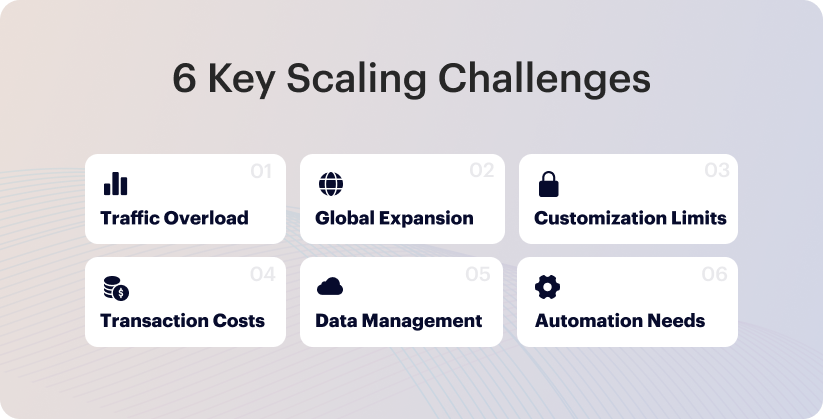
| 1. Traffic Overload Issues | If the underlying infrastructure is unable to manage the extra traffic, it can cause serious performance problems. With Shopify, the cloud-based infrastructure handles large spikes in traffic, so crashes from overload are rare. Performance issues usually stem from factors such as a poorly optimized theme or an excessive number of third-party apps, which can slow down the store. |
| 2. Global Expansion Needs | The necessity to enter foreign markets is becoming more and more important as eCommerce companies expand, particularly in the B2B eCommerce sector. Shopify simplifies the process with Markets and built-in tools. The platform supports multiple currencies with automatic conversions. Real challenges may still arise around fulfillment through third-party services. Invoicing under local laws can also require extra integrations. |
| 3. Customization Constraints | Do you ever feel that the customization choices on your current platform are too limited? Shopify restricts substantial backend tweaks while providing customization options within its framework. But it could be suppressed by, for example, paying for the Plus subscription. |
| 4. Process Automation Required | Repeated tasks that can take a lot of time and resources are common in eCommerce operations. Order fulfillment, inventory control, and customer follow-ups are examples of manual operations that might make it difficult for your team to work effectively. For that reason, businesses use ERP integrations (e.g., Flow or Klaviyo) to scale up eCommerce management. |
| 5. High Transaction Costs | On Shopify, transaction fees depend directly on whether a store uses Shopify Payments and its subscription plan. But for brands with low margins these fees can significantly erode profits, and in countries without Shopify Payments merchants face even higher costs due to higher fees from third-party providers. |
| 6. Data Management Complexity | The amount of data generated by enterprise eCommerce solutions increases in tandem with their growth. Making wise business decisions requires efficient management of this data. However, companies can find it difficult to use insights that could guide marketing plans or enhance consumer experiences in the absence of a strong data management strategy. |
Building a Custom Shopify Architecture
Despite their convenience, thousands of other stores employ pre-built themes. With a distinctive visual identity and user experience that precisely matches your company’s goals and the expectations of your target market, custom Shopify development guarantees that your brand stands out.
It is possible to optimize custom themes and architectures for your particular requirements by eliminating extraneous code and features that cause page load times to increase. Improved search engine ranks and noticeably higher Core Web Vitals scores are frequent outcomes of this focused strategy.
Integrations and apps
Webhooks and APIs are essential for integrating third-party services, enabling smooth system communication, and enabling real-time data updates. Marketing tools, logistics platforms, CRMs, and ERPs are frequently integrated. A more streamlined and cohesive operation can be achieved by linking your Shopify store with other crucial business tools.
When pre-existing apps are insufficient, custom Shopify development with apps might offer features that are specifically designed to meet corporate requirements. Off-the-shelf solutions cannot manage certain business processes, offer specialized functionality, or interface with other systems like custom apps can.
Bespoke software, for instance, can automate complicated processes like processing wholesale orders, providing bulk discounts, or more effectively managing returns and exchanges. This can improve customer satisfaction and business operations by saving time and lowering the chance of mistakes.
Future-Proofing Your Store
Use scalable, modular components when designing your infrastructure for Shopify to easily manage new additions, traffic surges, and integrations. Make use of headless commerce (e.g., Hydrogen, Next.js, Gatsby), and APIs to make sure your store adapts to your company’s demands. Future-proofing speeds your growth, enhances performance, and decreases downtime.
Conclusion
Remaining competitive and scaling effectively require a strong, unique Shopify architecture. Your store may adjust to shifting consumer expectations and market conditions without having to undergo expensive redesigns if you prioritize scalability, flexibility, and maintainability.
Are you prepared to grow your store using a Shopify solution that will last? Collaborate with Stellar Soft to create a unique architecture that is suited for expansion.
FAQ
What is scalable Shopify architecture?
An infrastructure for Shopify and design that can accommodate growing traffic, product SKUs, and transaction volumes without experiencing performance deterioration is referred to as scalable Shopify architecture. It supports expansion through server-side efficiency, modular app integrations, and optimized theme code.
When should a store upgrade to Shopify Plus?
Stores that need multi-channel and multi-store functionality, extensive automation, or huge traffic spikes should think about Shopify Plus. Dedicated support for large-scale operations, improved APIs, and enterprise eCommerce capabilities are all made available through upgrading.
How does architecture affect performance?
A well-designed architecture guarantees seamless page rendering even with high visitor volumes, decreases load times, and lessens server strain. Reduced conversion rates, increased bounce rates, and sluggish reaction times can all result from poor architecture.
Can small stores benefit from scalable solutions?
Yes, small businesses may manage expansion without needing significant redesigns or migrations if they use scalable architecture early on. As the company expands, it also future-proofs the website, making feature growth and performance optimization simpler.