
Last Updated | June 4, 2026

However, the situation is changing as digital interactions are getting more sophisticated, and CRO is no longer limited to small alterations, Thus brands in 2026 will incorporate AI personalization eCommerce and full-funnel strategies to improve every single aspect of the consumer journey.
Consumers of today have different ways of interacting with the companies, which makes it impossible to carry on with the static tests. The modern day CRO should be able to act on the fly, relying on AI-driven insights and micro-conversions to predict and shape user behavior. eCommerce companies that do not adapt to personalized campaigns will eventually lose considerable user engagement opportunities and get uncompetitive.
So, what are the 2026 CRO strategies? The main ones include AI taking real-time optimization, hyper-personalization delivering seamless experiences, and CRO influencing all interactions rather than only leading to conversions. Retailers that welcome this change will not only secure a competitive edge but also foster deeper customer relationships, resulting in improved engagement, increased sales, and customer loyalty in the long run.
How AI Personalization Works in Modern eCommerce
The process of AI personalization eCommerce understands the customer’s precise needs and tastes through the evaluation of his/her provided demographic and historical behavioral information like shopping and browsing habits, and interactions on social media. The most important personalization features are:
- customer behavior tracking across every touch point is done with behavioral tracking
- the modification of AI customer experience is through real-time adaptation according to the behavior of the customers
- client needs and preferences are predicted with the help of predictive recommendations
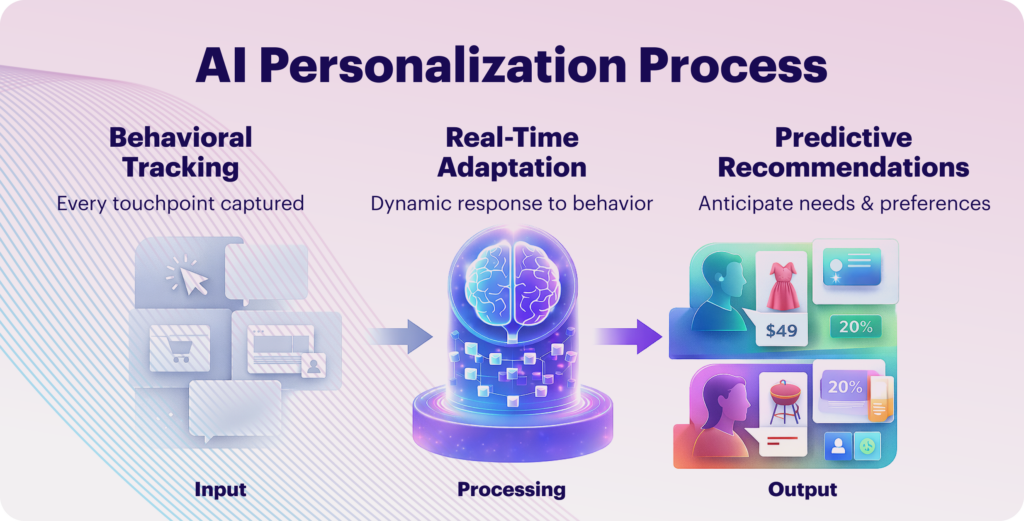
The technology can predict what they are curious about, through which channel they want to communicate with your business and at which stage of their perfect buying journey your next best touchpoint is.
The hyper-personalization concept goes beyond merely deploying static AI algorithms alongside pre-defined workflows. The AI that eCommerce companies are after would be the one capable of operating independently to serve their purpose in a wise and personalized manner to each and every consumer. Agentic AI is changing the landscape of personalized consumer experiences and making them truly one-to-one by giving autonomy, adaptability, and real-time optimization to business operations.
Benefits of AI-Powered Personalization for Conversions
Artificial Intelligence gives the possibility for eCommerce companies and sellers to rely less on basic trusting and more on real-time data, smart insights, and machine-made decisions. What do these new environments lead to? Shopping that is less time-consuming, more intelligent, and extremely customer-focused and oriented to making sales.
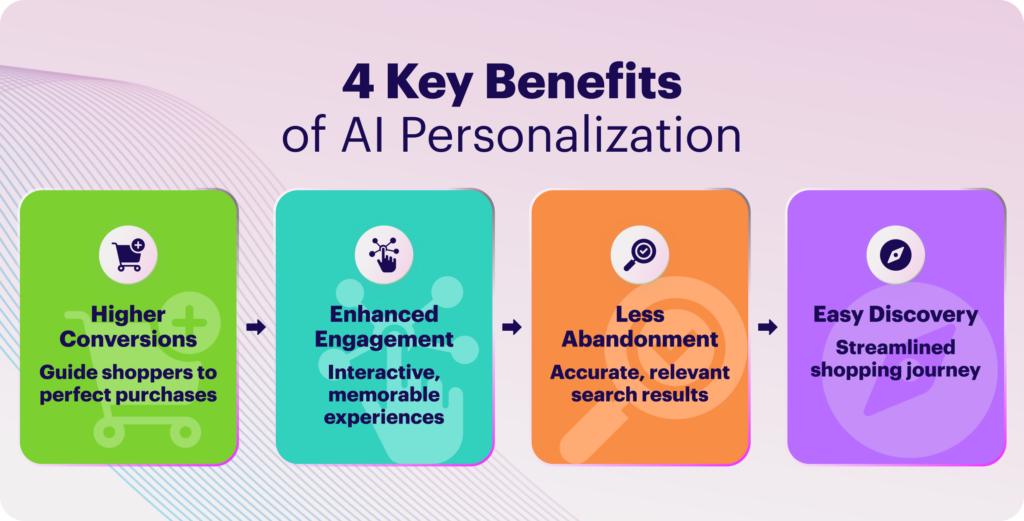
Increased Conversion Rates: Guiding Shoppers to the Perfect Purchase
Conversion rates are essential for the success of eCommerce. One of the reasons that AI-driven personalization is very important is that it makes AI customer experience very relevant for each shopper thus giving a direct impact on this measure. Customers visiting your site are usually introduced to many different types of products. Kids, if not properly guided, can get confused leading to dropping out. AI takes the role of a personal shopping assistant to support and relieve the situation.
Enhanced Customer Engagement: Creating Interactive and Memorable Experiences
Artificial intelligence aids retailers in providing dynamic and interactive shopping experiences that are not limited to merely showing products. AI-driven chatbots, for instance, can provide individual recommendations and give real-time responses to customer queries.
Consequently, the buying process becomes more lively and dynamic, which attracts customers to the site for a longer period.
Artificial intelligence can find opportunities to customize the message’s time and delivery by analyzing the customers’ behavior and preferences. For instance, a retailer might send a personalized e-mail containing a special discount to a customer who has shown interest in a particular category of products.
Reduced Search Abandonment: Delivering Accurate and Relevant Results
AI surpasses the traditional methods of matching keywords to understand what a customer is looking for through his or her search query. This implies that, no matter how complex or ambiguous the customer’s language is, AI will still be able to provide helpful results. AI also draws on past search activities and choices which it gradually enhances through time informing search results. This leads to the visibility of the most pertinent items to the customers even when they are not quite certain about shopping for something specific.
Streamlined Product Discovery: Simplifying the Shopping Journey
AI processes enormous amounts of product data, like characteristics, descriptions, and ratings, to discover the best-fitting products for each client. This accelerates the buying procedure, thereby facilitating customers in their search for the desired items. Individualized recommendations and search results bring the customers to the products that are most likely to attract them, thus, the time-consuming scrolling and searching becomes redundant.
Data and Predictive Models Behind Personalization
The use of AI in eCommerce personalization involves the integration of massive data gathering and predictive modeling of the highest order to develop and maintain continuous and highly personalized customer relations. It starts with:
- The combination of customer profile, comprising of demographic (age, gender, location, etc.) and psychographics (interests, behavior, etc.), transactional (purchases, browsing, etc.), and contextual data (location, device, time, etc.) into a unified feature store or customer data platform (CDP).
- Raw data undergoes various preprocessing steps like normalization, encoding, dealing with missing values, and feature extraction to be finally turned into structured inputs for modeling.
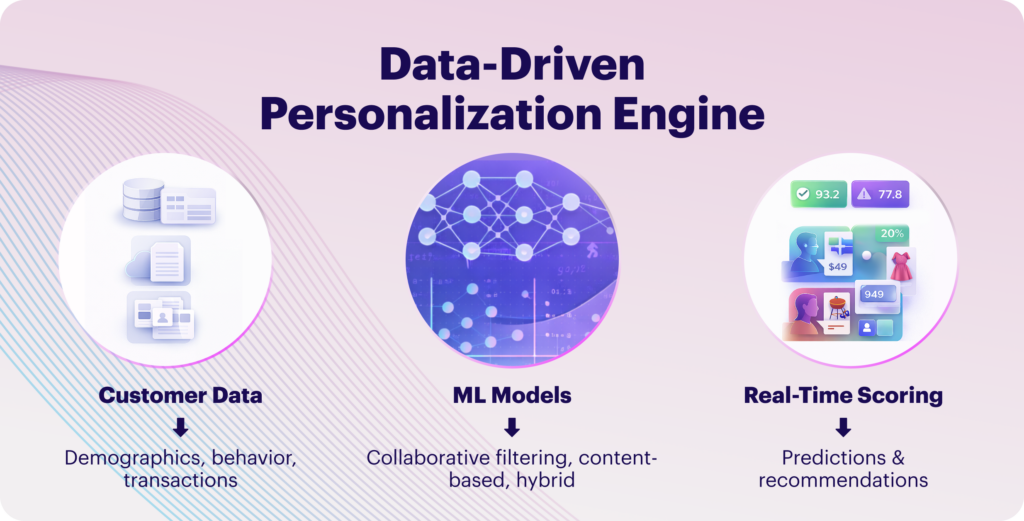
Personalization models utilize the methods of both, traditional statistics and machine learning together. User-item interactions reveal hidden preferences through filtering whereas content-based filtering recommends specialized or new goods based not only on product features and user profiles but also on user interests.
To deal with issues, hybrid models, for instance, make use of both approaches. Sequence models and transformer architectures based on temporal and contextual dependencies capture sessions, thus enabling real-time adaptive suggestions. On the other hand, graph-based models utilize graph neural networks for user relationship and interaction mapping, while reinforcement learning improves suggestions by treating interactions as reward-driven sequences.
The entire process involves feature engineering, model training, prediction scoring, and real-time adaptation, all of which are monitored by KPIs such as CTR, conversion rate, session length, and revenue per user. Hence, dynamic pricing AI and personalization is guaranteed to be responsive to customer behavior, which in turn leads to maximum engagement, higher average order value, and improved retention.
Tools for Implementing AI Personalization in 2026
Choosing the proper AI personalization eCommerce tool isn’t about chasing the latest technology; it’s about choosing the solution that best meets your business needs. Here are a few tools that might help brands rethink how personalization works across channels, journeys, and situations.
Yespo
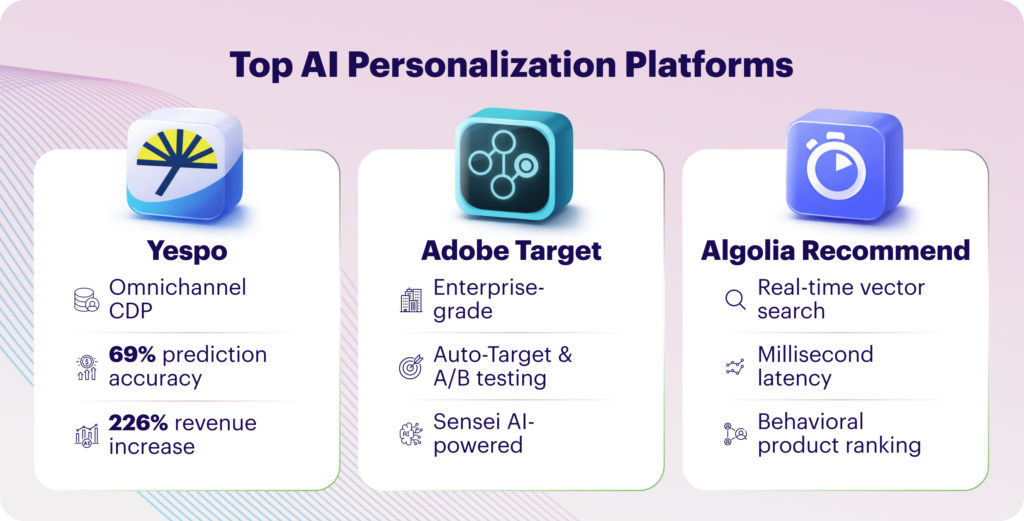
Yespo is an Omnichannel Customer Data Platform that offers ready-to-use solutions for online services, retail, and eCommerce that aim to increase sales and retain customers. Brands can personalize the consumer experience across nine channels by leveraging AI, product suggestions, behavioral triggers, and messaging, all without the need for developers.
Yespo consolidates all of a customer’s data into a single profile and makes it available for activation using predictive AI techniques.
Product Recommendations: Even with limited data, the algorithm can anticipate what customers will buy next with up to 69% accuracy. It also recommends new things that are useful to the consumer. When employed in site suggestion blocks, these algorithms increase revenues by up to 226%.
Predictive Segmentation: Artificial intelligence analyzes human behavior to identify clients who are most likely to make a purchase in the next 30 days. This keeps communication focused on people who are likely to buy and reduces expenses by up to 50% on expensive channels.
The platform provides nine channels for clients to connect (email, mobile push, online push, SMS, Viber, pop-ups, in-app, App Inbox, and Telegram bot), allowing you to completely tailor their experiences at every touchpoint.
Adobe Target
Adobe Target, part of Adobe Experience Cloud and powered by Adobe Sensei, is a platform for enterprise-grade personalization and experimentation. It enables businesses to automate, test, and scale personalized online, mobile, and email AI customer experience.
Auto-Target and Automated Personalization, like Dell’s global optimization, deliver dynamic content based on historical and real-time behavior. Ideal for organizations that require accurate testing and deep predictive analytics eCommerce integration, it blends predictive customization with robust A/B testing to adapt user journeys based on engagement data.
Algolia Recommend
Algolia Recommend is a vector-based system for real-time personalization that tailors search and personalized product recommendations by assessing user context with millisecond latency. It is used by firms such as Decathlon to tailor catalogs and rank products depending on behavior, providing speed, precision, and relevance on a large scale.
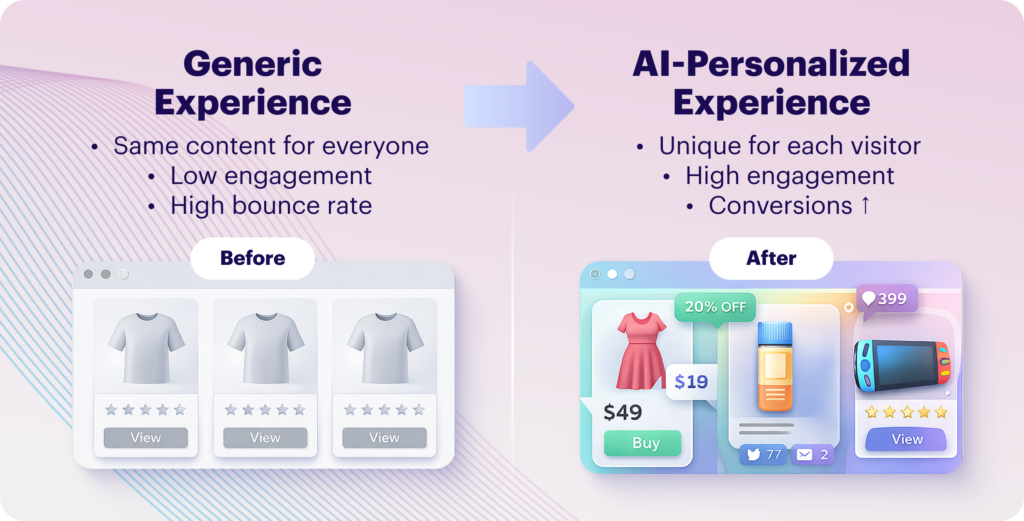
AI-powered personalization improves eCommerce by converting complex consumer data into actionable insights, allowing for real-time, one-on-one interactions that boost conversions, loyalty, and average order value. Solutions such as Yespo, Adobe Target, and Algolia Recommend demonstrate how predictive models, adaptive recommendations, and AI shopping behavior analysis make hyper-personalization scalable and quantifiable. Agencies who execute these techniques assist clients in achieving measurable business growth and a competitive advantage.
Partner with Stellar Soft to create and deploy AI personalization eCommerce strategies that yield measurable outcomes for your clients. We optimize trips, increase conversions, and maximize income potential.