
Last Updated | June 4, 2026

In their efforts to catch up with the customers, firms have to put forth unique characteristics in an already highly competitive industry. Amazon, eBay and Shopify are the major players in the use of AI tools for eCommerce to transform the online retail sector. AI has turned out to be a necessity rather than a luxury.
It’s almost impossible not to have heard a multitude of times that the deployment of AI technology is the shortcut to business growth. The truth is, you are probably already relying on some eCommerce tools. But are you really maximizing the potential of AI ‘tech stock’?
To ensure you don’t miss the boat, we will unveil the top AI technologies in the eCommerce area for 2026 and also how to adopt them in your firm. By the conclusion of this tutorial, you will have the perfect know-how to exploit AI innovations in getting significant competitive whiffs.
How AI Is Changing eCommerce Growth in 2026
AI-driven recommendation engines have reshaped the retail industry by analyzing behavioral, contextual, and predictive customer data. They power real-time product suggestions, dynamic merchandising, and personalized shopping experiences. While tech giants such as Amazon and Netflix pioneered these systems, many retailers now rely on advanced tools like Algolia Recommend and Luigi’s Box to provide similarly tailored experiences.
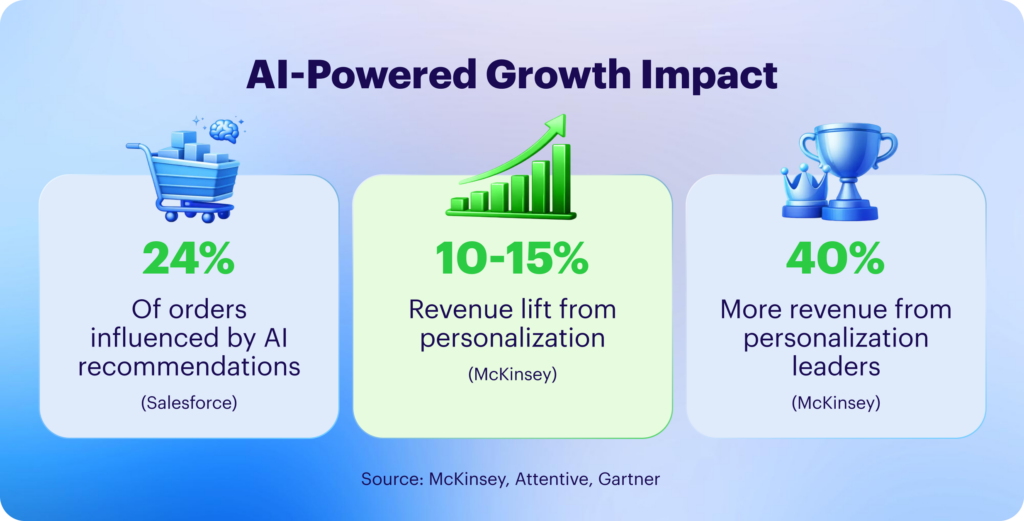
The effect is well-documented across multiple industry studies:
- Salesforce “State of Commerce” Report shows that AI-powered recommendations influence 24% of orders and 26% of revenue for digital retailers.
- McKinsey reports that personalization can drive a 10-15% lift in revenue and that companies excelling at personalization generate 40% more revenue from these activities than their peers.
- Algolia Recommend publicly cites reductions in friction and increases in click-through and add-to-cart rates due to behavioral and similarity-based product suggestions.
- Luigi’s Box reports measurable increases in product discovery efficiency and conversions through AI-enhanced search and recommendation modules.
Together, these findings illustrate why hyper-personalization is no longer optional – it is becoming a defining advantage in digital commerce. Retailers adopting AI recommendation engines consistently see improvements in:
- conversion rate
- customer satisfaction
- retention
- average order value
- marketing efficiency
Hyper-personalized retail experiences are rapidly shifting from “premium differentiator” to “industry standard,” especially as customer expectations continue to rise in 2026.
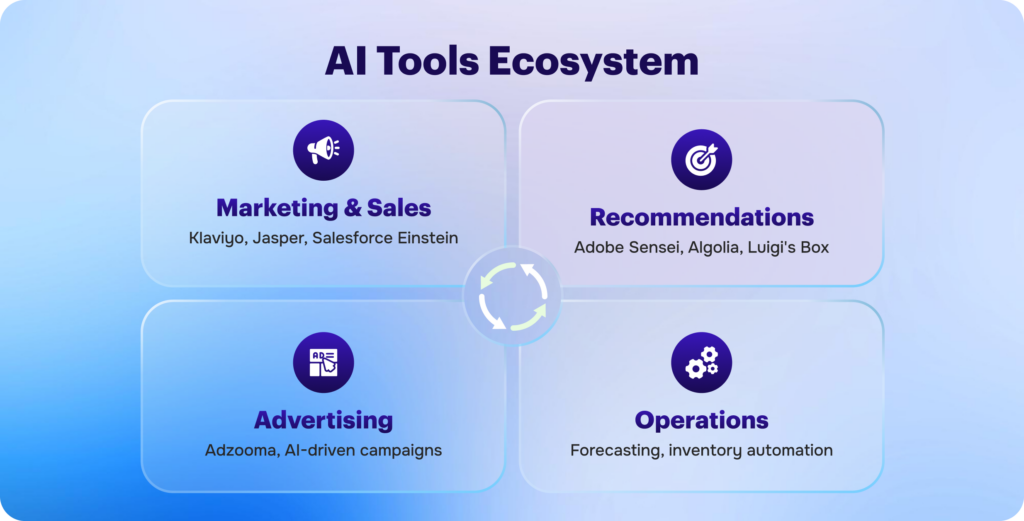
Best AI Tools for Marketing and Sales
The modern eCommerce teams, in their day-to-day activities, are powered by AI-tools that take over personalization, enhance content distribution and derive actionable insights from customer data. Such technologies that are exploiting machine learning, predictive analytics, and behavioral modeling are stacking up better segmentation, target precision, and cross-channel execution efficiency.
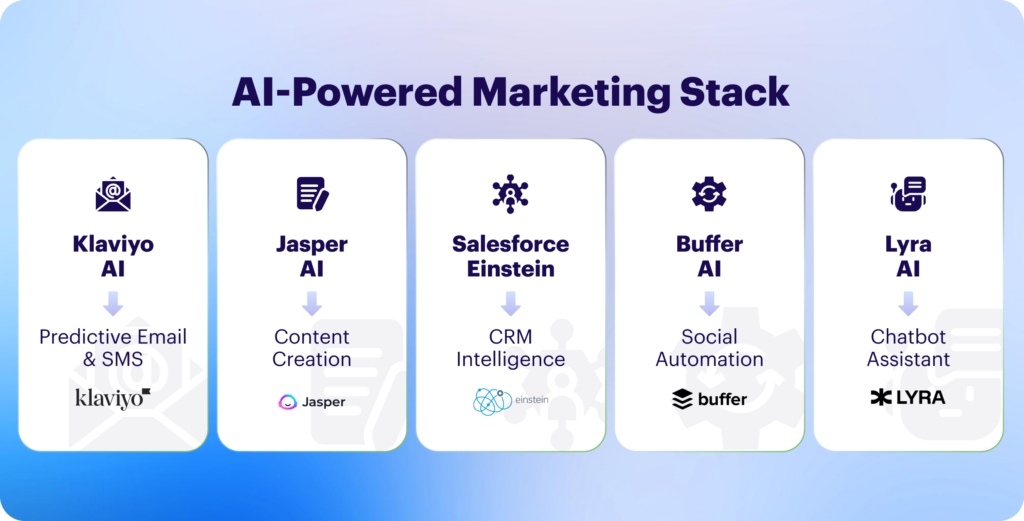
Lovable (AI Website & Funnel Builder)
Lovable helps eCommerce teams quickly create landing pages, marketing funnels, and campaign assets that are informed by user behavior data. It generates page layouts, improves copy, and suggests optimization ideas based on performance insights.
Klaviyo AI (Predictive Email & SMS Marketing)
Klaviyo’s AI features analyze purchase history, browsing behavior, and engagement patterns to predict metrics such as churn probability, next-order likelihood, and customer lifetime value. It helps marketers build accurate customer segments and automate lifecycle communication across email and SMS.
Jasper AI (Content Creation for eCommerce)
Jasper supports long-form content creation, ad copy, email campaigns, and brand-aligned messaging. It is widely used by marketing teams to reduce content production time and keep messaging consistent across channels.
Writer AI (Enterprise-Grade Brand Content AI)
Writer is designed for brands that need strict control over tone, accuracy, and brand language. It helps produce product descriptions, support content, documentation, and editorial assets while keeping everything compliant with internal guidelines.
Buffer AI Assistant (Social Media Content & Scheduling)
Buffer’s AI assistant helps generate post ideas, rewrite content, and analyze engagement patterns to suggest the best publishing times. It allows eCommerce brands to maintain a regular social presence without producing every post manually.
Salesforce Einstein (CRM & Sales AI Layer)
Einstein enhances Salesforce with predictive analytics, lead scoring, product recommendation algorithms, and automated customer service workflows. It supports merchandising, chatbots, and segmentation at enterprise scale.
Why These Tools Matter
Used together, these tools can enhance:
- content creation and distribution
- customer segmentation and lifecycle engagement
- predictive analytics for sales and retention
- cross-channel personalization
- automation of manual workflows
As a result, brands typically see:
- higher conversion rates
- reduced operational costs
- more consistent customer communication
- better use of first-party data
Assistant Chatbots
Chatbots are conversational AI eCommerce solutions with user interfaces that are powered by artificial intelligence and automatically interact with customers on the web, through messaging apps, and on commercial websites. In order to understand the user inquiries and to give appropriate replies, they utilize natural language processing, intent classification models, and occasionally, RAG.
In eCommerce and marketing, chatbots handle:
- 1-st level assistance (common questions, order tracking, and returns)
- product navigation and recommendations
- customer potential assessment and information recording
- help with payment and shopping cart process
Contemporary chatbots work together with various systems like CRM and ESPs, marketing eCommerce automation tools and eCommerce platforms, automating the whole process, updating user profiles, and personalizing the replies according to the user based on their actions and transactions. They reduce the cost of support, supercharge the response time, and keep the customers interacting through the entire journey.
Lyra AI is an example of such a system that learns from customer interactions on a continuous basis to improve its reactions and, thus, its effectiveness over time, with the shopping experience getting better and better with every visit. This model can deal with numerous questions like product suggestions, checking availability, and fixing problems, but all in an easy-going and user-friendly style.
Recommendation Engines
Recommendation systems use various approaches including machine learning, collaborative filtering, content-based modeling, and deep learning, among others, to deliver personalized AI product recommendations.
In order to determine the relevance of a product to a particular user and predict the likelihood of user interaction or purchase, these systems usually resort to massive datasets that include browsing activity, previous purchase history, product details, and real-time consumer signals.
What this means is that these engines can help you increase your average order value (AOV), conversion rate, and lifetime value (LTV) given that your store is already filtering product recommendations based on customer preferences.
Adobe Sensei extends the functionalities of Adobe Commerce and gives online retailers powerful tools for optimization and personalization, so it can be your ally in this process. It combines data analysis and GenAI to deliver not just personalized products but also automated catalog management via image tagging and analysis, and customizable content and copy, all of which are supported by image tagging and analysis.
AI-Driven Ads (AI Ads)
AI advertising uses machine learning and predictive analytics to automate campaign optimization across several channels, including Google, Meta, and programmatic ad networks. These systems use massive datasets, audience behavior, performance, bidding patterns, and competition signals to alter bids, fine-tune targeting, and develop high-converting content.
In performance marketing, AI ads support:
- Real-time bid optimization and budget reallocation.
- Audience segmentation and lookalike modeling
- Automatic creative variation testing (multivariate and A/B/n)
- Predictive modeling for ROAS and CAC
- Dynamic ad copy generation with NLP models
Similar AI eCommerce solutions with analytics platforms, CRMs, and eCommerce systems to bridge the gap between spend, behavior, and conversions. This enables advertising to self-optimize based on performance and long-term value rather than surface measurements.
For example, Adzooma centralizes cross-platform ad management and uses machine learning to diagnose underperforming campaigns, provide optimization solutions, and redistribute funds based on predictive performance insights.
AI in Operations: Forecasting and Automation
AI-driven operational forecasting starts with combining disparate datasets, such as transaction histories, traffic sources, campaign metadata, lead-time logs, performance data, and even external signals like weather or macroeconomic indicators, into a cohesive dataset.
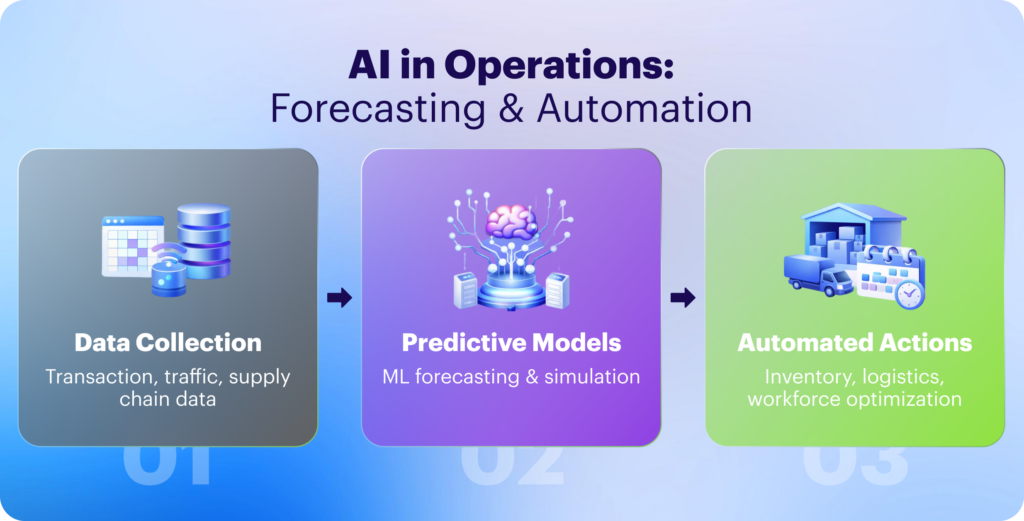
Advanced feature engineering then converts these raw data points into model-ready variables, capturing patterns like sales elasticity, demand volatility, and the temporal correlations between marketing activity and downstream operational strain. Read about it in detail.
Predictive Forecasting Models
AI-powered forecasting engines combine transactional data, historical demand trends, seasonality curves, traffic measurements, and supply chain signals into a single data layer. These systems use a combination of statistical time-series models (ARIMA, Holt-Winters) and machine learning techniques (XGBoost, LSTM networks, transformer-based sequence models) to capture non-linear trends, cross-SKU relationships, and rapid demand fluctuations.
ForecastPro, Zoho Inventory AI, and Microsoft Azure AutoML are platforms that can deploy these models on a large scale. They retrain to ensure accuracy and prevent drift, allowing for real-time modifications during promotions, traffic spikes, or supply shortages.
Scenario Simulation and Decision Support
After training, the forecasting layer performs counterfactual simulations to evaluate operational outcomes such as the impact of budget changes, supplier delays, pricing modifications, and inventory restrictions. These simulations calculate revenue effect, fulfillment burden, and risk probability, and input them directly into decision engines.
These outputs are used by operations teams to calibrate stock levels, change reorder points, optimize warehouse distribution, and fine-tune logistics routing based on expected throughput and lead time variations. AI platforms such as Anaplan, O9 Solutions, and SAP IBP offer simulation and decision-support capabilities.
Automation Across Inventory, Logistics, and Workflows
Automation activates when forecast outputs cross defined thresholds. See:
- in AI inventory management, it generates replenishment orders, redistributes goods between regional warehouses, and prevents stockouts and overstocking.
- in logistics, the system dynamically reroutes shipments, modifies carrier selection, and arranges pick-pack procedures based on expected demand.
- workforce operations also benefit from automated task prioritization, ticket deflection, and staffing suggestions based on predicted order volume, which are powered by engines like Zendesk AI and Freshworks Freddy AI.
When you integrate these technologies into your business model, you get an adaptable, self-correcting operational layer that transforms eCommerce operations from reactive to predictive.
Choosing the Right AI Stack for Your Store
The sheer amount of AI solutions available to eCommerce professionals today represents both a tremendous potential and a severe risk. As we have shown, best-in-class tools can transform anything from on-site search to fraud prevention. The natural impulse is to amass these powerful answers, resulting in a broad “toolbox” to face any situation.
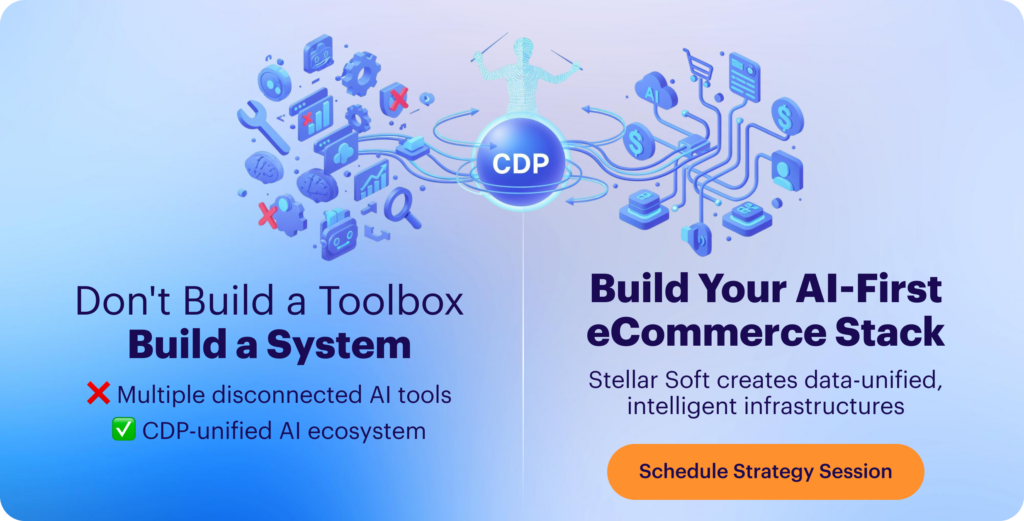
The most successful leaders are making a different decision. They understand that individual tools are only instruments; what they require is a conductor. They are basing their strategy on a core AI analytics eCommerce, a Customer Data Platform, which combines their data and orchestrates all activities. This is the approach to maximizing the ROI of any AI investment, and it distinguishes between establishing a collection of gadgets and building a true engine for growth.
Stellar Soft specializes in creating data-unified, future-proof eCommerce infrastructures that leverage AI for a competitive edge. Schedule a session and create your intelligence roadmap.