
Last Updated | June 4, 2026

Machine learning, natural language processing (NLP), and predictive analytics are used in AI-enabled stores so that they can keep learning from consumer interactions, sales data, and market trends, in contrast to traditional eCommerce platforms that depend on static rule-based systems.
Consider AI in online stores as environments where AI incorporates the context. Even just to give a product catalog, the AI store will actually change pricing, messages, products, and customer services on the basis of the user behavior. Here comes intelligence and automation combined: everything has to work in real time, scale at will, and serve customization. Could there be something more? Yes, the intelligent algorithms: from recommendation engines suggesting products tailored to the individual to chatbots responding to queries, to pricing algorithms reacting to demand changes in the market.
Why Traditional eCommerce Stores Are Becoming Outdated
Traditional eCommerce platforms were based on a “one-size-fits-all” architecture. Most of the product listings are static. A search result will depend on the keywords used, not the actual intent behind the search. The incidence of a client journey is sequential and rarely bends for specific preferences or habits. In the early part of the decade, such models would have sufficed; however, given the present competitive stage where customization and instant gratification are the orders of the day, these fall short in their application.
Consumers expect to get AI UX on the lines mentioned by Amazon, including context assistance, cart recommendations in prediction, and shipping information in a flash. Companies that continue to run static eCommerce websites will run the risk of going obsolete. McKinsey catalogued some of its benefits for AI personalization, saying it increases sales by 10 to 30 percent for digitally mature brands.
Getting new customers is becoming more expensive. Without the use of AI to enhance retention strategies like predictive churn alerts or intelligent re-engagement emails, brands will find it increasingly difficult to remain profitable. In such a setting, a static approach to eCommerce is not only suboptimal but a full-on liability.
AI Use Cases in eCommerce Websites
Similarly, building a purpose-built AI in online stores is no longer just a futuristic idea, but a necessity for competitive advantage. Integrated AI transforms a lifeless online storefront into a dynamic, living entity that continually interacts with data, learns from it, and evolves in parallel to business goals. No other technology delivers the differential advantage to online retailers in their quest to increase revenue per visitor, decrease operating and fulfilment costs, and improve Customer Lifetime Value.
Search and Product Recommendations
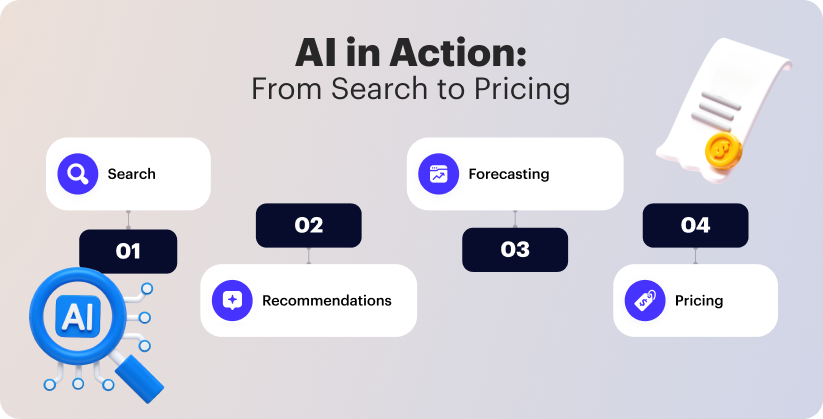
Why do so many people leave an eCommerce website after utilizing the search bar? The search feature in the majority of traditional retailers depends on exact keyword matches, which frequently fall short of capturing what the buyer is actually looking for.
Semantic search and intent recognition are made possible by AI. AI-powered search engines comprehend the meaning of the query rather than searching for specific text.
AI systems like Algolia or Klevu, for example, may understand a customer’s purpose when they put in a “lightweight laptop for travel” and present products with intelligent features like portability, weight, and battery life, even if the product descriptions don’t contain those precise terms. This lowers friction in the path to buy and significantly enhances product discovery.
Inventory and Demand Forecasting
Smart inventory management is another crucial area where AI excels. How can internet merchants steer clear of the two dangers of understocking and overstocking? Machine learning-powered predictive demand forecasting holds the key to the solution. By evaluating real-time variables like promotional calendars, customer sentiment, and even macroeconomic indicators, artificial intelligence (AI) goes beyond traditional demand planning, which is based on historical sales and seasonal trends.
By anticipating which products would be in demand at particular periods, down to the SKU and location, tools like Lokad, Inventoro, and Google Cloud’s demand forecasting technologies assist businesses in making accurate inventory decisions. As a result, carrying costs are decreased, stockouts are reduced, and fulfillment reliability is increased. Based on local purchasing patterns, AI may also help omnichannel firms optimize their warehouse distribution and replenishment cycles.
Fraud Detection and Dynamic Pricing
Real-time fraud detection is a significant advantage of developing an AI eCommerce store. Without interfering with valid transactions, how can a store spot fraudulent activity?
Anomalies in transaction behavior, such as mismatched IP addresses, abnormally high order values, or frequent repeat transactions, can be detected by AI systems that have been trained on large datasets. Machine learning is used by platforms such as Forter and Sift to detect and block fraud more accurately than rule-based systems, which lowers financial risk and chargebacks.
AI’s capacity for dynamic pricing optimization is equally potent. Conventional pricing systems frequently depend on seasonal updates and set criteria, which make it difficult to adjust to changes in market demand in real time. Artificial intelligence (AI)-driven pricing systems, such as Pricefx or Prisync, automatically modify prices in real time by analyzing inventory levels, rival prices, and product popularity.
How to Implement AI in Your Store
The multi-phase, intricate process of launching an AI-powered eCommerce business goes much beyond that of conventional eCommerce development. Every step needs to be carefully carried out, from testing and optimization to backend setup and AI integrations. This section, which is intended for companies looking to create an intelligent AI UX that is ready for the future, breaks the process down into seven distinct parts.
Set Up the eCommerce Infrastructure
Your user system, cart, checkout, order flow, and product catalog make up the core layer of your eCommerce platform. The first thing to consider is whether to create a custom solution or leverage an established commerce platform.
Key components to set up at this point:
- User account system with OAuth2.0 or JWT authentication
- Secure payment gateway integration (Stripe, Razorpay, or PayPal)
- SSL encryption and compliance for secure data handling
- CMS and product information management system integration
The infrastructure is designed from the ground up with security, scalability, and performance in mind.
Integrate AI for Product Discovery
Even if consumers are unsure of what to look for, how can they still find what they want? Semantic and visual search are the two main technologies that AI-powered product discovery uses to address this.
Natural language processing, or NLP, is used in semantic search to determine the purpose of a user’s query. It matches context rather than exact keyword matches. For example, even if the product title doesn’t utilize the precise terms, a customer searching for “durable running shoes for flat feet” will discover carefully chosen options with cushioning and arch support.
To implement this, your backend must include:
- NLP model integration (e.g., OpenAI’s GPT embeddings or BERT)
- Vector database setup to store product and query embeddings
- Real-time retrieval logic via APIs
Users can upload a photo and utilize visual search to identify related products. This allows users to shop using images rather than words, which significantly increases conversion for fashion, accessories, and lifestyle products. This feature integrates straight into the mobile app or search bar of your store and makes use of computer vision models that have already been trained on huge image datasets.
To ensure real-time performance under pressure, developers at Stellar Soft deploy these AI models using scalable microservices and integrate them via secure APIs. A natural, intuitive, and intelligent product discovery experience is the end result.
Implement Dynamic Pricing and Inventory Forecasting
Pricing and smart inventory optimization are two of the most potent uses of AI in business. However, how can one determine whether to increase prices or when to mark down stock that is soon to expire?
AI inventory forecasting also aids in avoiding overstocking and stockouts. ML models forecast future demand based on the following criteria rather than static reorder points:
- Seasonal patterns
- Campaign calendars
- Macroeconomic trends
- Product velocity and return rates
Depending on what best suits the company needs, our team uses gradient boosting, deep learning (LSTM), or time-series algorithms to create forecasting models. The entire supply chain planning process is automated by these tools, which interface with your ERP or order management platform.
Test, Monitor, and Deploy
Thorough testing and strategic deployment are the last steps prior to launch. How do you make sure that everything works perfectly in the actual world, including the AI models?
The QA procedure consists of:
- Functionality testing (for every AI and commerce module)
- Performance testing (page load, API response, scalability)
- Regression testing (to catch model errors after new data is introduced)
Post-deployment observability tools are set up to track conversion rates, AI model performance, API latency, and system health in real time. There are rollback methods in place to immediately undo modifications if something goes wrong.
An AI smart eCommerce launch initiates a cycle of continual improvement rather than ending with deployment. With Stellar Soft’s post-launch assistance, you can be sure that your platform will adapt to changing market trends, consumer behavior, and new data, making it smarter with each transaction.
Tech Stack Considerations
Your AI-powered eCommerce store’s success depends on selecting a tech stack that is scalable, adaptable, and specifically designed for AI integration—not just on excellent design or astute marketing. Your store’s speed, security, customisation options, and even the speed at which you can develop new intelligent features in the future are all impacted by this fundamental choice.
A React-based framework called Next.js is frequently the best option if speed and search engine optimization are your primary concerns. It is perfect for AI stores that require search engine visibility and depend on dynamic content and AI personalization because it supports server-side rendering (SSR), static site generation (SSG), and API routes. Next.js offers integrated routing, prefetching, and image optimization and integrates easily with headless CMS platforms.
Final Thoughts
A scalable, intelligent system that increases conversion, retention, and operational efficiency is the result of using AI, which calls for careful architecture, reliable data pipelines, and ongoing monitoring. From infrastructure and AI model integration to deployment and continuous optimization, Stellar Soft provides comprehensive AI eCommerce development solutions.
To begin transforming your eCommerce platform into a genuinely intelligent, revenue-generating machine, get in contact with us right now.