
Last Updated | November 6, 2025

Every team or function has been involved in anything from rewriting emails to doing extensive assessments. Today’s definition of B2C AI success is being redefined by product managers who view AI as a true execution partner, regardless of whether they are developing for consumers or enterprises.
We’ll examine AI development case studies in which top B2C platforms are utilizing AI to shorten development times and increase conversion rates and pipeline growth in this blog article. We’ll look at the platforms and tools leading this change, industry trends and expert opinions, and the strategies and best practices used by prosperous businesses.
Background of the B2C Projects
Artificial intelligence (AI) development tools are transforming the coding and deployment phase. Vibe coding has made it possible for even non-programmers to write code, while skilled developers can use AI technologies to boost their output. AI copilots, who function as virtual pair programmers, are now included in contemporary IDEs to include generative AI into eCommerce development. This is effective automated software development.
You may construct full functions, finish code, and identify possible logical flaws with the aid of AI software tools like GitHub Copilot. All from a prompt in natural language. This improved development cycle reduces frequent errors and increases efficiency. Teams should be aware of errors in AI development, though, as these might lead to inefficiencies or ethical issues in the software.
Large language models (LLMs) can be fine-tuned by teams working on particular domains to meet the requirements of domain-specific jobs. Working with professional eCommerce development services guarantees that these AI-driven applications are developed and implemented effectively, while LLMs handle creating compliance-friendly code or optimizing performance for edge devices.
During the implementation phase, eCommerce projects encounter a number of particular difficulties, such as:
- Taking care of privacy issues and guaranteeing excellent data quality
- Connecting our platform to their current eCommerce automation and CRM capabilities
In order to overcome these obstacles and reach B2C AI success, a data quality framework must be created to guarantee correct and trustworthy data inputs. Use APIs to link the platform to their current infrastructure.
Initial constraints
The smaller system takes a fast time to deploy and has a lesser risk of failure. Even simple SaaS-based stores experience problems. Some might be blamed on the implementation agency; others might be blamed on the store owner. It differs.
Currently, there is a price for issues that arise during deployment in eCommerce. How much? Well, that depends. While some might just drain your time, others might be costing your company millions. It is better to be prepared and foresee them.
Restricted scalability management
Your site might slow down due to heavy traffic, and this could further hamper conversion rates if a proper infrastructure is not in place. Marketing campaigns, seasonal peaks, or product launches may all pose scalability challenges in this respect.
High turnover in the project team
Simultaneous efforts on a project create hindrance toward the smooth progress of its operations so is the establishment of internet retailers. The good way to say this is that your projects can never proceed if your team members keep switching every month. A newly hired developer must have to get acquainted with the project, what has been done so far, and your expectations every time a change is experienced due to this constant turnover.
Inconsistencies in system testing
We praise your courage while understanding the consequences of placing your store into production without testing. Such an approach is useless. Bugs will be there; other things would just stop working, or an outright crash of the platform may take place. System testing is one of the most important areas of implementation. Unfortunately, more often than not, we miss this. On our way through the road, we begin to ask why things don’t work.
Timeline expectations
One of the main factors influencing the timetable is the intricacy of your eCommerce website. It can take three to six months to create a simple eCommerce site using a standard template and little customisation. A more intricate website with unique features, integrations, and sophisticated functionalities, however, may cause the timetable to increase to six, twelve, or even more months.
Backend Development
Backend development, which takes eight to twelve weeks, involves databases, server-side logic, and APIs. Important elements include:
- Setting up your database’s structure and tables is known as database design and setup, and it usually takes two to three weeks.
- Writing the code for server-side logic, which manages data processing and business logic, can take three to five weeks.
And last, API development. Creating and integrating APIs for various features typically takes 3 to 4 weeks.
Frontend Development
The process of turning designs into a working interface takes six to ten weeks. Included at this stage are:
- Coding with HTML, CSS, and JavaScript: This process takes three to five weeks and involves creating the site’s interactive features and visual elements.
- Ensuring that the user interface and user experience design are appropriately represented in the code is known as UI/UX implementation, and it typically takes two to three weeks.
It typically takes one to two weeks for testing, debugging, and locating and resolving frontend problems.
Integration of AI into the Dev Cycle
AI is a vital component of contemporary development. Finding more efficient building methods is essential due to developer productivity gaps, stringent project deadlines, code quality and bugs, security, and intense market competition. All of these technical issues in software development can be resolved with AI. The technology is being used by even the leading providers of IT project management consulting services to expedite important software development activities.
Software development that incorporates AI upholds high standards and satisfies all requirements by:
- Automating routine activities
- Increasing the cycles of testing and coding
- Making feedback loops available in real time
This aids companies in refocusing their attention from physical work to strategic innovation that has a significant impact on the globe. AI speeds up the process, resulting in fewer developer hours overall and significant cost savings on software development. Professional engineers reduced development time managing technical aspects and more time resolving user issues.
Predictive QA models identify possible regressions prior to release, while AI-driven test generators generate unit and integration tests based on code analysis. Build logs are examined by ML monitoring systems to find irregularities and suggest improvements. Using CI/CD pipelines coupled with AI software tools, teams may apply real-time feedback loops and adjust LLMs to match outputs with standards or compliance needs.
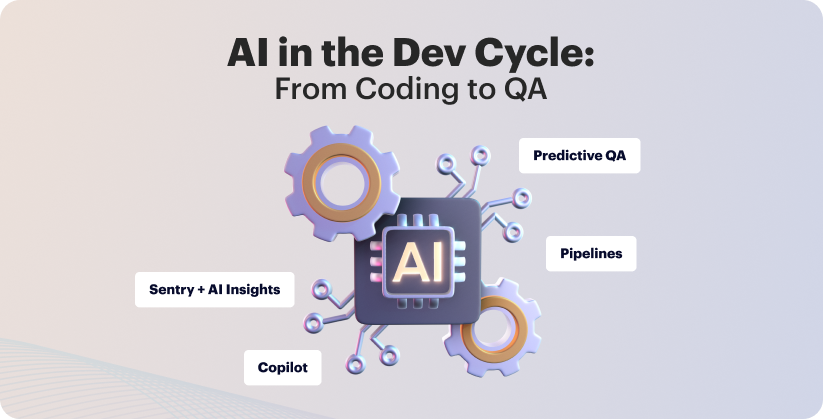
Implementation workflow
Scalability entails being aware of how AI may affect their current development process and technological stack. It entails dealing with the issues that will come up, like data reliance, AI-generated code maintainability and debugging, and security threats.
Businesses ought to think about drafting a plan for implementing AI in software development. This roadmap outlines how to manage data privacy, regulatory compliance, and security in this new mode of operation, as well as how to upskill their developers to become platform engineers.
Without having to make significant investments in internal infrastructure, outsourcing enables companies to access specialized eCommerce automation knowledge. Because outsourcing firms frequently have firsthand knowledge of the newest frameworks and tools, businesses can benefit from innovative solutions without having to navigate a challenging learning curve. In short, it speeds up creativity.
Practical Examples
Leaders in global eCommerce are using AI into their development processes and producing quantifiable results. Walmart reduced the amount of time spent on manual quality assurance by 40% and shortened the release cycles for upgrades to their digital storefronts from two weeks to three days by implementing testing and code review AI software tools.
Developer velocity increased by 35% and post-release defects decreased as a result of eBay’s integration of AI-powered code intelligence throughout its repositories, which automatically identified superfluous functionality and optimized legacy modules.
Beyond eCommerce, here are two well-known instances of leading businesses that successfully incorporated AI into their operations:
- Microsoft: Reduced lengthy testing cycles and streamlined quality assurance by integrating AI into QA processes.
- Sigma Solve: To integrate AI-assisted deployment and predictive analytics, they collaborated with a logistics software company. They thereby increased delivery speed by 25% and decreased operational errors by 40%.
AI’s influence on software development is growing as the use of AI-assisted development keeps growing. Many businesses began looking to hire ChatGPT developers when the trend gained traction, but ChatGPT is not the only application of AI in the future.
Emerging AI-driven technologies are now poised to advance the sector by providing new instruments and techniques that improve accuracy and productivity.
Key Takeaways
This AI development case study shows how incorporating AI into the B2C development lifecycle may improve scalability, compliance, and code quality while reducing manual coding and testing overhead and delivery delays by up to about 30%. Intelligent CI/CD pipelines, AI copilots, automated testing, and predictive QA are just a few examples of how forward-thinking eCommerce teams are changing the definition of high-performing, safe, and quick development.
Our specialty at Stellar Soft is creating AI-augmented development environments that help companies cut expenses, scale more intelligently, and reduced development time to market.
Let’s discuss how we can assist your team in utilizing AI to build more effectively. To begin, get in touch with Stellar Soft right now.