
Last Updated | October 7, 2025

Team expansion isn’t very helpful because this strategy is hard to scale.
The reasons AI customer support by using AI chatbots and virtual assistants have become essential for retail firms, which features have the biggest effects, and how they might improve the consumer experience will all be covered in this article. We’ll also discuss recommended practices and what distinguishes high-performing conversational AI commerce systems from those that only respond to simple inquiries.
What are AI chatbots and virtual assistants?
Chatbots are your specialized, knowledgeable conversationalists. They are excellent at doing particular duties in a particular field. Serving as virtual representatives, live chat vs chatbots are ready to respond via text or voice to often asked queries, help clients, or speed up the purchasing process. Imagine that a representative is available 24/7 through your website or messaging app, ready to provide you with a response time improvement to any questions you may have.
Think of virtual assistants (VAs) as multi-talented wizards who serve as your personal concierge. Instead of limiting them to only talking, ask them to manage a wider variety of duties. These clever virtual assistants eCommerce are adept at making proactive suggestions according to your preferences. Your life is slightly easier when you have a virtual assistant at your disposal, giving you the assurance of having a very well-organized PA.
Because chatbots and virtual assistants have so many amazing functions, most people are left wondering how these technical wonders operate. They make use of ML, NLP, AI, and NLU. Because of the technologies that enable them to understand context, comprehend human language, and learn from interactions, they possess extraordinary intelligence and adaptability.
Benefits of chatbots in eCommerce customer support
Chatbots in eCommerce may greatly boost conversion rates by offering tailored product recommendations based on past purchases and browsing behavior. Regardless of the level of website traffic, chatbots guarantee that every customer receives prompt attention during the busiest shopping seasons. In this manner, companies reduce the amount of sales they lose as a result of preventable consumer annoyance. Additional advantages of AI-powered chatbots for superior AI customer support include the following:
Availability and instant responses
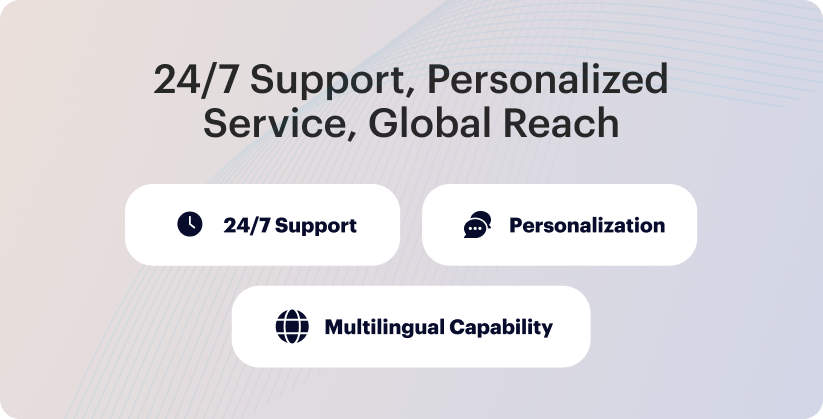
Fast and simple service is what customers demand, especially during busy times. Wait times are eliminated with immediate assistance when bots take over the initial interaction. Chatbots for online stores may offer worldwide, round-the-clock assistance whenever it’s most convenient for the client because they never sleep.
AI agents are used by retailers to offer round-the-clock assistance to foreign clients who might require assistance outside of usual business hours. Customers can find information on their own or obtain answers to frequently asked questions in a matter of minutes with these sophisticated, 24/7 customer support bots. They have observed improvements in initial resolution time and customer satisfaction since deploying a chatbot.
Personalized recommendations
AI-powered chatbots can provide individualized experiences by utilizing pertinent data when they are coupled with other business systems, such as your CRM, marketing automation software, or AI customer support tool. Here are few instances:
- Modifying messaging to align with the stage of their client journey
- Providing details about new goods or services
- Giving an order’s status without requesting order details
Although customers are aware that bots gather personal information, they prefer that it be used to improve customer experience. Integrating human-centered AI into your customer service operations makes the process simple.
Handling high-volume requests
Chatbots reduce the workload of agents by intercepting and rerouting possible support tickets. They help clients discover the information they require by managing repetitive chores, answering general inquiries, and providing self-service options. This enables agents to concentrate their knowledge on intricate problems or requests that call for a personal touch.
Depending on a company’s industry, product, or service, these requests might take many forms, but typically consist of:
- Providing tracking details and order status
- Providing product information
- Getting input
Chatbots drastically lower ticket volume by automatically answering these common questions, freeing up your human agents to focus on more complicated client issues that need individualized care.
How virtual assistants enhance the shopping experience
People who choose to implement virtual assistants eCommerce for your company view them as versatile friends. They can help you by providing more than just task automation. Calendar management, appointment scheduling, reminder setting, vacation planning, and even smart home gadget control are all possible with AI-powered virtual assistants.
Voice-enabled assistants in online shopping
Voice-enabled assistants allow users to search for products, compare prices, and place orders using simple voice commands, eliminating the need for manual browsing or typing. This improves accessibility for users who prefer or rely on voice interactions and enhances convenience for multitasking shoppers, such as those ordering while driving or cooking.
They drive higher engagement and conversion rates by creating a more conversational, personalized eCommerce customer service automation. They can remember user preferences, recommend products based on purchase history, and offer real-time support, reducing cart abandonment and improving customer satisfaction. These assistants transform online shopping into a more personalized and efficient process, benefiting both consumers and businesses alike.
Multilingual support for global customers
Customers are no longer restricted to purchasing at nearby physical stores thanks to internet shopping. Since consumers can purchase goods from any location in the world, removing communication barriers is essential to providing a positive customer experience. Customers who speak different languages can receive multilingual service from chatbots.
Chatbots can either ask the user what language they prefer at the beginning of a session or use artificial intelligence to guess the language based on user input. Omnichannel customer support bots are able to converse via chat, text, or voice in a variety of languages. You may utilize AI in conjunction with multilingual chatbots to provide compassionate, people-centric responses to common inquiries and carry out basic operations in a customer’s preferred language.
Seamless integration with eCommerce platforms
Virtual assistants can connect with existing product catalogs, CRM systems, payment gateways, and customer engagement tools, allowing shoppers to complete their entire journey through a single voice interaction. This integration ensures that product availability, pricing, and promotions are always up to date, improving operational efficiency.
For retailers, this seamless connectivity means they can extend their existing digital ecosystem without rebuilding their infrastructure, leveraging APIs and AI frameworks to embed voice capabilities into websites, apps, and IoT devices. Customers enjoy a unified eCommerce customer service automation experience whether they’re shopping via smart speakers, mobile apps, or web browsers, while businesses gain real-time insights and consistent branding across all touchpoints.
Implementing Chatbots in eCommerce
To optimize customer satisfaction and corporate return on investment, using the AI chatbots in eCommerce calls for careful planning and execution. Success hinges not only on selecting the appropriate technology but also on adhering to tried-and-true procedures that guarantee your chatbot provides smooth, customized interactions.
The following advice will help you create an eCommerce chatbot:
- Specify objectives and use cases. Establish the goals of the chatbot, such as increasing sales, improving customer service, or getting feedback. Setting clear objectives aids in identifying key components and determining development priorities.
- Recognize your audience. Do extensive study on the technical comfort levels and preferences of your target audience. The expectations for interactions differ by demographic. While older users might prefer more structured, in-depth responses, younger viewers might prefer brief, casual discussions.
- Have easy-to-understand conversations. Create simple conversation flows with language that is clear and succinct. Customers should be guided through interactions using logical, simple paths rather than being overloaded with options.
- Learn the most popular questions. Create a comprehensive knowledge library that addresses frequently asked questions by customers on refunds, shipping, and merchandise. This demonstrates a dedication to providing exceptional customer service while saving time for both clients and support workers.
- Choose between purchase and growth. Choose between working with a specialized vendor, purchasing an off-the-shelf platform, or developing your own solution. More flexibility and control are possible with custom creation, but it also requires a significant investment of time and technical know-how. Though pre-built solutions reduce customer service costs and deploy faster, their customization is limited.
Prior to starting an AI chatbot project, it’s critical to identify the essential functional personalization in eCommerce requirements. Building a solution that is not only technically sound but also in line with customer expectations and corporate objectives is made easier by taking these strategic factors into account.
Future Trends of AI in eCommerce Support
Virtual assistants will be able to comprehend not only what clients are saying but also how they feel thanks to emerging AI-driven sentiment analysis and predictive engagement models, which will enable more sympathetic and contextually aware responses.
Artificial intelligence chatbots, for instance, can identify urgency or dissatisfaction in a user’s tone and will automatically prioritize escalation to AI-powered virtual agents or provide proactive answers. By transforming customer service from reactive problem-solving to proactive help, this degree of intelligent contact will increase brand loyalty and confidence.
Businesses’ post-purchase and backend activities will be revolutionized by autonomous AI agents. While AI-driven analytics will continuously track encounters to find service gaps and training opportunities, these agents will handle returns, refunds, and customized follow-ups automatically. By integrating generative AI, FAQs, manuals, and quick responses may be created dynamically, increasing accessibility worldwide.
Conclusion
Chatbots and virtual assistants driven by AI are now required. In eCommerce, they are the new norm for providing prompt, astute, and customized help.
At Stellar Soft, we assist companies in creating and deploying AI-powered chatbot and virtual assistant solutions that improve customer satisfaction and support operations. Our team can help you from planning to deployment, whether your goal is to increase global reach, improve engagement, or expedite processes using multilingual support in eCommerce and voice-enabled assistants.