Last Updated | June 4, 2026

The most vocal supporters of this commerce model cite a variety of reasons for establishing a headless architecture, including substantial increases in site performance and unprecedented agility to make changes on the fly. On the surface, going headless sounds like a no-brainer, right?
Headless commerce provides marketers with complete creative freedom while also allowing developers to create bespoke eCommerce experiences using their composable commerce tech stack. However, implementing a headless architecture is not as simple as it may appear. So you need to understand what it means to go headless. We’ll also walk you through the basics of headless architecture.
What Is Headless eCommerce?
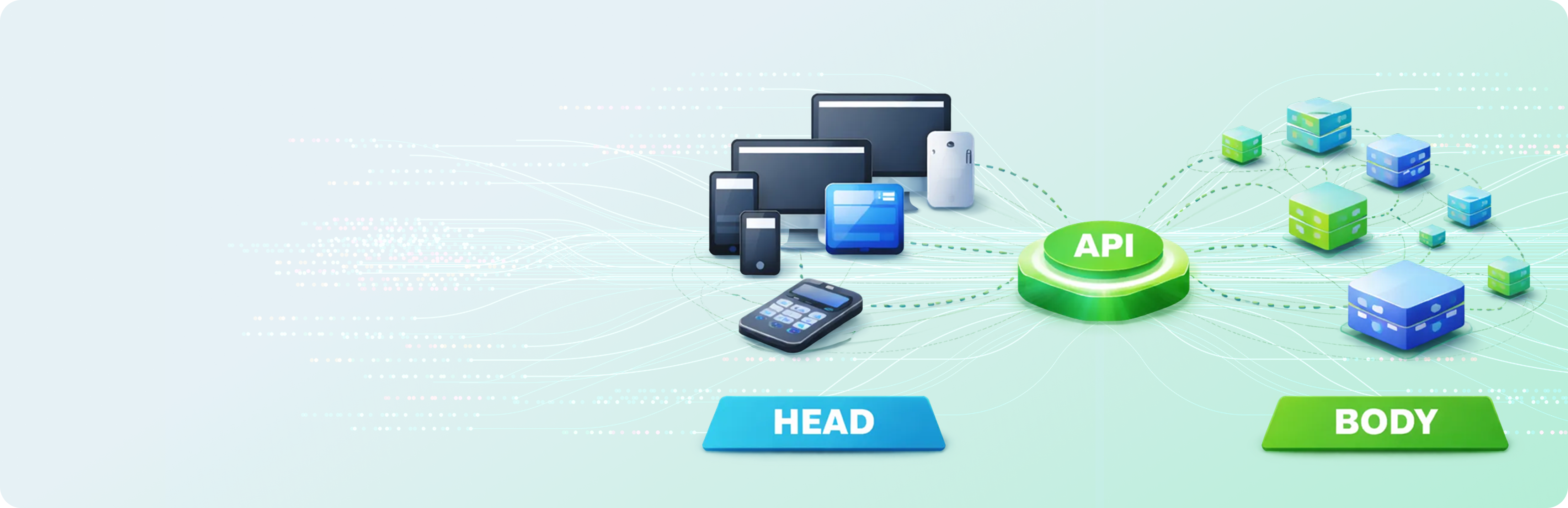
In general, headless eCommerce is an architecture that separates the customer-facing “head” from the “body” (back-end, or structural logic), allowing for complete freedom to create unique shopping experiences on any device (web, app, IoT) via APIs without being tied to a rigid platform, making it flexible, fast, and omnichannel-ready for changing customer demands.
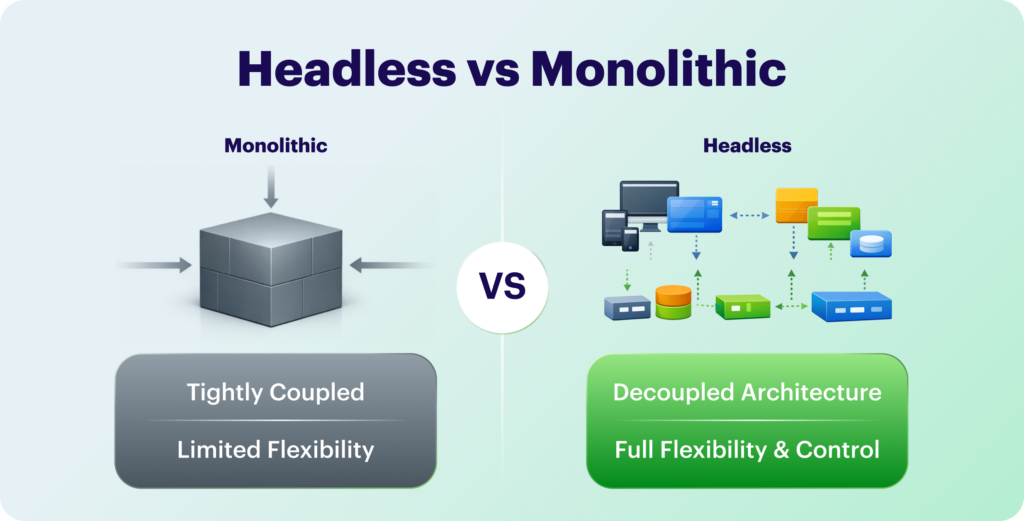
A monolithic design is based on a single codebase, which means that any changes made to the front-end have an immediate impact on the back-end. This implies that connections with social media platforms or other third-party vendors may not be fully compatible with the rest of your eCommerce experience. In other circumstances, you may be unable to make the desired changes to the front-end of your monolithic system due to back-end restrictions.
Unlike a monolith, a headless commerce architecture allows you to modify front-end features like the user interface or design without affecting the back end. This decoupling can give you a much clearer path to designing custom eCommerce store experiences that are dynamic, performant, and scalable as your business expands.
Advantages of Headless Architecture in 2026
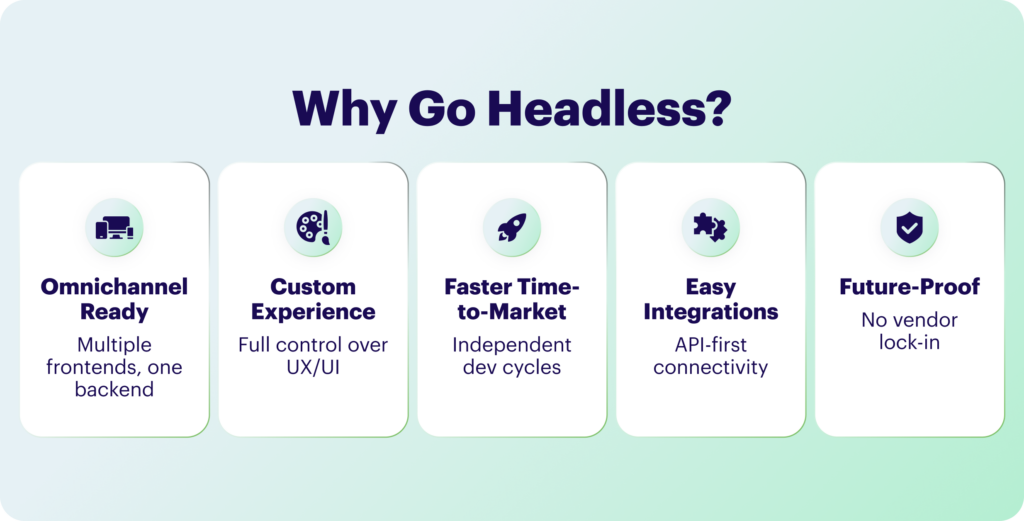
How much of the purchasing process should you manage yourself? That’s headless vs. theme-first. In 2026, eCommerce theme reliance is rarely a one-size-fits-all decision.
Developers are eager to go headless because it provides a high level of development control and allows them to combine tech stacks with their preferred best-of-breed commerce tools.
- You can design several front-end experiences for various customer touchpoints. Your online, mobile, voice, and point of sale (POS) front-ends may communicate with a single backend system via the API eCommerce layer, allowing companies to expand globally.
- On the backend, you can leverage fine-grained services to suit your brand’s complicated operational requirements. Because your technology stack is modular, you can easily integrate headless CMS, CRM, or DXP. There is also no vendor lock-in, allowing you to switch between different services as your needs evolve.
When does building a headless commerce architecture make sense? When your buyer experience resembles a custom internal application rather than a standard storefront, decoupling your front-end is the best course of action.
Headless for Magento and Shopify Stores
For many brands, the headless conversation starts with the platforms they already use most – Magento (Adobe Commerce) and Shopify / Shopify Plus. Both platforms support APIs and modern developer tooling, which makes them natural candidates for a gradual move toward headless.
On Magento, headless is often used to overcome limitations of heavy, legacy themes and long deployment cycles. A decoupled React or Vue storefront (for example, via Magento PWA Studio or a third-party PWA framework) can dramatically improve page speed, Core Web Vitals, and mobile UX without replacing the entire commerce engine. This approach is especially relevant for merchants with large catalogs, complex pricing rules, or multi-store setups.
On Shopify, brands usually consider headless when a standard Liquid theme can no longer support the level of customization they need. Using Hydrogen or another custom frontend, teams gain more control over layout, content, A/B testing, and performance, while Shopify remains the stable transactional backend for products, orders, and payments.
In both cases, headless does not mean “abandon Magento or Shopify.” Instead, it allows you to keep a proven commerce core while upgrading the customer experience layer. That’s why many mid-market and enterprise merchants view headless Magento or headless Shopify as a way to extend the life of their current platform, rather than a full replatform from scratch.
Custom Shopping Experience and Full Control
With a headless design, the decoupled user interface is completely customisable. Multiple, tailored front ends can be designed for various channels and audiences. You can create your storefront with whatever technologies, tools, and frameworks work best for you. This enables you to provide fully tailored purchasing experiences for various audiences.
Headless commerce can offer a personalized experience to each type of buyer. To satisfy buyer preferences, you can add custom functionalities as well as change content and the purchase experience.
Lessen Time to Market and Targeted Scalability
With the front end and back end segregated, developers may work on website features and enhancements individually before launching them. This enables businesses to integrate new features more quickly without having to worry about the impact on other portions of the website.
To boost performance, add more frameworks, codebases, and other front-end resources. For B2Bs that wish to provide totally separate front-ends for different customer bases, a headless solution allows them to manage everything from a single unified back-end, easing operations and workflows. Resources may be scaled independently, providing for a more agile and flexible reaction to expansion and rising client demand.
Integratable with Preferred Tools and Services
When your store uses a headless architecture, you have the ability to interface with your existing systems via APIs. ERP, CRM, IMS, WMS, and PIM are some examples of such systems.
Integratable with Preferred Tools and Services
Headless architecture makes it easy for your store to connect with existing business systems through APIs. This includes ERP, CRM, IMS, WMS, PIM, and other tools that support your operations.
When these systems work together, they simplify workflows and keep your data consistent across every channel.
Here’s how these integrations typically help:
ERP integration
Connecting your store with an ERP keeps product information up to date in real time and ensures accurate stock levels across every storefront. It also streamlines order routing and fulfillment, adapting to customer preferences and giving shoppers clear information about their orders.
CRM integration
A CRM gathers customer data from all touchpoints, helping your team provide more personalized service. It becomes easier to tailor product suggestions, run targeted marketing campaigns, and give support teams the details they need to assist customers quickly.
PIM integration
A PIM system keeps product content consistent across all your sales channels. It helps maintain accurate descriptions, technical details, and attributes, which is especially important for large catalogs. With cleaner data, you can also deliver more relevant product recommendations.
Aside from those three major integrations, a headless strategy enables businesses to connect with advanced third-party technology such as chatbots, voice assistants, and AI tools. It adds up to a modern customer experience, regardless of how many different types of clients you have.
Real-World Use Cases and Brands Using Headless
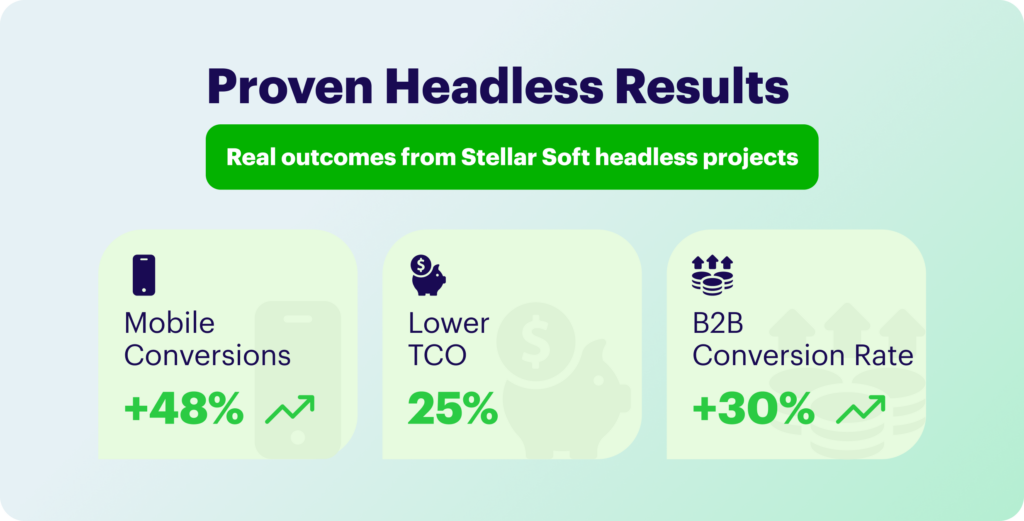
Both Stellar commerce scenarios demonstrate the revolutionary power of headless and microservices architectures, whether they improve a consumer-facing marketplace or modernize industrial B2B procedures. Key themes include divorcing frontends from legacy backends, incorporating AI for customisation, and developing future-proof systems.
The technical approach used during the project included the following methods:
Headless backend separation and API layer
We decoupled the storefront from the legacy monolithic platform and introduced a dedicated API layer based on REST/GraphQL.
This allowed product catalogs, pricing, account data, and checkout flows to be delivered independently to any frontend (web, mobile, or native apps).
PWA storefront built with React / Vue.js
A new Progressive Web App storefront was developed using React (or Vue Storefront – в зависимости от твоего реального стека).
Pages are rendered dynamically, with only essential data fetched on demand. This improved initial load times, helped achieve a mobile-first UX, and reduced server load during peak hours.
Image optimization and performance tuning
We implemented lazy loading, WebP image formats, CDN delivery, and dynamic compression – critical for a cosmetics marketplace with large visual assets.
This improved Core Web Vitals and increased mobile conversions.
Search, filtering, and personalization enhancements
An improved search and filtering engine (ElasticSearch / Algolia / Meilisearch – выбери что вам подходит) was added to handle:
- typo-tolerance
- fast autocomplete
- filtering by shades, brand, skin type
- personalized ranking based on browsing behavior
This made product discovery faster and more accurate, especially on mobile.
Scalable architecture for high traffic
The backend and storefront were deployed using cloud-native hosting (AWS / GCP / Vercel), enabling automatic scaling during promotional periods or new product drops.
This solved the previous performance bottleneck caused by traffic surges.
Integration with mobile apps
Instead of maintaining two separate native applications, we implemented a unified API that feeds the PWA storefront and both Android/iOS apps.
This reduced development overhead and improved consistency between platforms.
Mobile conversion rates rose by 48% thanks to PWA performance and AR features. Real-time, AI-powered product suggestions improved CX at scale. Integration with Amazon Payment Services and logistical systems made checkout and fulfillment easier.
The role of headless PWA architecture in connecting legacy systems with modern, mobile-first user experiences while allowing for ongoing innovation and customisation.
Microservices-Based Digital Transformation in Industrial B2B (Rewritten Case Study)
A German industrial manufacturer of gas-analysis equipment needed a full eCommerce overhaul. Their legacy platform relied on manual order handling, disconnected data sources, and a monolithic store that could no longer support modern B2B requirements such as multi-warehouse inventory, account-level pricing, and automated customer operations.
The goal was clear: build a scalable, API-driven B2B storefront that supports automation, real-time data flow, and global expansion.
What We Delivered:
Digital Transformation Roadmap
We began by mapping the existing digital ecosystem: data flows, customer journeys, order lifecycle, and operational bottlenecks. Based on this audit, we created a strategic roadmap and a Work Breakdown Structure (WBS) outlining recommended technologies, architecture changes, and implementation phases.
Migration to a Composable Commerce Architecture
We rebuilt the store on commercetools (MACH architecture) – a microservices-based, cloud-native, API-first commerce platform.
This allowed the client to:
- decouple frontend and backend systems
- scale individual services without affecting the entire system
- reduce deployment risks
- quickly introduce new digital features
SAP ERP Integration
We established real-time two-way synchronization between the new storefront and the client’s SAP ERP.
This integration enabled:
- precise multi-warehouse inventory
- automated order creation and routing
- synchronized pricing and customer-specific terms
- consistent product data across all sales channels
UI/UX Overhaul
We redesigned the navigation, catalog structure, and account dashboards based on behaviour analytics from real B2B buyers.
The new UX improved:
- product discovery speed
- time-to-order
- repeat purchase rates
- error rates in order placement (dropped by 22%)
AI-Driven Search & Product Discovery
We implemented Algolia to support:
- tolerance for misspellings (critical for technical SKUs)
- dynamic ranking based on user behaviour
- personalized search suggestions and frequently purchased items
- faster filtering for complex product attributes
This significantly reduced search friction for B2B procurement teams.
Business Impact
After the rollout, the company moved from outdated manual workflows to a modern, automated digital commerce system. Measurable results included:
- 25% reduction in total cost of ownership due to microservices and cloud infrastructure
- 30% increase in B2B conversion rate thanks to UX improvements and enhanced search
- real-time visibility into orders, pricing, and stock across all business units
- faster onboarding of new international markets due to modular architecture
- significant drop in operational errors thanks to automated data synchronization
This transformation equipped the manufacturer with a future-ready, flexible B2B commerce platform capable of supporting industrial-grade processes, multi-market expansion, API integrations, and advanced customer workflows.
The new microservices architecture gives their teams the ability to innovate quickly, while ERP integration ensures stable day-to-day operations. Together, this creates a long-term technical foundation for scaling their digital business globally.
Is Headless eCommerce Right for Your Business?
If your store runs smoothly on a traditional architecture and you’re not struggling with performance or flexibility, switching to headless may not bring enough value to justify the investment. Everything depends on your long-term goals and how fast you want to innovate.
Many companies start considering headless after facing a similar set of challenges. For example, their current platform may be stable, but every new feature becomes a slow and complicated process. Competitors might be moving faster simply because they can update the frontend and backend independently.
Some businesses start noticing that customers expect quicker, more polished shopping experiences across all devices, yet the existing system cannot deliver that speed or level of control.
Others hit personalization limits – templates, themes, and built-in settings stop allowing further growth.
And in more advanced cases, brands want to experiment with new retail formats such as smart mirrors, wearables, in-store devices, or automated vending commerce, but their current platform cannot support these ideas.
Before moving to a headless setup, it’s important to evaluate the costs and the time commitment. Enterprise-level projects vary significantly, ranging from hundreds of thousands to several million dollars depending on integrations, customization, and architecture.
If the challenges above resonate with your situation, it may be a good moment to consider a headless approach. Stellar Soft can audit your existing system, propose an optimal architecture, and build a practical roadmap focused on performance, personalization, and measurable ROI.