
Last Updated | October 28, 2025

In 2025, it outlines how companies draw in, win over, and keep consumers. The ideas underpinning these technologies, which range from AI bots performing tasks to massive language models driving consumer interactions, are influencing how companies expand.
eCommerce executives should focus more on comprehending these AI ideas than on technical expertise. It’s a strategic realization. Teams that just experiment with AI in eCommerce are rapidly falling behind those who create AI-driven infrastructures. Understanding the basics enables brands to customize experiences, modify consumer journeys, and maintain competitiveness.
More than just the AI eCommerce trends 2025 are broken down in this article, along with their practical applications. Whether you’re interested in automating marketing, improving customer service, or creating scalable coding workflows, these ideas are the cornerstone of the upcoming expansion.
Current State of AI in eCommerce
Even while AI is widely seen as being essential to the future of eCommerce, the majority of businesses have only just begun to implement it. According to a recent analysis by the Harvard Business Review Analytic Services:
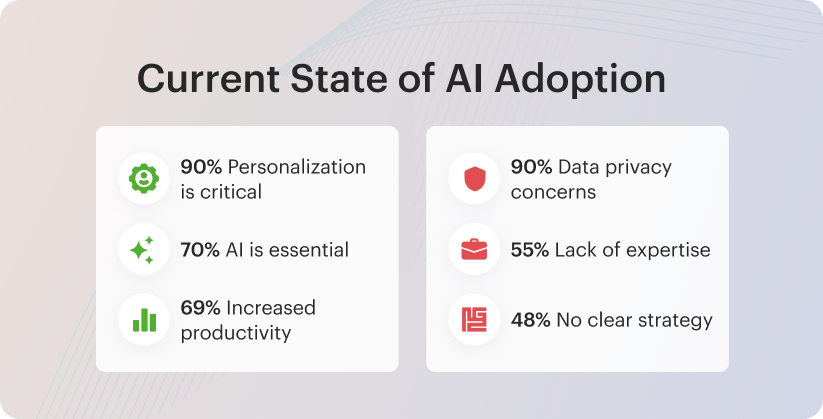
- Personalized experiences are now crucial, according to 90% of eCommerce executives.
- 70% of people think it’s crucial to use AI in eCommerce.
- 69% of companies that now use AI report increased productivity and speed.
But the study also identifies important obstacles to adoption:
- 55% say that one of the biggest challenges is data privacy.
- 49% of organizations suffer from a lack of AI knowledge.
- 48% are unable to grow AI initiatives because they do not have a clear AI strategy.
These difficulties highlight the disconnect between goals and implementation, which will widen as AI in eCommerce transforms the market.
Key AI trends shaping 2025
AI eCommerce trends 2025 has nearly always been in the news, in part because of how it is portrayed in the media and in part because of the hype around it. According to reports, the technology is contributing to a 15% rise in retailer revenues. This implies that there is a large body of research and publications that show how it has grown. Read in-depth about the main themes in AI.
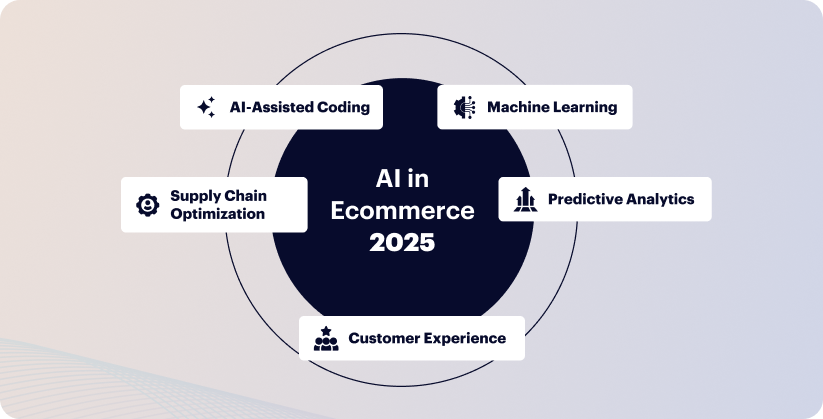
Fundamental Trends
Supply chain optimization is one of the most significant short-term uses of AI in retail. Data science-powered AI-driven predictive models are anticipated to improve demand forecasting, inventory management, and customer happiness while streamlining operations. These developments may result in improved customer experiences for businesses that have invested in CRM and marketing automation by facilitating a more smooth transition between marketing initiatives and product availability.
AI-Assisted Coding
Apart from integrating AI with operations, teams now also apply AI directly to software development. Coding AI tools, like GitHub Copilot and CodeWhisperer, enhance the speed of coding, providing optimization suggestions and reducing the chances of human error. This ensures development speed and gives businesses an initial competitive edge in adopting AI-driven methods
Machine Learning (ML)
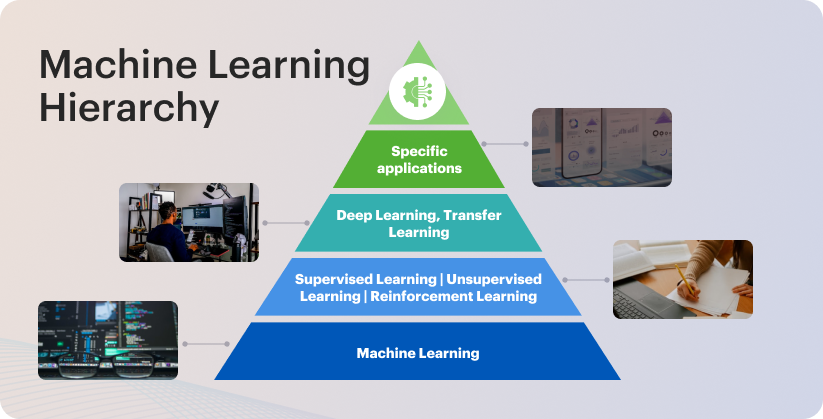
The foundation of artificial intelligence is ML algorithms, which allows systems to learn from past data and forecast future events. Features like recommendation engines (such as “Customers who bought this also bought…” on Amazon) are powered by machine learning in the eCommerce industry. Businesses looking for predictive analytics in consumer behavior are increasingly expected to use machine learning.
Deep Learning
Deep learning is a branch of machine learning that processes complicated input, like voice or images, using multi-layered neural networks. Deep learning is used by retailers such as ASOS and Zalando to increase the accuracy of visual searches and automate product categorization.
Supervised Learning
Labeled data with known results is used to train a model. A fraud detection system educated on previous transactions classified as “legit” or “fraud,” for instance. To lower chargebacks, Shopify businesses employ supervised models in fraud analysis apps.
Unsupervised Learning
Algorithms that analyze unlabeled data for patterns. This is used in AI retail to segment customers and find hidden groups like “one-time discount hunters” or “high-value repeat buyers.” Advanced customisation techniques are driven by unsupervised learning.
Reinforcement Learning
Trial-and-error learning with incentives for wise choices. This is the idea behind dynamic pricing engines, which change prices in response to inventory, demand, or rivals’ prices. Two well-known adopters are Uber and airline platforms.
Transfer Learning
AI speeds up learning in one area by reusing knowledge from another, rather than starting from blank when building a model. For instance, time and computation can be saved by fine-tuning a vision model that was trained on general objects to recognize particular fashion items.
Training Data & Datasets
The quality of the data is crucial. Recommendations will be prejudiced if a dataset is biased (for example, underrepresenting a demographic). As an illustration of the significance of openness in training sources, Stability AI was criticized for using biased datasets in Stable Diffusion.
Architectural Trends
It will take more than simply technological advancements to increase confidence in AI. Governments and private businesses will probably need to work together to develop moral guidelines and legal frameworks that take these dangers into account. Some problems might go away as AI models get better and costs come down, while others will need systemic fixes.
Generative AI
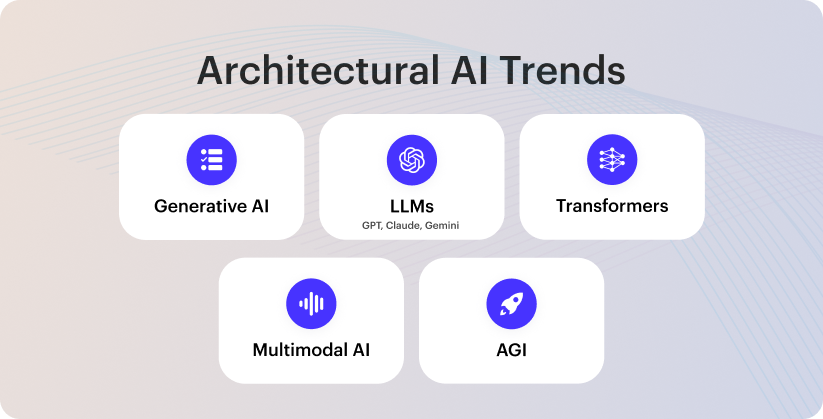
New content is produced by generative models. AI-generated ad graphics, product descriptions, and even 3D materials are being tested by brands. Customers collaborated to produce artwork as part of Coca-Cola’s Real Magic campaign using generative AI.
Large Language Models (LLMs)
GPT-4, Gemini, and Claude from Anthropic are examples of massive models that can compose copy, respond to inquiries, and help with customer support. LLM AI shopping tools like Sidekick AI, which assist merchants in managing their stores, have already been incorporated into Shopify.
Transformers
It was the architecture that enabled LLMs. Transformers, which were first presented in Google’s “Attention is All You Need” paper in 2017, are the reason why modern models are able to interpret lengthy client questions with contextual correctness.
Multimodal AI
Text, image, video, and audio input are all processed simultaneously by these models. TikTok and Pinterest are early adopters that use both textual and visual data to propose content. This drives “search by image” functions for eCommerce (e.g., upload a shoe photo → find comparable products).
Artificial General Intelligence (AGI)
AGI, which is still theoretical, would refer to an AI system that can perform every intellectual task that a person can. Companies like OpenAI and DeepMind are aggressively working toward this horizon, even though it is not yet here. AGI is less important to AI retail leaders now, but monitoring its development helps with long-term strategic planning.
How businesses benefit from AI adoption
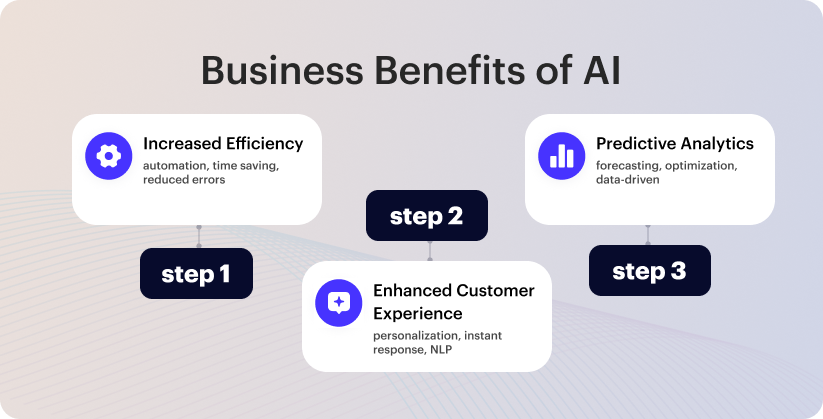
The broad applications and advantages of AI in eCommerce development doesn’t stop at automating repetitive tasks (e.g., generating code drafts or snippets, extracting data), personalizing customer targeting and message conveyance, etc. These are even more specialized applications of AI that are already being used by numerous companies.
Increased Efficiency
AI increases efficiency in a variety of corporate operations by automating repetitive tasks. For instance, data entry takes a lot of time and is not the most efficient use of a qualified professional’s time. It’s also vulnerable to human error when done by hand. When data in one system changes, AI shopping tools can automatically update the data in connected systems and receive notifications.
Even handwritten documents can be scanned by certain AI-enabled devices, which can then store the content for editing. Some contemporary electronic health record (EHR) systems used by healthcare organizations have this feature. For the benefit of the patient, medical professionals, and insurance companies, AI makes sure that both digital and handwritten records are consolidated in one location.
Enhanced Customer Experience
Regardless of the type of question they have, customers expect businesses to remain open around-the-clock. But it’s not always feasible to respond to every question right away. Here’s where AI can be useful. Many client inquiries can be handled by chatbots and automated emails because of natural language processing (NLP) and natural language generation (NLG).
By responding to every social media comment in real time, brands can elevate their customer service to a new level. By using NLG, AI can also quickly respond to emails or messages and provide a highly customized experience.
Predictive Analytics
A subfield of advanced analytics known as predictive analytics makes use of statistical algorithms, machine learning methods, and historical data to determine the probability of future events. By making it possible to swiftly and precisely analyze big datasets and spot intricate patterns that human analysts might overlook, artificial intelligence (AI) improves predictive analytics. This gives companies the confidence to predict market shifts, foresee trends, and make data-driven decisions.
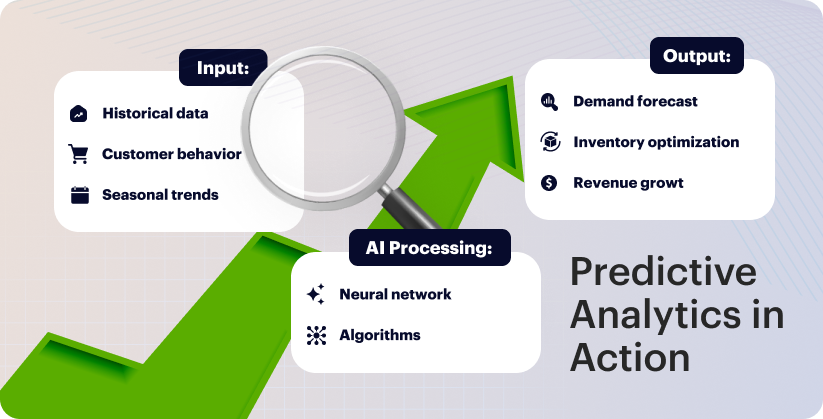
Think about a retail business that uses predictive analytics to control inventories. Artificial intelligence is able to forecast which products will be in great demand in the coming months by examining past sales data, consumer preferences, and outside variables like seasonal trends. By doing this, the business can minimize overstock and stockouts by optimizing stock levels. As a result, the business can lower expenses related to excess inventory, boost revenues, and enhance customer satisfaction by always having the proper products accessible.
Final Thoughts on Implementation
AI helps brands to move more quickly, customize more deeply, and function more intelligently. Examples of this include predictive analytics, intelligent automation, and huge language models that are changing the way developers work over commercial websites or software. The future phase of digital commerce, when intelligent algorithms inform every interaction, recommendation, and workflow, will be led by the companies that successfully convert AI principles into workable, scalable solutions.

Stellar Soft assists AI retail industry leaders in transforming these cutting-edge AI capabilities into practical applications. Our proficiency in data-driven programming, scalable automation, and AI integration guarantees that your store is not only staying up to date with innovations, but also establishing new benchmarks with initial AI-supported coding.
Are you prepared to adapt your eсommerce development approach to the AI era? Transform your digital operations into intelligent, growth-ready ecosystems by partnering with Stellar Soft. To begin creating the future of your internet business, get in touch with us right now.