
Last Updated | June 4, 2026

Software development cost 2026 will still be the primary means through which businesses will be able to gain access to innovations, flexibility, and long-term ROI.
This comprehensive piece will outline not only the true cost of custom software development but also a step-by-step guide, primary advantages, and case studies. Everything you need for making the best technology selection for your company will be provided to you.
Key Factors Influencing Software Development Cost
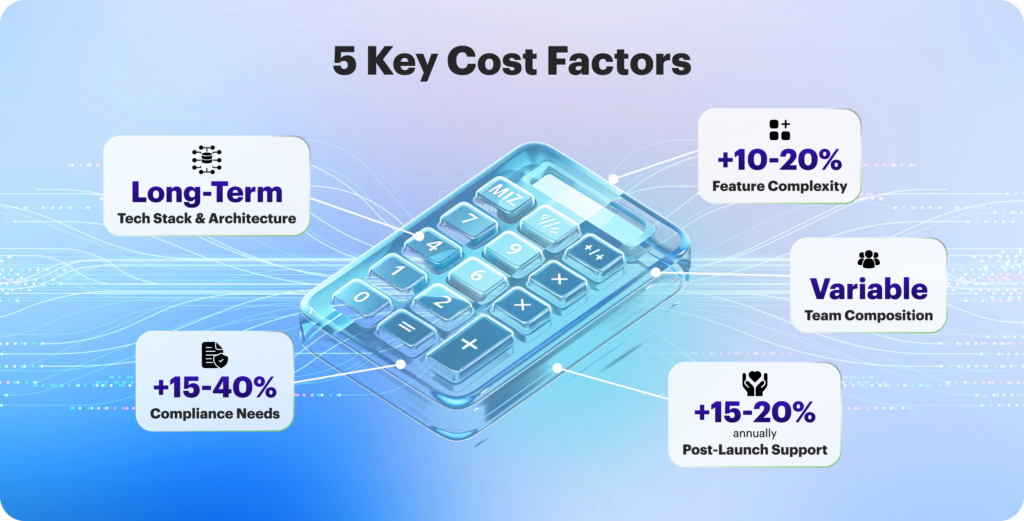
About 60-70% of the total budget is allocated to development directly. Still, the ultimate software development cost 2026 is not a straightforward reflection of the team’s hours worked. It varies with the product, the people, and the process. The main factors that determine the custom software cost are as follows.
1. Feature and UX Complexity
Adding any feature would mean more logic, testing, and edge cases to tackle. A straightforward booking process? Quite minimal. Then add multi-role dashboards, approval chains, and analytics. Your range (and budget) soon grows very large.
The same applies to design. Template-based user interaction is quite fast. Unique processes, dashboards, or components can indeed consume and to the extent that they offer functionality and how everything fits together the real motivator is the volume of design work.
That level of depth usually adds 10-20% to the total software project budget. What is the best way? First, get the essentials right. When your core functionality is up and running and people start giving feedback, it is a lot easier (and cheaper) to then expand from that.
2. Industry and Compliance Needs
Your environment determines how long it will take to meet security and regulatory requirements, with the most regulated or risky environment taking the longest (and getting the most testing). All the extra security and validation work takes about 15 to 40% more time than the standard testing scope at most.
If you are engaged in a highly regulated area, it is always advantageous to think of compliance and risk management early in the software development process rather than late when the product is almost finished.
3. Team Composition and Delivery Model
You can build your team in different ways — hire freelancers, assemble an in-house department, or work with an outsourcing partner. Each model gives you different levels of control, cost, and delivery speed, so the best choice depends on how your project is structured:
- an in-house team gives you the highest level of control and deep product familiarity, but it also brings the highest overhead: salaries, hardware, office space, and ongoing costs even during slow periods
- freelancers are usually the cheapest and most flexible option, especially for small, well-defined tasks, though you’ll spend more time coordinating their work and maintaining consistent quality
- an outsourcing company takes over both delivery and team management — you typically pay for development hours while getting a cross-functional team with structured processes, without committing to long-term employment costs
Seniority level is another factor to be reckoned with. Senior software engineers cost more on an hourly basis, but they can actually save you several weeks of redoing the work. We usually assemble teams that have the right mix of experienced, intermediate, and less experienced professionals.
The best configuration is defined by your objectives: speed, cost, and reliability do not always fit perfectly. Rather than concentrating on the hourly rate of the software developer, think of the worth you get for every dollar spent.
4. Tech Stack and Architecture
The development of tools and the establishment of the infrastructure will impact the custom software cost as well as the maintenance in the long run. The right technology stack selection is important, but the way you plan, screen, and run your project also plays a part in both cost and performance.
Common stacks like React, Node.js, Python, or .NET are liked by developers for their simplicity and for being a quick start, on the other hand, the professional techs like Rust, Elixir, or AI/ML are usually more expensive and time-consuming for the onboarding process.
The costs of operation are also determined by your configuration. A small application serving a couple of hundred users needs a little bit of cloud support compared to a very busy and data-hungry system. The recurring costs from third-party APIs (payments, analytics, or AI) may also rise with an increase in usage.
Consideration of architectural choices is important as well. A single monolith is quicker and cheaper to notice, but it is also very hard to extend later on. A modular or microservices-based architecture offers better scalability, but it also calls for a higher initial investment. The most favorable stack is one that is in harmony with the aspirations of the product, not what is trendy at the moment.
5. Post-launch Scaling and Support
When creating an app, the best outcome should be a bog-standard, fully operational, and fast product. This will encompass expenses for the cloud, monitoring of downtime, constant updates, fixing of problems, and technical support.
However, there are still a lot of teams that forget to allocate money for this item; nevertheless, it is usually around 15% to 20% of the initial annual expense. If you consider continuous support as a major factor of the product stabilizing, securing, and improving over time, then an MVP will turn out to be a long-lasting business.
Development Cost by Type and Region
eCommerce development costs increase with project complexity and system architecture. MVPs, or lightweight storefronts, custom software cost $50,000 to $100,000 and provide fundamental shopping functions, minimal integrations, and a semi-custom user interface. Scalable solutions ($100,000-$300,000) feature personalized UX/UI, modular or headless architecture, various integrations, and efficient infrastructure.
These ranges represent overall backend, frontend, API, QA, DevOps, and project management expenditures. Accurate project type classification promotes alignment with scalability, maintainability, and performance objectives, while minimizing scope creep and technological debt.
Europe vs USA vs Asia
Regional labor markets, hourly rates, and developer availability significantly influence software development costs. While exact pricing varies by project complexity, technology stack, and team seniority, several industry surveys highlight common cost patterns across regions.
- European development costs
According to multiple outsourcing market reports, Western Europe generally has higher average hourly rates than Central and Eastern Europe, largely due to labor regulations and higher operational overhead. In many surveys, the difference can range anywhere from 10% to 30%, though actual project totals vary depending on scope and required expertise. - United States development rates
U.S. engineering talent – especially senior full-stack developers and specialized eCommerce experts – tends to fall into the highest cost category worldwide. Many industry benchmarks indicate that U.S. rates may exceed Western European averages by 20% to 50% or more, depending on the specialization and market demand. - Asia and off-shoring regions
Numerous outsourcing studies indicate that development in Asia (India, Vietnam, Philippines, etc.) may be significantly more cost-effective, with project costs sometimes estimated 40% to 70% lower than in the United States. However, these savings vary widely depending on the provider, code quality, communication standards, and experience level – making careful vendor selection essential for complex or enterprise-grade builds.
Cost optimization in outsourcing necessitates weighing hourly rates against knowledge, while also assuring architectural rigor, modular design, and system performance. Strategic regional allocation, combined with rigorous vendor assessment, reduces risk while leveraging cost savings, allowing SMBs and businesses to complete large-scale eCommerce projects within established budgets.
Pricing Models: Fixed, Time & Materials, Dedicated Team
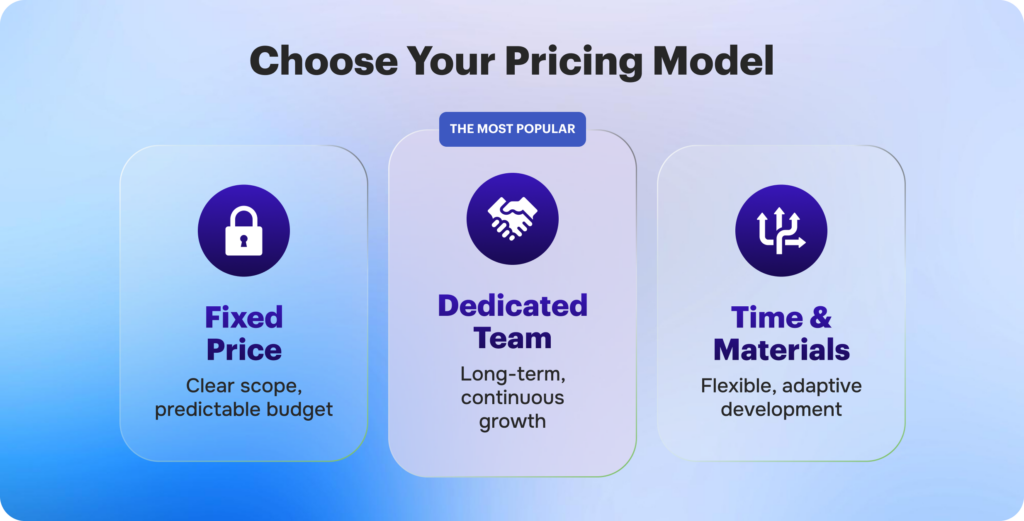
Where do you begin if you want to identify the best outsourcing vendor for your company or project? When looking through all of the different vendors, one of the first things to note is the business strategy used. Not all development pricing models are appropriate for your business or project. That is why, in this essay, we will go over the three main models to assist you find your match.
Fixed-price
A fixed-price model means the budget and deadline are agreed upon before the work begins. It works best when the project has clear requirements and a low chance of major changes.
Some practical advantages include:
- predictability – you know the total cost and delivery date from the start, so budgeting is easier
- clear expectations – the scope and timeline are defined upfront, reducing confusion later
- less day-to-day involvement – a project manager oversees the process and keeps everything on track
- great for smaller, well-scoped tasks where the feature set is already known and unlikely to shift
Time and Materials
The Time and Materials model works best when a project’s scope is likely to evolve or when it’s difficult to estimate the full workload in advance. You pay only for the hours and resources actually used, which keeps the process flexible and transparent.
Key advantages:
- flexibility – the team can adjust features, priorities, and workload as the project develops
- responsiveness – it’s easier to react to market changes or updates in your business strategy
- scalability – you can scale the team up or down depending on the current needs and budget
This model is ideal for long-term projects where requirements are expected to shift gradually and adaptability is essential.
Dedicated Teams
A dedicated team model provides you with full-time developers focused exclusively on your project, typically billed on a monthly basis. It works especially well for long-term initiatives where requirements evolve and continuity matters.
Key advantages:
- lower operational costs – recruitment, onboarding, and HR are handled externally, reducing your overhead
- better efficiency – the same team stays with the project, building familiarity and delivering faster, higher-quality results
- continuous development – it’s easy to scale the team, bring in specialists, or shift focus as the project grows
This model is the right fit for complex, specialized, or ongoing projects – particularly when your internal team lacks the bandwidth or specific expertise required.

How to Optimize Your Software Development Budget in 2026
To get the most out of your 2026 development budget, focus on disciplined planning, smarter resource allocation, and efficient execution. This means aligning every initiative with business value, leveraging automation where possible, and using flexible team structures such as blended or outsourced teams. Clear scoping, realistic forecasting, and long-term thinking help prevent overspending and keep projects on track.
Here’s what truly makes the difference:
- define value early – choose initiatives that have measurable ROI and support long-term growth, not just short-term fixes
- manage scope carefully – well-defined requirements at the planning stage help reduce unnecessary changes and avoid expensive rework later
- make ROI-based decisions – monitor performance throughout the project, use data to validate investments, and make sure each phase delivers real, trackable value
At Stellar Soft, we assist organizations in aligning strategy, technology, and resources to maximize ROI. From sketching MVPs and leveraging cloud or open-source solutions to designing scalable architectures and optimizing processes with AI and automation, our team makes every dollar work harder for your success.
Contact our specialists immediately to plan, prioritize, and carry out your 2026 development initiatives with confidence and efficiency.