
Last Updated | June 4, 2026

Unfortunately, a majority of companies believe that it is better to have more visitors and do not care about maximizing the value of those who come to their online store.
The reality is that business growth is driven by conversions, not by the number of visitors. Knowing how to raise your conversion rate is what turns visitors into customers and directly increases your income.
This post will talk about the importance of conversion rate improving. Along with that, there will be practical ways for you to increase it by means of effective eCommerce conversion rate optimization. We are going to guide you through every step of the process, so you’ll be able to apply it and steadily grow your business regularly.
Why Conversion Optimization Matters in 2026
CRO continues to evolve from a set of simple UI tweaks into a structured, data-driven discipline. The goal remains the same – increasing the share of visitors who take meaningful actions – but the way companies approach CRO in 2026 is far more sophisticated. Modern optimization relies on behavior analytics, UX research, and first-party data to help businesses focus not just on conversions, but on qualified conversions that bring long-term value.
Industry reports throughout 2025 showed a clear pattern: brands that moved beyond surface-level experiments (like button colors or headline swaps) saw much stronger, more stable results. The companies that performed best were those combining several methods at once – continuous A/B testing, behavioral insights, personalization, trust-building elements, and multi-step customer journeys.
Across these studies, one theme kept repeating: reducing friction and creating a more “human” experience drives the biggest gains. When pages load fast, navigation feels intuitive, communication is transparent, and recommendations are relevant, users are simply more willing to trust the brand. And because these improvements are guided by first-party data, teams can measure their impact accurately and scale what works.
This shift explains why CRO is so important in 2026 – it’s no longer about isolated quick wins, but about building a long-term optimization system that continuously increases revenue and customer lifetime value.
Analyzing Customer Behavior and UX
A plethora of eCommerce conversion rate optimization methods are mainly based on different figures such as percentages, averages, and benchmarks. Even though the conversion of visitors into buyers is the main target of CRO, it will not help you much if you only depend on numbers. The more time you spend looking at the spreadsheets that are filled up with data points and actions, the more you will overlook the people who are behind them.
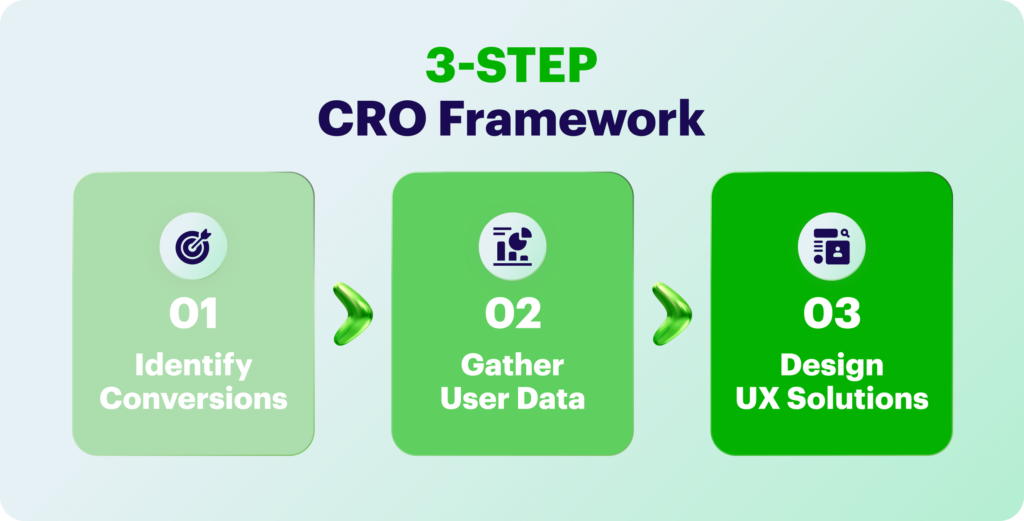
The people-centered strategy in the case of the holistic CRO eCommerce draws their attention and tries to find out what factors drive, what factors deter, and what factors convince them to buy. The very first thing that needs to be done is establishing a link between UX design and customer behavior.
Step 1: Identify Important Conversions
Conversions, or the specific actions you wish to see more users doing, differ from one business to another and are depending on your goals. If you are running an online store, a completed order could be considered a conversion.
When you have already specified the activity you want to focus on, you can enhance the rate at which visitors do it. To put it differently, ‘conversion rate’.
Step 2: Gather User Data
Once the significant drop-off points in the conversion funnel have been recognized, the next step is to start collecting a substantial amount of information about your users. This can be considered the most important stage in every user-centric CRO eCommerce method and you will find that not all the factors preventing conversions are measurable or evident.
When it comes to the final step, the conversion, focusing on that aspect is essential. Nevertheless, there is a lot going on before reaching that stage:
- some particular incentives attract users to your site
- some exclusive obstacles make them go away
- some unique appeals persuade people to take the action
On occasion, a problem is as simple as a lone bug hindering 80% of the users to carry out a required action. However, your site could be running perfectly, yet still, visitors do not convert. In this case, you will have to continue looking into the reason behind the data and concentrating on your users’ requirements, which is the essence of CRO.
Step 3: Design UX Around Customer Insights
Once the user data has been gathered, the next step will be to transform the identified drivers and barriers together with the tested hypotheses into UX optimization of great importance. User experience creations reflecting the up-to-date signals of demand, reduced friction, and smoothly conducted conversions are planned as the primary objective.
First and foremost, it is important to develop the user journey map. Display clearly each step from getting in touch to successfully converting and putting under each stage pain points, moments of friction, and delight. The user data you have collected can help you to point out places where users abandon, are stuck, or are not clear about the process.
After that, begin with the changes that will have the greatest impact on conversions. To illustrate, if surveys indicate that users abandon checkout due to shipping costs being unclear, do checkout optimization where the costs are to be displayed upfront in a very clear way. If statistics reveal that users frequently click on the wrong CTA, alter the button’s location, color, or text accordingly.
Always apply the core principles of usability when making UX decisions. A few fundamentals consistently help improve conversions:
- clarity – keep instructions straightforward and avoid unnecessary wording, so users immediately understand what to do.
- simplicity – remove steps, visual noise, or distractions that don’t contribute to the task.
- feedback – let users know what’s happening after they click, submit, or interact with an element, so they feel in control.
- consistency – use familiar patterns, similar layouts, and predictable behaviors across all pages to reduce cognitive load.
Wireframes or low-fidelity prototypes are suitable for testing new UX features in advance of their complete implementation. The intention is to make the design decisions based on the real user experience.
Top CRO Techniques That Work
CRO is more than numbers and analytics dashboards. The strongest results usually come from a mix of psychology, UX, and continuous testing. Here are a few practices that consistently move the needle:
- personalization helps shape content, offers, and messaging around what each user actually does on your site – their behavior, past interactions, and preferences; this creates a sense of relevance and usually lifts engagement and conversions
- trust elements reassure visitors that your brand is legitimate and safe to buy from; reviews, testimonials, security badges, certifications, and third-party mentions all reduce hesitation and make the next step feel easier
- fast loading pages keep people from dropping off; slow sites frustrate users and increase bounce rates, so optimizing images, using caching, and cleaning up code can have a direct impact on conversion rates
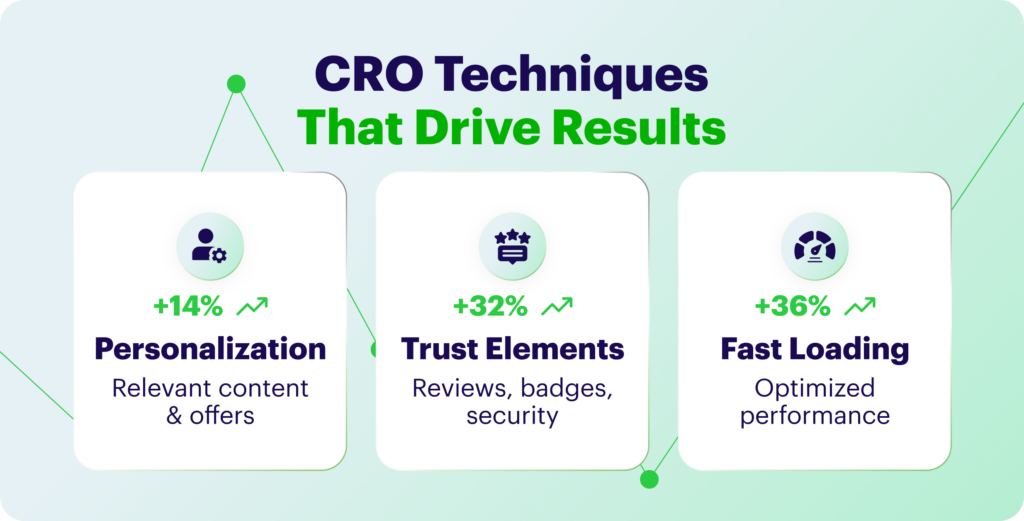
CRO isn’t something you set up once – it grows through testing, learning, and small, repeated improvements. Personalization, trust, and performance are the base, but the biggest gains come from analyzing how people behave on your site and refining the experience week after week.
Tools to Track and Improve Conversion Performance
To measure the efficacy of your CRO initiatives, you must use dependable techniques that provide both quantitative and qualitative data. Tracking user behavior and conversion metrics allows you to make more educated decisions about UX, content, and conversion funnel optimization.
1. Analytics Platforms
You can track traffic, page views, bounce rates, and conversions using tools such as Google Analytics, Adobe Analytics, and Matomo. They assist you in determining which sites work effectively, where users drop off, and how different traffic sources contribute to conversions.
2. Heatmaps and Session Recordings
Hotjar, Crazy Egg, and FullStory are platforms that visually demonstrate how users interact with your website. Heatmaps show which regions receive the most clicks or attention, whereas session recordings allow you to observe actual user journeys and identify friction points or confusing parts.
3. A/B and Multivariate Testing Tools
Tools such as Optimizely, VWO, and Google Optimize allow you to test numerous variations of pages, headlines, and CTAs to see which version generates the most conversions. Testing helps to validate hypotheses and avoids guessing in UX design.
4. Feedback and Survey Tools
Obtain direct user feedback using platforms such as Typeform, SurveyMonkey, or in-page widgets from Hotjar or Qualaroo. Understanding why consumers behave in specific ways allows you to identify hidden barriers and improve the overall experience.
5. Conversion Funnels and CRM Analytics
Using HubSpot, Salesforce, or other CRM-integrated technologies, you can track leads and conversions across the whole customer journey. Marketing touchpoints can be linked to boost eCommerce sales outcomes to uncover high-impact improvement opportunities.
You can develop experiences that organically direct visitors to conversion by reading your consumers, aligning UX with their behavior, testing hypotheses, and utilizing proven CRO approaches like customization, trust signals, and site speed. The key to success in 2026 is a data-driven, iterative approach that combines insights, action, and continual improvement.
Ready to convert more visitors into loyal customers? Stellar Soft commerce enables you to apply advanced CRO methods, optimize your eCommerce UX, boost eCommerce sales, and track performance with precision. Begin improving your website today. Book a demo or learn more about our solutions to increase conversions and drive long-term growth.
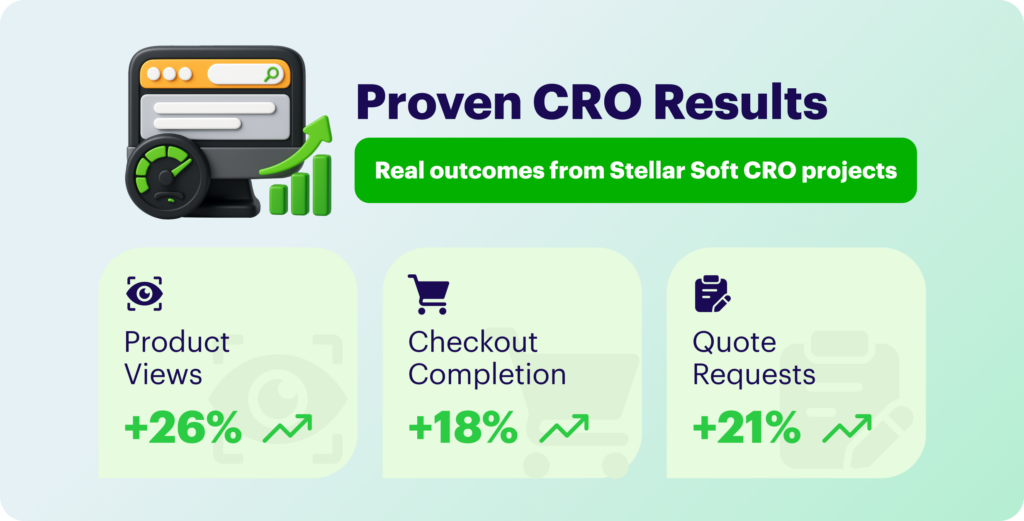
Real CRO Results: Examples from Stellar Soft Portfolio
Numbers and tools are useful on their own, but they become truly meaningful when tied to real projects. Below are a few snapshots from our CRO portfolio that show how analytics, heatmaps, testing, and UX changes translate into revenue and lead growth.
Fashion eCommerce – fixing product discovery on mobile
Using Google Analytics and Hotjar, we saw that mobile visitors were spending time on category pages but rarely opening product pages. Heatmaps showed that filters and size options were hidden too low on the page. After moving filters higher, simplifying the grid, and testing several mobile layouts, the store achieved:
- +26% increase in product detail page views
- +14% growth in add-to-cart rate on mobile
- lower bounce rate on key collection pages
Beauty subscription brand – checkout friction and trust signals
Session recordings and exit-intent surveys revealed that many users abandoned the checkout on the payment step because delivery time and return conditions were unclear. We redesigned the checkout to highlight shipping estimates, guarantees, and trust badges, then A/B-tested clearer CTAs and shorter forms. As a result:
- checkout completion rate grew by 18%
- overall subscription sign-ups increased by 12%
- support tickets about “where is my order?” dropped noticeably
B2B equipment supplier – long forms and weak lead quality
For a B2B client, CRM data showed that a large share of marketing leads never progressed to qualified opportunities. Analytics and funnel reports pointed to a complex quote form with many optional fields. After restructuring the form, splitting it into steps, and testing different field orders, the client saw:
- +21% increase in completed quote requests
- higher share of sales-qualified leads (up by 17%)
- shorter response times from the sales team thanks to cleaner data
Global lifestyle brand – pricing and offer experiments
Using VWO and first-party analytics, we ran a series of A/B tests on promotions, bundles and pricing presentation. Instead of offering site-wide discounts, we focused on value-based bundles and clearer savings messaging. Over several test cycles, this led to:
- +9–15% uplift in revenue per session on tested segments
- more stable margin compared to blanket “-20% for everyone” campaigns
- better understanding of which benefits resonate with different customer groups
These and other cases from our CRO portfolio show the same pattern: when you combine behavioral data, user feedback, experimentation and careful UX changes, conversion growth stops being guesswork and becomes a repeatable process.