Last Updated | June 4, 2026

The value of the worldwide online retail market was approximately $5.2 trillion in 2021. According to Statista, the amount will increase by 56% in the next few years, reaching $8.1 trillion by 2026.
To operate your business, you will need to create an online store. Magento and Shopify are two well-liked options while searching for the best eCommerce platform. Although the operation of both platforms is comparable, their features and target markets differ greatly.
The distinctions between Shopify vs Magento 2026 will be examined in this post, along with how each eCommerce platform might assist you in beginning an online business. We’ll divide up our study according to a number of important criteria, such as pricing, main features, customizability, and simplicity of use.
Overview of Both Platforms
The target user base and degree of customization are the primary distinctions between Shopify and Magento. Magento is an open-source platform designed for big businesses with complicated requirements that is very adaptable. Conversely, Shopify is a hosted platform designed for small and medium-sized enterprises that is easier to use.
What is Magento?
A self-hosted eCommerce platform with powerful features for launching an online business is called Magento Open Source. Enterprise-level businesses and users who desire total control and customization for their websites will find it suitable.
The platform’s module-based architecture allows for the expansion of eCommerce store functionality. By creating or selecting from the thousands of Magento extensions available on the market, site owners can create online stores and add a variety of eCommerce features.
What is Shopify?
The homepage of Shopify, another well-known company eCommerce platform
Shopify is a well-known eCommerce platform that serves both online and offline businesses. Its point-of-sale capabilities provide a flexible way to facilitate offline transactions in physical storefronts and pop-up shops.
With the help of this platform’s many capabilities, you may create a fully functional online business that can manage branding, marketing campaigns, and online transactions. Installing plugins from the Shopify App Store makes it simple for Shopify users to grow their online store.
Key Features
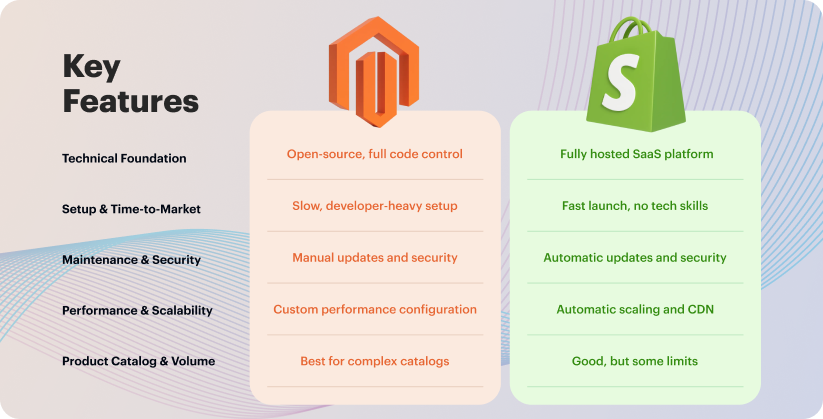
Knowing the architecture and usability of eCommerce platforms comparison is essential when selecting one. The speed at which you can open your store, its ease of management, and the degree of control you will have as your brand expands are all determined by these two factors. Shopify and Magento both have sophisticated features, but their foundations are very different.
Technical Foundation
One significant distinction between Shopify vs Magento 2026 is the way each platform is developed and hosted. Because Magento is open-source, brands have complete control over their code, hosting, and personalization. Deep customisation and interaction with intricate business processes are made possible by this flexibility.
Shopify pros and cons are in charge of everything, including hosting and upgrades. Without having to worry about servers, patches, or downtime, merchants just log in, set up their store, and begin selling.
Magento: Cloud-Hosted Model
Businesses can choose between self-hosting and cloud hosting with Magento.
- In a self-hosted configuration, you put up your server, select your own hosting company, and manually control security, scalability, and performance.
- Adobe takes care of cloud infrastructure with Adobe Commerce Cloud, delivering open-source customization options along with scalability, backups, and monitoring.
For brands with a dedicated technical team or agency support, this option is perfect. It gives you total flexibility to change the platform at the code level, integrate it with ERP or CRM systems, and create an audience-specific digital experience.
Shopify: Fully Hosted SaaS Model
Shopify adopts an entirely different approach. Being a fully hosted SaaS platform, it takes care of all the backend tasks, such as hosting, uptime, SSL certificates, and updates. This means that instead of concentrating on technical setup, business owners may fully concentrate on products, marketing, and sales.
Shopify provides quick load times, integrated Content Delivery Network (CDN) performance, and almost 100% availability because it is cloud-based. However, restricted flexibility is the trade-off. In contrast to Magento’s open-source ecosystem, Shopify requires merchants to operate within its framework, which limits backend alterations.
Initial Setup and Time-to-Market
The speed at which you may launch your store is one of the main distinctions between Shopify and Magento.
- You may begin using Shopify in a matter of hours. It is ideal for firms who wish to launch rapidly because of its pre-built templates, drag-and-drop editor, and integrated hosting. Setup is simple even for non-technical people.
- In contrast, Magento requires more preparation and time. Setup entails setting servers, installing extensions, creating layouts, and guaranteeing performance readiness because it is completely customizable. The end product is a highly customized store that satisfies intricate specifications, even though it takes longer.
Magento wins in control and accuracy, while Shopify pros and cons win in ease of use.
Maintenance, Updates, and Security
In terms of daily management, this is where the platforms diverge the most.
- Unless they use the Adobe Commerce Cloud, which automates some of these operations, Magento provides merchants complete control over updates, fixes, and security monitoring. Although this method offers flexibility, it necessitates technical supervision or a development partner to maintain the site’s security and optimization.
- Everything is automated by Shopify. Security fixes are applied promptly, updates roll out smoothly, and businesses never have to worry about server maintenance or downtime. Shopify is a low-maintenance option for busy store owners because it also handles SSL certificates and PCI compliance.
Therefore, Shopify serves customers who desire a hands-off, worry-free experience, but Magento appeals to brands that want to control every detail.
Performance and Traffic Management
Magento provides a great deal of control over optimizing performance. To manage large spikes in traffic, brands might adjust server resources, use CDNs, and modify caching techniques. Additionally, cloud scalability, automatic load balancing, and performance monitoring tools are integrated into Adobe Commerce Cloud for merchants. Because of this, Magento is perfect for companies that want complete control over their store’s performance and anticipate complicated, busy conditions..
In eCommerce platforms comparison, Shopify’s completely hosted cloud architecture makes performance management easier. Global CDN delivery, improved caching, and a network that easily scales during sales peaks or big campaigns are all automatic benefits for every Shopify site. Shopify takes care of scaling in the background, so merchants don’t need to configure or keep an eye on anything.
Product Catalog and Transaction Volume
Businesses must effectively handle an increasing number of items, variations, and transactions as they expand.
- Magento is great at managing intricate and sizable catalogs. When properly tuned, it can handle hundreds of SKUs, sophisticated product features, and unique pricing rules without sacrificing performance. Because of this, it is a great option for merchants with a variety of categories and product configurations, B2B establishments, and enterprise-level brands.
- Despite its reputation for simplicity, Shopify has significantly improved its ability to manage massive inventories, particularly with Shopify Plus. Custom product structures and variant possibilities are nevertheless subject to certain practical restrictions. Magento continues to be more flexible for firms with large catalogs or complex pricing structures.
Both platforms are capable of handling high-volume sales in terms of transaction volume. Magento enables sophisticated caching and database optimization for better performance during traffic spikes, whereas Shopify’s cloud servers automatically scale during occasions like flash sales.
Pricing Comparison
The platform’s TCO profile is essentially shaped by the basic differences in how you pay for it. By combining infrastructure, security, and maintenance into a single, recurring price, subscription models provide financial predictability. While Open-Source systems move the cost from licensing to a substantial investment in self-managed development and maintenance, licensing models include a high annual software cost. The decision establishes whether your charge will be a flexible capital expenditure or a set operating cost.
| Cost Component | Shopify | Magento |
| Platform Model | Subscription-Based. You pay a predictable monthly rate that grants access to the platform, software updates, and core features. Costs are clear and stable. | Licensing/Open-Source. The core Open Source version has no software cost, but you assume all responsibility. The Enterprise version requires a significant annual license. |
| Hosting & Infrastructure | Managed and Included. Shopify takes care of all server performance, security, global Content Delivery Network (CDN), and automated scaling for peak traffic. | Self-Managed. The merchant is responsible for sourcing, paying for, and managing their own high-performance cloud hosting and servers. This requires dedicated technical oversight. |
| Maintenance & Upgrades | Automatic. Security patches, platform updates, and compliance are handled by the platform, requiring no merchant intervention or additional investment. | Manual and Resource-Intensive. Requires dedicated developer time to apply all security patches, manage complex upgrades, and maintain system health. |
In order to determine ROI, it is necessary to go beyond the first cost reductions and assess which platform has the capacity to generate income and the least amount of overall friction over time. It entails measuring how well the features — or the capacity to add them — translate into business expansion, such as simplified inventory control and decreased maintenance time.
Use Cases
Shopify is perfect for rapidly expanding businesses that appreciate scalability, speed, and ease of use. Teams can concentrate on sales and marketing since its fully hosted SaaS approach removes technical maintenance. Global expansion, multi-store administration, and high-traffic performance are all included with Shopify Plus. Hydrogen and Oxygen can be used by developers for headless builds, allowing for simple omnichannel experiences and sophisticated customisation.
Magento is suitable for big or complicated companies that require extensive system integration and customisation. Large catalogs, sophisticated pricing, and unique workflows connected to ERP, PIM, or CRM systems are all supported by its open-source design. According to the Magento review 2026, this platform is the preferred option for brands that value versatility over simplicity since it provides complete control, scalability, and precision for multi-market or B2B operations, making it ideal for businesses with internal technical teams.
At Stellar Soft, we have found that the decision between Shopify and Magento largely depends on a brand’s future strategy. Throughout our headless constructions, we have witnessed particular strengths and shortcomings of both platforms. Read about this Shopify case study, where we partnered with a fashion store to revitalize their site performance.

Ready to Scale with the Right Platform?
Stellar Soft assists companies in creating eCommerce systems that are quicker, more intelligent, and more robust, whether they are building a custom Magento solution or optimizing their Shopify store. From headless builds and API integrations to data-driven automation, our team of qualified engineers and integration experts transforms challenging processes into flawless digital experiences.
Join together with Stellar Soft now to transform technology into your next competitive edge and future-proof your commerce strategy. Reach out.