Last Updated | June 4, 2026

The landscape for eCommerce platforms 2026 is a great opportunity for the youths to come up in the trade considering that online shoppers are now more than ever.
Your online store’s profitability will be affected by every move you make from selecting the product and platform to marketing techniques and providing customer support. In this eCommerce business guide, we are going to guide you step by step through the whole process of eCommerce firm launch in 2026 alongside the essential stages, challenges, and the most effective ways to compete in the market.
Why 2026 Is a Great Year to Start an eCommerce Business
In 2026, the decision to start an eCommerce business venture is an excellent decision because the trend of online shopping is going up. The facts are that running an internet business is cheaper than a brick-and-mortar store, it provides you with the possibility to sell worldwide, and all the activities can be done via your computer.
Besides, online selling gives you the choice of working full-time or part-time. It’s an attractive source of passive income, has the advantage of a flexible schedule, and allows you to choose any place with internet access as your office. The further the online purchasing rises, the bigger the quick growth opportunity is.
Steps to Build an Online Store from Scratch
The eCommerce market keeps growing, thus, you must consider how to differentiate yourself from others when everybody can apply digital marketing to their business. Even though the competition is tough, the door is still open for eCommerce businesses. This is the way you can take the first step.
Step 1: Research eCommerce Models and Decide What to Sell
The eCommerce industry is very big and competitive nowadays, so the analysis of your eCommerce business plan is a must. The categories are very basic and there are four of them.
Business-to-consumer (B2C): A widely used business model in which a company sells directly to the customers. The products sold under this model can range from foods to shoes. Examples of B2C companies are Amazon, Walmart, and Alibaba all of them present and sell many different brands in one place.
Business-to-business (B2B) models: They sell products or services to other businesses. Orders usually consist of repeat purchases. Examples of B2B models include Amazon Business, Alibaba, and Rakuten.
Customer-to-customer (C2C) marketplaces: These are platforms where customers can trade and sell their products and services to each other. Craigslist, Etsy, and eBay are examples of online consumer trading between customers.
Customer-to-business (C2B): This is where individual sales of goods and services to businesses occur. Upwork is one of the platforms for freelance hiring by companies that are known for going this way.
Identifying the specific market for your product starts with examining what product niche selection you want to sell, who is going to buy it, and how it is going to be distributed. When you start a business, you have all the power to make decisions, including the option of selling your own handmade products or sourcing generic ones. It is up to you to find what works best.
Step 2: Write an eCommerce Business Plan
Once the foundation for your company has been established, you can start an eCommerce business plan. This written document will illustrate your aims and approaches in the areas of finance, operations, and marketing. Besides, it will help you to arrange and lure potential investors.
A thorough research needs to be conducted to get the information about the current competitors and the market situation for your product or service. Identify your target audience and decide your tactics for reaching potential customers. Organize the details, that is, when, where, and in what ways you will be taking steps in the following months, including the logistics.
Step 3: Choose a Business Name and Start Building your Brand
Selecting a name for your company can be fun and at the same time it will need wise consideration. Besides a simple but one-of-a-kind name that can easily be understood for the type of product you are selling, you must also verify if the web domain, social media handles, and eCommerce legal setup name are available. Conduct your research to make sure that it will be understood well in every culture, especially if you plan to be a global player.
Brand development will come with the necessity of designing a logo that will be present on all types of packaging, website, and marketing material design. With time, you might want to bring in a designer to convert the essence of your brand into beautiful online visuals.
Step 4: Create your eCommerce Business Website
After this, the next step is to develop a website with full eCommerce functionality. When your site goes live, it becomes the digital face of your business – a place where visitors browse products, explore your brand, and complete purchases. As a result, the performance and usability of your website will directly influence your overall success.
The process begins with choosing a domain name that accurately reflects your brand. The next step is selecting an eCommerce platform that matches your technical requirements, growth plans, and preferred level of customization.
Businesses often choose all-in-one solutions (like Shopify), which provide built-in tools for inventory management, payments, and shipping.
However, companies that require deeper customization, advanced integrations, or enterprise-level performance frequently choose Magento (Adobe Commerce). It offers unmatched flexibility, robust B2C and B2B functionality, and the ability to fully tailor the store to complex business needs.
If you’re considering a custom Magento build, explore our capabilities here: Magento Custom Development Services.
After you select the right platform, you can proceed with creating and configuring your online store. This includes defining your layout, preparing wireframes, uploading product inventory, and writing product descriptions that convey your brand story and values.
Step 5: Source and Develop your Products or Services
A prototype of your website is the first step to adding products with names, descriptions, and pictures. Besides, there is a need to get your items, either by making them yourself or by buying them from a wholesaler.
In case you’re an artist, you must have enough stock for the first couple of months. It can mean preparing one garment from every color and size of your clothing line or 20 identical ceramic pots. The number really depends on how much labor you can put into this, as well as your marketing plan, which might include the amount of traffic you drive to launch an online store.
You would also have to consider logistics, such as branded packaging, warehousing, inventory management, and shipping.
Step 6: Launch and Market your eCommerce Business
Congratulations! After the decision to launch an online store, you can now start monitoring your metrics and key performance indicators (KPIs) gradually as the firm grows. Keep on trying different digital marketing methods to bring more visitors to your brand.
Besides managing inventory, logistics, and marketing, you will have to ensure that shipping and fulfillment are done successfully for each customer. It is wise to prepare contingency plans in case something goes wrong.
Common Mistakes First-Time Store Owners Make
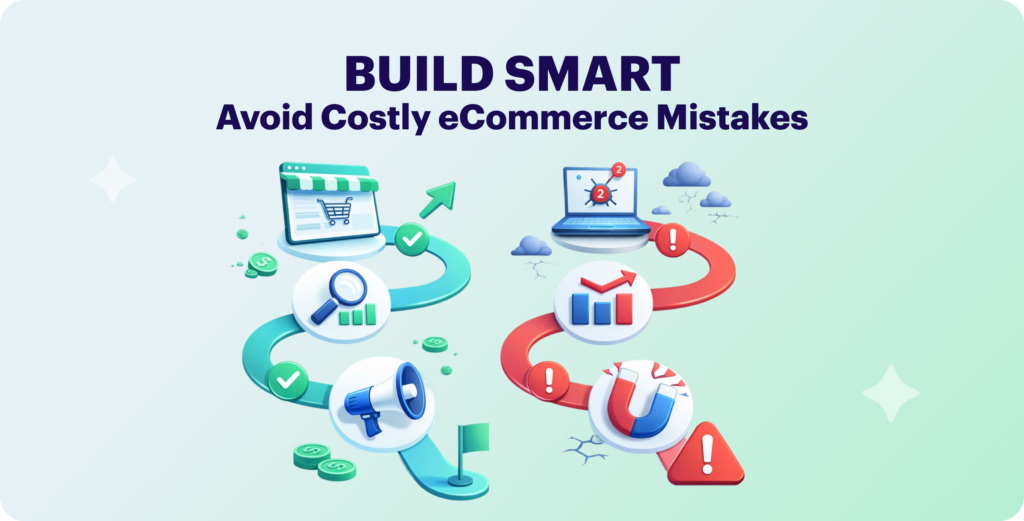
New eCommerce founders often underestimate the operational and technical demands of running an online store. A few patterns show up repeatedly:
- choosing a platform based on price instead of requirements
- skipping early analytics setup, neglecting site architecture
- and launching without proper QA
Many also invest heavily in paid ads before fixing core issues like slow load times, unclear navigation, or missing product data, driving traffic to a system that can’t convert.
Another common pitfall is overbuilding including selecting complex features, custom plugins, or full-stack solutions before validating basic demand. Others do the opposite and depend entirely on out-of-the-box tools, only to face scalability issues months later. No backup process and poor inventory planning round out the list. These mistakes are avoidable with technical planning, realistic budgeting, and support from people who’ve built stores before.
Legal, Financial, and Marketing Essentials for Success
The decision to start an eCommerce business is a lucrative investment, especially if your brand resonates with a big number of customers. It also takes time: starting and profiting from an online business might take up to two years.
Here are key upfront costs and essentials to consider:
Licenses and Permits: Your legal documents, including business licenses, resale permits, and local permits, will be determined by your business entity type, state/location, and products sold. Fees range widely, usually from $50 to several hundred dollars.
eCommerce Platform, Domain Name, and Hosting: Shopify’s basic plans cost $29 per month, while regular subscriptions cost $79 per month. Open-source platforms, like Magento, are free to download but have hosting and development charges. Domains can cost anywhere from $1 to $50 per year, while hosting can range from a few dollars to $700 per month, depending on traffic and services.
Shipping and Fulfillment: Shipping rates vary according to product quantities, carrier services, and delivery speed. Some organizations completely outsource fulfillment to third-party logistics (3PL) providers so they may concentrate on operations and marketing.
Marketing and customer acquisition costs vary depending on the size of the firm and its stage of growth. Marketing accounts for 13.8% of overall budgets, with new eCommerce enterprises spending up to 30% to gain clients.
Insurance and Risk Management: Business insurance provides protection against liability, property damage, and cyber hazards. Based on your operations, you should consider general liability, product liability, and cyber insurance plans.
eCommerce Legal Setup: Depending on your items, you may need to follow safety, labeling, and consumer protection standards. If you’re selling worldwide, be mindful of customs, import and export legislation, and data protection regulations such as GDPR or CCPA.
If you’re ready to put your idea into action and want your store built on strong design rather than guesswork, Stellar Soft can help. We assist founders and growing organizations with validating platform selections, designing scalable storefronts, and implementing the backend systems they will rely on for years (inventory, connectors, payments, and automation).
If you’re ready to turn your company concept into an action to launch an online store, contact us right away. The appropriate technical basis will save you money, shorten build time, and prevent costly rebuilds later on. Before you invest in growth, let us first determine what your store requires.