
Last Updated | October 15, 2025

You must choose which services your resource will use and take into account different 3rd-party API integrations during the development phase. What and how are you going to streamline or optimize your eCommerce functionality? The work is difficult and necessitates careful consideration.
Understanding 3rd-Party API Integrations
By using APIs to link two or more applications, 3rd-party API integrations allow systems to share data sources. API integration enables data synchronization and productivity gains, creating conditions for revenue growth across different organizational levels.
APIs facilitate communication between many systems, creating an integrated network that exchanges data with ease. This procedure not only facilitates a natural division between your front-end and back-end processes, but it also allows data to be shared across various systems that support the smooth functioning of your company.
Why APIs Are Critical for eCommerce Success
With a variety of features, eCommerce functionality, and services, online marketplaces like Amazon, eBay, and Etsy give customers a full virtual shopping experience. Additionally, many eCommerce businesses rely on integrations with external service providers (e.g., shipping companies, payment gateways, or marketing platforms) to connect their systems to marketplaces and extend functionality.
API integrations eCommerce systems not only enhance the customer experience but also facilitate the marketplace administrator’s management and marketing of the eCommerce enterprise, contributing to the expansion of their enterprise. It enables the business to maintain a website while concentrating on its primary competencies.
Types of eCommerce API Integrations
A crucial component that allows for instantaneous data flow across systems is real-time updates. Applications that need real-time information, like social media monitoring tools or financial trading platforms, need this feature. Applications can improve user engagement and deliver timely insights by incorporating real-time update APIs.
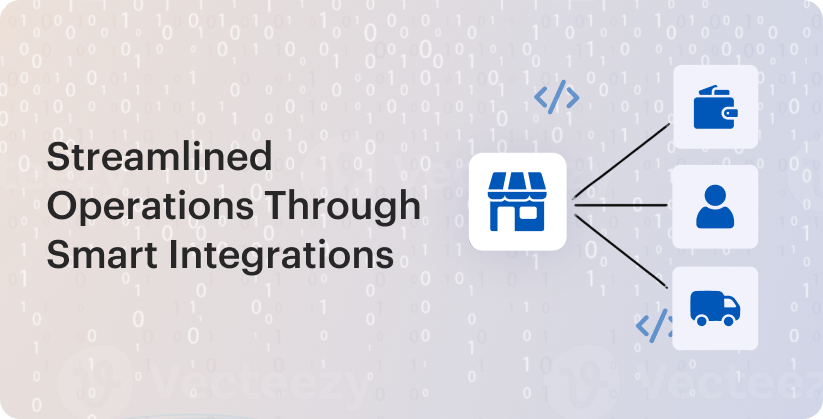
Payment and checkout
An eCommerce site’s objective is to generate revenue for you. It implies that the consumer ought to be able to pay promptly and securely. As a result, the online store needs a trustworthy payment gateway. Third-party software must be integrated in order to connect it.
The buyer receives an invoice to pay after making an order at the online store. The customer is being sent to this system (or, more accurately, to its online page) and order data are being passed to the selected payment service. The consumer can choose his preferred method of payment here. Naturally, he must also enter all of the needed data.
CRM and marketing
In order to create enduring relationships and encourage repeat business, a flawless client experience is essential. In order to improve consumer data synchronization across multiple platforms and systems, API connectivity is crucial.
A unified customer profile can be created by automatically syncing customer data, including order history, preferences, and payment methods, through API connections that connect your CRM systems and eCommerce platform.
Businesses can leverage client data to customize the buying experience by integrating APIs. For example, you can use a customer’s browsing and purchase history to provide personalized product recommendations, promotions, and recommendations.
Logistics and shipping
Any eCommerce business eventually realizes how important it is to automate both stock balancing and product management. The issue is particularly severe when there is a wide variety of products available. You must therefore link your inventory to the online marketplace at that same moment. Stated differently, you need to choose a trustworthy eCommerce inventory management solution.
Marketplace owners can automate the shipping process from the point of sale to the customer’s package delivery with the help of a shipping API. From the first sale to the final delivery and all points in between, this covers it all. Additionally, it can be used to automatically create labels and packaging bills.
Using the shipping API, you may choose from a range of carriers according to their location, pricing, and delivery time. Shipment tracking is another feature of this kind of API. Order tracking information can be sent by email or text message, and it can be integrated into a website or mobile application.
Benefits of Custom API Development
Since APIs are the backbone of eCommerce custom development, it is crucial to comprehend them before creating a marketplace. Here are a few advantages of integrating APIs:
| 1. Automation | Most businesses require process automation to reduce manual operations. APIs make this possible by enabling seamless data exchange between systems. For example, it’s done by synchronizing orders, inventory, and shipping data with logistics automation. |
| 2. Increased Security | APIs can be designed with built-in security features, such as authentication, authorization, rate limiting, and encryption. This creates an additional abstraction layer between systems, reducing direct exposure of backend services and lowering the risk of breaches. |
| 3. Better Customer Experience | You may create a smooth and easy customer experience by connecting your different systems with an API. Customers are unaware that they are interacting with several platforms connected via an API when they utilize a system. They only see chances and capabilities that are quick and simple to obtain from the market. |
| 4. Scalability | Scalability is the capacity to grow and change as your present system does. This means you can extend and scale your eCommerce ecosystem without rewriting the core system. For example, you can add new payment methods, marketing platforms, or analytics tools via APIs, keeping the underlying architecture intact. |
Real-World Examples
These days, most Shopify custom development works as nodes inside a larger digital commerce ecosystem rather than as standalone stores. Shopify merchants may automate operational procedures, create bidirectional data flows, and guarantee system compatibility across finance, logistics, customer engagement, and enterprise resource management by integrating third-party APIs. Common use scenarios consist of:
- Payment Gateways: Shopify supports tokenized transactions, multi-currency processing, and safe payment flows that comply with PCI DSS by integrating with the Stripe and PayPal APIs.
- Shipping and Fulfillment: Real-time webhook-driven order status updates, automated label creation, and rate fetching are made possible by direct API connections with UPS, FedEx, and ShipStation.
- CRM Systems and Customer Data: For segmentation, event-driven marketing automation, and lifecycle tracking, HubSpot and Klaviyo integrations make use of Shopify’s customer and order data APIs.
- Customer Service: By integrating Zendesk and Gorgias, support processes may access contextual order history via Shopify APIs, facilitating quicker resolution through unified agent dashboards.
By integrating Shopify into an API integrations eCommerce ecosystem or service-oriented architecture (SOA), businesses may minimize operational silos and maximize end-to-end data fidelity. In order to match enterprise-grade scalability, compliance, and customer experience objectives with commerce infrastructure, Stellar Soft designs and implements customized Shopify ERP integration strategies.
Conclusion
eCommerce connectors enhance the eCommerce functionality of an online marketplace in a number of ways. The eCommerce marketplace is a strong tool that you may use to onboard vendors and draw clients to your marketplace because they automate most of the procedures. A successful eCommerce business can be built on a solid foundation of enhanced functionality.
Do you need assistance? To find out more about potential solutions, get in touch with the Stellar Soft team.
FAQ
What are the benefits of 3rd-party API integrations?
Third-party API interfaces link external systems such as payment gateways, CRMs, and ERP integration to a store’s inherent capabilities. They offer real-time data synchronization, workflow automation, and decreased manual intervention between platforms.
Which APIs are most popular in eCommerce?
Payment APIs (Stripe, PayPal), shipping APIs (UPS, FedEx), and marketing APIs (Meta Ads, Google Analytics) are frequently utilized in eCommerce. In order to streamline corporate processes, ERP/CRM APIs such as Salesforce and HubSpot are also extensively connected.
Are custom API integrations expensive?
The cost varies according to complexity: bespoke, large-scale integrations that need middleware or intensive error handling are more costly than basic API connections. Long-term costs are further increased by ongoing security monitoring, scaling, and maintenance.
How do APIs improve customer experience?
Real-time inventory insight, customized product suggestions, and expedited order tracking are just a few of the smooth services made possible by APIs. This facilitates the shopping process and fosters confidence by providing precise and timely information.