
Last Updated | June 4, 2026

Discover the trends that will alter how we discover, purchase, and engage with things in the coming year. Continue reading to understand how to positively future-proof your business.
Market Shifts Define Trend Baseline for The Following Year
The global business-to-business (B2B) eCommerce market is predicted to develop at a 14.5% CAGR until 2026. Some eCommerce trends to keep an eye on in the coming year include virtual and augmented reality, mobile shopping, more payment options, voice search, AI eCommerce, data forensics, and ethical branding. Begin implementing these eCommerce trends by making your brand sustainable and ecologically conscious.
The United States continues to have one of the largest global eCommerce innovation markets, with online sales expected to reach $1,036 billion by 2024. The Census Bureau reported $304.2 billion in seasonally adjusted sales in Q2 2025, up 1.4% from the previous quarter and 5.3% from Q2 2024. Unadjusted, these sales totaled $292.9 billion, representing 15.5-16.3% of overall omnichannel retail sales.
However, the main market movement that defines such a trend baseline for the following 2026 year happened significantly earlier. During the COVID-19 pandemic, many brick-and-mortar businesses struggled to maintain constant sales, while others focused on internet sales. The expected growth of global eCommerce markets can be used by online brands to identify this trend.
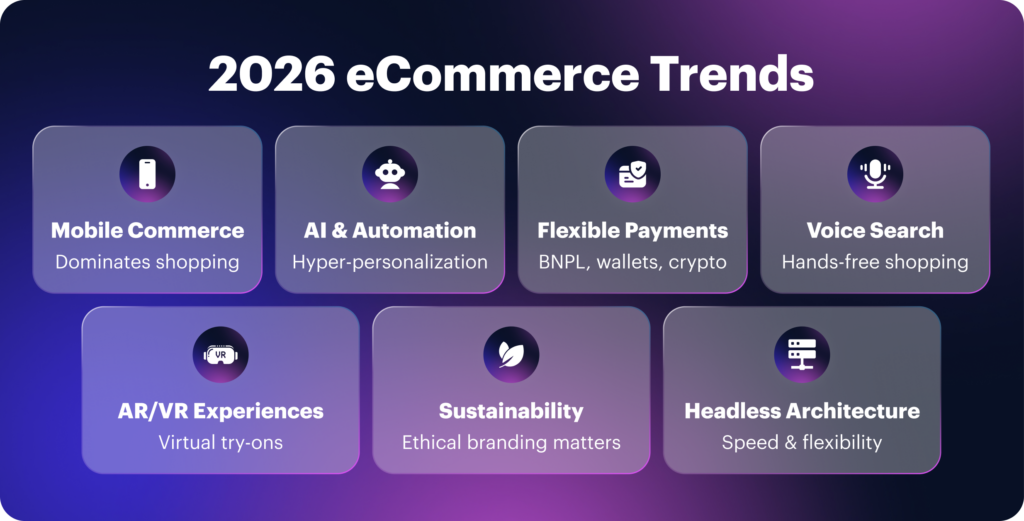
Mobile Shopping Continues to Dominate the eCommerce Landscape
Mobile commerce is no longer an optional channel – it is steadily becoming the primary way customers browse, compare, and purchase products online. Instead of relying on desktops, users increasingly make buying decisions directly from their smartphones and tablets. This shift is not temporary: according to Statista, global mobile commerce revenue has shown consistent year-over-year growth, and mobile now accounts for a substantial and expanding share of total online retail sales.
The trend is driven by several factors: faster mobile networks, seamless digital wallets, improved UX patterns for small screens, and the growing influence of social commerce. Consumers expect instant access, frictionless navigation, and checkout processes optimized for handheld devices.
For eCommerce businesses, staying competitive means prioritizing mobile-first optimization across every part of the customer journey – from page speed and responsive layouts to product discovery, search experience, and one-click payments. Brands that adapt quickly to mobile-centered user behavior gain higher conversion rates, stronger engagement, and better long-term retention, while those relying on outdated desktop-oriented experiences risk losing visibility and revenue.
How Magento, Shopify, and Modern Platforms Align With 2026 eCommerce Trends
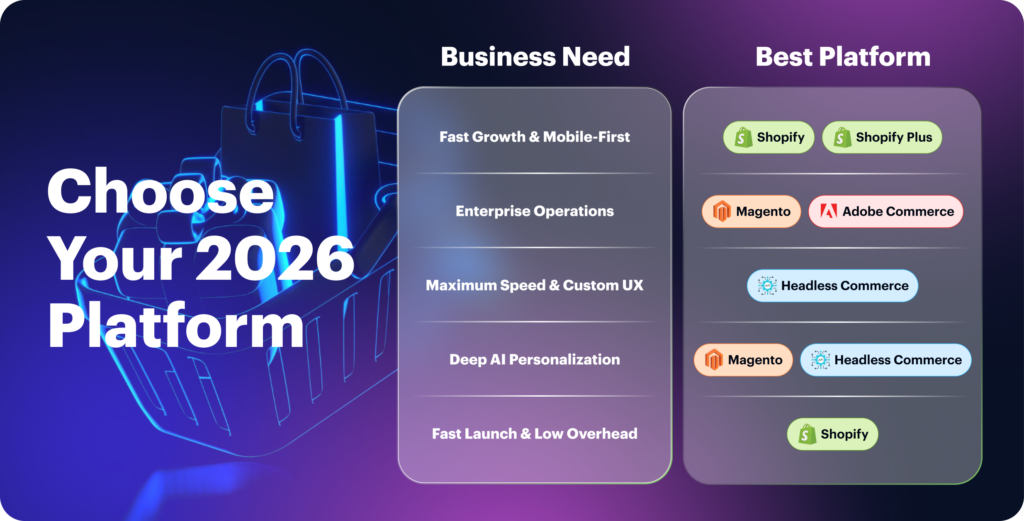
As new technologies continue shaping the digital commerce landscape, choosing the right eCommerce platform becomes a strategic decision. Magento, Shopify, and headless architectures each respond to 2026 trends in different – yet highly effective – ways.
Magento / Adobe Commerce: Built for Enterprise Agility
Magento (Adobe Commerce) remains the leading choice for mid-market and enterprise brands that require:
- deep customization and full control over code
- advanced B2B capabilities
- multi-store and international expansion
- large catalogs and complex pricing rules
- flexible integrations with ERP, CRM, and custom systems
Magento’s modular architecture makes it ideal for companies prioritizing:
- AI-driven personalization at scale
- custom checkout and payment flows
- PWA or headless storefronts
- long-term ownership of infrastructure and data
In 2026, businesses with complex digital ecosystems increasingly rely on Magento to support rich omnichannel experiences and fast adaptation to emerging AI tools.
Shopify & Shopify Plus: Optimized for Speed and Rapid Growth
Shopify continues to dominate among D2C, retail, and lifestyle brands that prioritize:
- fast go-to-market
- mobile-first storefronts
- streamlined app integrations
- built-in payment options (Shopify Payments, BNPL, wallets)
- simple and scalable management without technical overhead
Shopify’s strengths align perfectly with 2026 trends:
- the rise of mobile shopping
- growth of social commerce
- adoption of digital wallets and one-click checkout
- AI-powered tools built directly into the admin
Shopify Plus also unlocks enterprise features, allowing high-volume merchants to scale globally with minimal maintenance costs.
Headless Commerce: The Future of High-Performance Experiences
Headless solutions (Shopify Hydrogen, Magento headless with React/Vue, custom JAMStack builds) are rapidly gaining popularity in 2026 due to their ability to deliver:
- ultra-fast mobile and PWA experiences
- fully custom UX and design freedom
- seamless integration with AI, AR/VR, and personalization engines
- API-driven scalability across multiple front-end channels
Brands adopting headless commerce can adapt to new trends significantly faster without rebuilding their eCommerce engine.
Which Platform Fits 2026 Trends Best?
The answer depends on your business model:
| Business Need | Best Platform |
| Fast growth & mobile-first UX | Shopify / Shopify Plus |
| Complex enterprise operations | Magento / Adobe Commerce |
| Maximum speed & custom experience | Headless Commerce |
| Deep personalization & AI integration | Magento / Headless |
| Fast launch + low technical overhead | Shopify |
Platform Choice Is Part of Your Trend Strategy
Every 2026 trend – AI, mobile commerce, flexible payments, sustainability, AR/VR – is influenced by the technical capabilities of your eCommerce platform.
Choosing Magento, Shopify, or a headless setup determines how effectively you can implement these innovations and stay ahead of competitors.
Consumers Value the Flexibility of Payment Solutions
Customers hoping for convenience and simplicity may be thrown off by limited payment options and lengthy processes. eCommerce payment methods are developing, and buyers want multichannel shopping alternatives. Many businesses also provide flexible payment options such as “buy now, pay later,” mobile wallets, and the ability to pay using cryptocurrencies.
Increase in Use of Voice Search for Online Shopping
Recent surveys indicate that voice shopping search is becoming a significant aspect of the online purchasing experience. According to a 2025 survey by Capital One Shopping, nearly half of US consumers use speech-search to shop and roughly one-third have made purchases by voice. It is especially frequent with smart speakers like Google Home and Alexa, which enable users to purchase groceries and meals hands-free.
How AI and Automation Are Transforming eCommerce
According to eCommerce trends 2026, conversational AI will be much more than merely a supplement. It has already progressed beyond the initial stage. Conversational AI innovation is now an assistant that increases sales and brand loyalty through customisation and unique experiences. Personalization is extremely significant, particularly in mobile commerce, where it serves as a market differentiation.
Rather than providing product recommendations, information, or messages based on large user categories, eCommerce innovation businesses may tailor each shopper’s experience to a higher degree.
What Does This Look Like in Practice?
Here are some real examples of how data-driven personalization works in modern eCommerce:
Dynamic product page content
Smart algorithms adjust product page sections based on who the user is – their preferences, past behavior, or even how they interact with the landing page.
AI-enhanced search and product discovery
Instead of showing the same results to everyone, AI re-ranks items using a customer’s browsing history and intent, making search results far more relevant.
Personalized product recommendations
Recommendations are no longer random. They are generated from purchase history, viewed items, demographic data, and real-time behavior – showing shoppers exactly what they are most likely to buy.
Adaptive pricing and tailored offers
Some systems personalize discounts or pricing based on loyalty, sensitivity to price, or current market conditions, increasing the chances of conversion.
Smarter messaging across email, SMS, and Ads
AI analyzes engagement patterns to send messages at the perfect time and with the most relevant content, depending on each customer’s preferences and lifecycle stage.
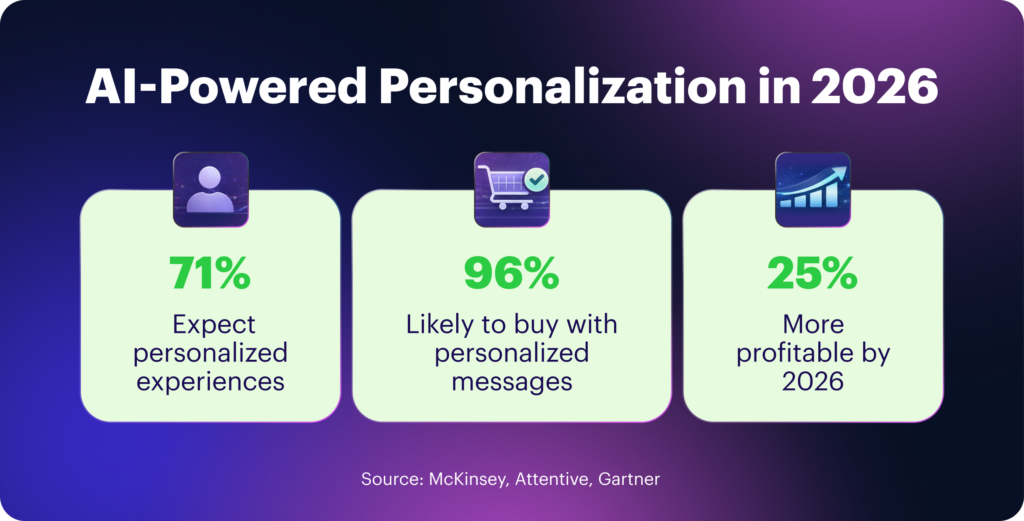
Why is it important, you could ask? Today’s consumers expect personalization throughout the purchasing experience, and AI and social commerce helps to deliver on that expectation. Personalizing shopping experiences improves engagement, conversions, and income for your organization.
McKinsey and Attentive’s reports demonstrate this. According to the first source, 71% of consumers want organizations to provide tailored experiences, and 76% are upset when they don’t. According to the second source, 96% are likely to buy when messages are tailored, while 77% are persuaded by appropriate product recommendations.
Furthermore, Gartner estimates that by 2026, firms that effectively use AI eCommerce to tailor client buying experiences will be 25% more profitable than their competitors.
Significance of eCommerce Virtual and Augmented Reality
Augmented reality (AR) and virtual reality (VR) are increasingly used in eCommerce experiences. Previously only employed by Fortune 500 companies and enterprises, more firms are now utilizing these technologies to fully immerse clients in the purchasing process. It involves presenting customers with 360-degree views of products, viewing furnishings in virtual showrooms, and allowing them to digitally try on clothing.
How AR and VR Typically Work in Real Shopping Experiences
In real eCommerce scenarios, augmented and virtual reality show up in several practical ways that help customers understand products better and feel more confident before buying.
- Many stores now let shoppers “try on” items virtually – whether it’s makeup, glasses, or accessories – by placing them directly on the user’s face or body through the phone camera. It helps people see how something actually looks before committing to a purchase.
- For home and interior products, customers can place furniture or décor right inside their room using their smartphone. This helps confirm scale, style, and how the item fits into a real environment.
- Some brands recreate a full showroom experience online. Instead of browsing traditional product pages, visitors can move around an immersive digital space and explore collections as if they were in a physical store.
- Advanced sizing tools are becoming more common as well. By analyzing body measurements through a camera, these tools help determine the right size for clothing, shoes, eyewear, or other fitted items – reducing returns and uncertainty.
- And when products come in multiple configurations, AR previews let customers switch colors, materials, or finishes and instantly see how the final item will look once customized.
Agencies who help businesses flourish in this area do more than just install an AR viewer.
They include augmented reality into the entire buying process (from discovery to purchase) and tailor the brand’s ecosystem, such as a mobile app, website, or store, to accommodate these immersive features.
Why Sustainability and Ethics Matter for Modern Brands
Shoppers increasingly pay attention to the environmental and social impact behind the products they buy. They look for signs that a company treats workers fairly, uses responsible materials, and reduces unnecessary waste. This shift directly influences how much people trust a brand and how likely they are to return.
Across different studies, several trends appear again and again:
- many consumers say their confidence in a brand grows when it openly shares sustainability information, such as sourcing practices or packaging impact
- a large portion of shoppers choose products from companies with proven environmental credentials, even when these items are more expensive
- research based on supermarket sales shows that products made with higher animal-welfare standards often sell at a premium, which means ethical practices can translate into higher perceived value
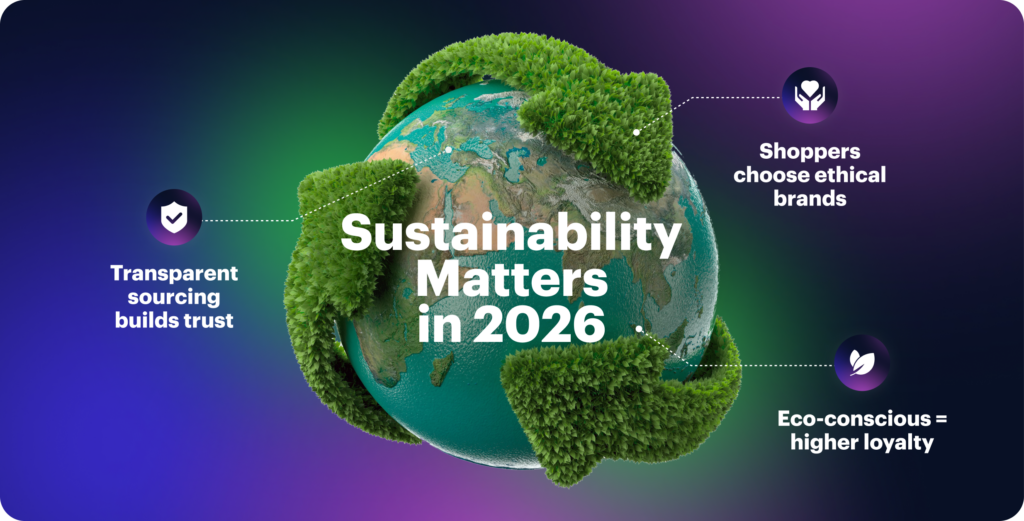
When customers understand and agree with a brand’s values, they form a stronger emotional connection. Companies that support fair work conditions, transparent supply chains, and mindful production methods tend to build more loyal audiences and outperform competitors in long-term brand trust.
Adapting to the Future of eCommerce
Predicting the future of eCommerce may always need some educated guessing, but one thing is certain: every trend is based on one thing above all else: product data.
You don’t have to completely revamp your eCommerce firm to prepare for the future. Most of your rivals continue by focusing on three core infrastructural levels.
- Stabilize the foundation. Product, pricing, order, and customer data are all shared.
- Modernize the commercial core. An eCommerce platform that can support numerous business models, customize features, and integrate with AI without requiring frequent rewrite.
- Tune the levers. Smarter routing, improved store operations, and more flexible fulfillment.
Your competitors are already adapting to these changes. Those with greater infrastructure. They are experimenting with novel fulfillment models that do not require engineering rewrites. They are activating first-party data across channels, while others are still attempting to integrate their systems.
Gain an advantage by using Stellar Soft commerce to future-proof your store. From AI personalization to mobile optimization and sustainable eCommerce solutions, we help firms stay ahead of the trends in 2026. Begin the digital revolution of your store immediately. You can book a free meeting with our technical experts to discuss how your eCommerce can expand in the future.