
Last Updated | June 4, 2026

Market changes, corporate requirements, and customer expectations all shift quickly. How can companies swiftly expand their brand to suit new demands as artificial intelligence (AI) develops quickly and staff are expected to accomplish more with less? With headless eCommerce AI integration, its adaptability and agility. We’ll explain headless commerce if you haven’t heard of it already.
What you should know is as follows.
Understanding Headless eCommerce with AI Integration
The need for headless commerce is growing. In the past 18 months, about 75% of consumers have altered their purchasing habits, and the majority intend to continue doing so. Customers want tailored experiences that change quickly, therefore businesses need to use flexible architectures that allow for quick modifications without interfering with backend operations.
Businesses like Amazon have already adopted headless commerce, delivering highly customized interactions through independent services and decoupled architecture. However, flexibility also brings complexity, which is why quality assurance (QA) is so important.
What is headless eCommerce?
Headless commerce, in its most basic form, is the division of the front and back ends of an eCommerce application. When the front and back ends of a platform function independently, modifications made to one end do not impact the other. This architecture gives brands the ability to create anything they desire. It makes it possible for brands to improve the purchasing experience.
The usage of eCommerce APIs, experience managers, and tools like Vercel and GraphQL, together with the significance of IT partners, are characteristics of headless. To engage consumers and remain ahead of their expectations, these materials are an essential component of any brand’s innovation strategy.
Headless integration vs. traditional integration
Your back-end logic and front-end experience are connected in traditional commerce architecture. For companies wishing to establish eCommerce directly, this type of architecture might be quite helpful. Setting it up is simple and quick.
Conventional eCommerce suppliers offer drag-and-drop storefront templates that facilitate the rapid launch of an eCommerce website. Nevertheless, this developmental strategy may negatively impact customisation and complicate the integration of new technologies.
In contrast:
- Conventional Integration: Any feature upgrade necessitates changing the entire system because the front-end and back-end are connected. This may restrict flexibility and hinder progress.
- Integration without a head: Headless systems, which are based on a decoupled architecture and communicate via APIs, maintain the independence of the front-end and back-end. This makes it possible for brands to grow into new sales channels and add new tools without any problems..
Therefore, headless integration provides the flexibility and scalability brands need to adapt, grow, and innovate, whereas traditional integration may be appropriate for smaller firms with simple needs.
Benefits & Risks
Unquestionably, the transition to headless commerce has benefits, but only if all channels function consistently. Here are the ways that headless commerce improves scalability, speed, and flexibility, along with the QA techniques that make sure these advantages don’t create new dangers.
| Vertical | Risk | Advantage | Outcome |
| Faster Time to Market | Frequent decoupled architecture releases increase the risk of regressions and integration mismatches between front-end and back-end services. | Independent front- and back-end deployments accelerate development cycles and enable faster iteration of new features. | Continuous integration (CI) and automated regression testing stabilize release velocity, ensuring reliability while maintaining agility. |
| Flexibility & Customization | Frequent UX experimentation can introduce inconsistent layouts, UI degradation, or broken front-end logic across frameworks. | Teams can freely swap frameworks, redesign experiences, and innovate UX without backend disruption. | Automated visual and functional testing ensures consistency and cross-framework reliability before production deployment. |
| Enhanced Scalability & Resilience | Microservices and eCommerce APIs introduce new points of failure, where untested dependencies can bottleneck under load. | Independent microservices scale elastically to handle variable demand and minimize downtime. | Proactive load testing and API monitoring detect bottlenecks early, optimizing performance and service uptime. |
| Omnichannel Consistency | Fragmented front ends across web, mobile, and IoT can create inconsistent experiences and desynchronized data. | A unified commerce engine enables consistent product, pricing, and customer data across all touchpoints. | End-to-end and cross-platform testing safeguard omnichannel cohesion and prevent data or UX fragmentation. |
| Personalization & Innovation | Dynamic personalization can lead to inconsistent logic or performance degradation at scale. | Real-time, AI personalization drives engagement and conversion through tailored experiences. | Automated A/B validation and UI testing verify personalization accuracy and performance across customer segments. |
| Increased Complexity | Distributed architecture adds multiple integration layers, increasing configuration and coordination overhead. | Modular components allow scalable innovation and independent system evolution. | Centralized test management and API test automation provide full coverage across layers, maintaining interoperability. |
| Multiple Integrations | New or updated third-party services may disrupt order processing, payments, or data synchronization. | API-first integration enables rapid adoption of specialized third-party tools. | Automated integration tests and monitoring ensure seamless data flow and stable third-party performance. |
| Consistent Customer Experience | Disparate front ends risk brand inconsistency and uneven performance across browsers or devices. | Centralized commerce logic ensures consistent brand presence across all interfaces. | Automated visual regression and performance testing uphold design integrity and responsiveness across environments. |
| Security & Compliance | Expanding API surface increases vulnerability exposure and compliance complexity. | API-based architecture enhances security isolation and data control when properly managed. | Automated security scans, penetration testing, and compliance checks maintain regulatory standards and protect data integrity. |
Unmatched flexibility, speed, and scalability are possible with a headless approach—but only if everything functions safely and smoothly. Businesses run the danger of uneven experiences, system breakdowns, slow performance, and security flaws if they don’t conduct thorough automated testing. Brands may expedite change while maintaining stability and security without raising operational risk by integrating test automation at the center of a headless commerce strategy.
AI use cases
Leading eCommerce companies are utilizing chatbots or virtual assistants to increase customer retention, investing in real-time analytics to better forecast demand, and implementing AI-powered auto-suggest technologies to display results based on search intent. View:
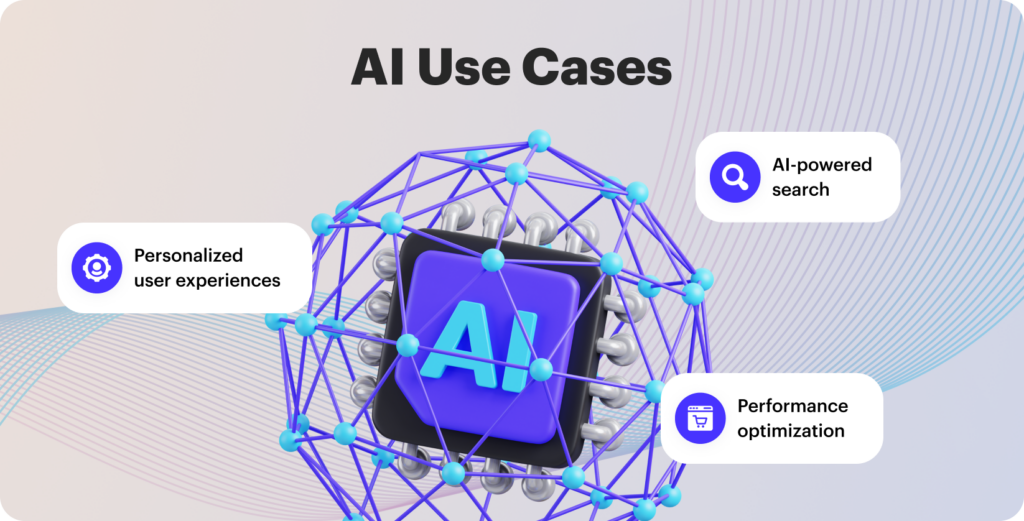
- AI-powered search: Headless eCommerce platforms can enhance consumers’ entire buying experience by using AI algorithms to deliver more precise and pertinent search results. AI-driven search algorithms are able to comprehend user intent, take user preferences and behavior into account, and provide tailored search results.
- Personalized user experiences: By examining user data, preferences, and behavior, AI enables headless eCommerce platforms to provide tailored user experiences. This increases engagement and conversions by enabling companies to give personalized product recommendations, tailored offers, and focused marketing efforts.
- Performance optimization: By automating procedures, forecasting consumer behavior, and improving product recommendations, AI can improve the performance of headless eCommerce platforms. Large datasets can be analyzed by AI algorithms, which can then find trends and make wise choices to enhance overall performance.
And that’s just the beginning of what digital shops can benefit from AI adoption. Businesses can quickly add the newest AI technologies to their backend by implementing a headless architecture, which will help them stay ahead of the competition and adapt to the ever-changing marketplace.
Tech Stack Overview
You are already familiar with the agony of navigating a maze of templates and plugins in order to implement a straightforward UX modification. By dividing your stack into distinct, loosely connected layers that communicate via eCommerce APIs, this architecture removes that friction.
Core Components
There are four main layers in the headless eCommerce AI integration, each with distinct roles and interfaces:
Commerce Engine (Backend)
All transactional business logic is handled by this central service, which exposes endpoints such as:
- GET /products/{id} retrieves product information, including pricing and inventories.
- GET /products?sort=price&category=shoes – Returns product collections that have been filtered
- POST /items/cart Products are added to shopping carts
- POST/checkout Orders with payment details are processed.
- GraphQL changes for intricate operations: place an order and apply a promotion
Each endpoint is framework-neutral and adheres to REST or GraphQL conventions with predictable replies.
API Gateway Layer
This layer, which sits between clients and the commerce engine, manages:
- JWT tokens with programmable expiration for authentication
- Role-based access constraints for authorization
- CORS regulations to permit only authorized sources
- Token bucket algorithms for rate limitation (X requests per period)
- Verify the request using schema definitions.
- Critical events (order.created, inventory.updated) trigger webhook dispatches.
By separating backend complexity from frontend usage, the gateway turns your commerce engine from a basic service into a powerful platform.
Frontend Clients
Different client implementations are powered by the same eCommerce APIs:
- React/Vue browser SPAs using client-side API calls
- Next.js SSR server-rendered apps for enhanced SEO
- Offline caching techniques in native mobile apps
- Lightweight API clients for IoT devices
Regardless of platform, all clients reflect the same business rules and data thanks to this uniform API contract.
Supporting Services
Enhancing the main engine of commerce:
- CMS for rich narrative (marketing content, product descriptions)
- Normalizing product data using PIM (Product Information Management)
- Order Management System (OMS) for workflows in fulfillment
- CRM for segmentation and customer profiles
Instead of forming a fragile monolith, these services create a modular network with defined interaction points by exchanging data across the API fabric.
Microservice Integration
You’ll probably move toward domain-specific microservices as your commerce platform grows. Rather of a single, cohesive commerce engine, you may break down into:
- Catalog Service: Product, category, and attribute management
- Costs Service: Managing tax computations, promotions, and dynamic pricing
- Inventory Management: Monitoring stock levels throughout fulfillment facilities
- Order service: Handling payments and client transactions
Through a single API gateway (such as the AWS API Gateway), each service exposes specially designed APIs while maintaining its own data store. By routing requests, translating protocols, and enforcing international policies, the gateway turns into your traffic control hub.
Robust observability is necessary for production-grade solutions. While centralized logging (ELK stack) and metrics collecting (Prometheus) offer insight into system health, distributed tracing with OpenTelemetry monitors requests across service boundaries. When downstream services deteriorate, circuit breakers (like Hystrix) quickly fail to prevent breakdowns.
Through serverless services and containerization (Kubernetes), this architecture expands horizontally, enabling individual components to scale independently according to their unique resource requirements and demand patterns.
Is headless right for your business?
From a growth perspective, strategists concentrate on how to advance the company. Your company’s demands will determine whether a headless commerce solution is appropriate for you.
Conventional eCommerce platforms were created with desktop computer users in mind. For instance, if you are a small and midsize firm (SMB) that would need more personnel or resources to create and manage a headless structure, a traditional platform would make sense.
In conclusion, given the growing prevalence of artificial intelligence and voice search integration, headless can provide a potent option for eCommerce companies seeking to future-proof their brand with more flexibility, scalability, and omnichannel capabilities.
Learn more about Stellar Soft’s headless solution
Flexibility and expense must be balanced when deciding whether to use a headless commerce strategy. Higher levels of customisation, scalability, and quicker user experiences are provided by headless solutions, but they also need more money and technical know-how.
As the eCommerce software development agency, Stellar Soft can handle all of your headless needs, regardless of your company’s needs. We provide everything an eCommerce company needs to fulfill standards and prosper in this dynamic sector, from integrating all of your systems to creating unique themes for your store. Get in touch with us right now to find out more.