

The customers have reached a stage where their needs are satisfied first and they expect the same from AI solutions; they not only desire the presence of AI in their operations but also, the use of AI as a supplement for the overall performance of their systems. The principal thought of eCommerce development 2026 is one of amelioration and hastening.
Expert ArticleShopifyIntegrationsDevelopmentEcommerce
Why AI-First Agencies Dominate Shopify eCommerce Development in 2026
The process is slow but Shopify's support continues to make the lives of online sellers easier by enabling them to manage their operations seamlessly.
The personalized and consultative shopping experience that had been the domain of the upscale shops and online shopping was another aspect apart from the “smarter” product search. Witness this:
- The retail experience was already masked by AI and ChatGPT, and the customer was not obliged to accept the seller's offers, as it changed from a one-sided communication to an interactive talk.
- Such intelligent assistance accelerated the selection process but also gave exact replicas of human responses that made the customer feel like their concerns were addressed thus providing comfort.
The Rise of AI-First Agencies in Shopify eCommerce Development
AI's impact on eCommerce agencies' performance isn't the same for every agency. They all seem to point to the future where AI would need a huge effort. Surely the eCommerce sector would be the one to profit from that change, so only if you are ready to shift your methodology would you be able to make the most of it. Smart eCommerce agencies have always adapted to the extreme. With every new trend came the need to go through the learning process of new programming languages and we had to do that, great times for us.
Last year, only 68% of B2B (business-to-business) buyers were of the opinion that generative AI played no role in the B2B technology purchasing process. Now, 64% of executives are of the opinion that AI will have a noticeable effect on the future sales, thus disclosing this little secret. It is not yet another technology but artificial intelligence that has ever come to the heart of commerce technology, forming users to control their requirements.
The future of merchants will be greatly affected by AI indirectly through the phasing out of existing services and the ushering in of next-gen ones. Just picture the scenario where the consulting, integration, proprietary agents, and both merchants and tech companies that, if paired rightly, would be able to create, optimize, and even personalize their own solutions.
What is an AI-first agency?
To be clear, an AI-first agency Shopify is more than just a department that incorporates AI tools into its operations. It is where artificial intelligence of all kinds — such as Generative AI, etc. — forms the operational foundation and influences the development of services.
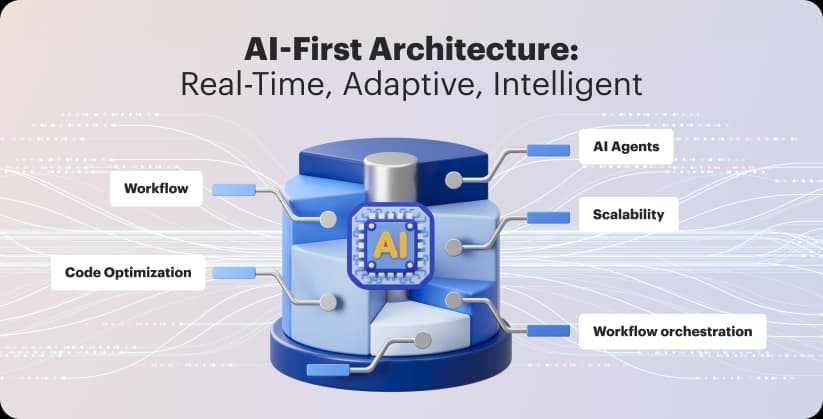
Smart eCommerce agencies re-architect workflows around intelligent agents that can execute and adapt in real time, as opposed to only depending on manual processes or passive automation.
These AI agents manage workflow orchestration, client reporting, content creation of all kinds, and campaign optimization. However, as the general public is already aware, "human teams" prioritize ethical oversight, supervision, and strategic direction.
Advantages of AI integration
In general, AI is integrated in eCommerce development 2026 because it is a technology capable of mimicking, augmenting, and in some cases exceeding human capabilities. Clients can utilize this feature to increase operational efficiencies, improve end-user experience and retention, and give them tools to improve decision-making speed and accuracy.
Intelligent content management
By automating the production, categorization, and optimization of product content, generative AI has the potential to completely transform content management. Generative AI can produce new content that is customized for each customer, in contrast to traditional AI, which evaluates and classifies already-existing content. Product descriptions, pictures, videos, and even interactive experiences are all included in this content.
Brands can provide high-quality, captivating content that appeals to their target audience while saving time and money by utilizing Shopify AI tools. Additionally, by ensuring that product information is correct, current, and conversion-optimized, generative AI may assist organizations in maintaining consistency across all touchpoints.
Smart search and recommendations
By offering users tailored, contextualized results that align with their tastes and intent, generative AI has the potential to completely transform search engines and recommendations. Generative AI can comprehend natural language and intent, in contrast to classical AI, which depends on keyword matching. This allows it to provide users with relevant results that are more likely to match their search queries. Brands may provide intelligent search and suggestion capabilities that improve the product experience and increase conversions by utilizing generative AI.
Demand forecasting
AI can forecast demand by evaluating past data, assisting companies in optimizing inventory levels and minimizing surplus, which lowers expenses and boosts productivity. Businesses can respond swiftly to shifting circumstances thanks to real-time inventory updates, which also enable efficient resource allocation and actionable insights.
Inventory transparency and order accuracy
Real-time visibility into every facet of the crucial order management workflow is offered by AI-powered order management systems. With the use of Shopify AI tools, businesses may proactively detect any disruptions and reduce risks. Customers can be more certain that their orders will be delivered precisely when and how promised because of this visibility.
Intelligent payments
For B2C and B2B customers making purchases in online stores, both traditional and generative AI improve transaction processes. Conventional AI streamlines operations and enhances customer experiences by optimizing point-of-sale systems, automating new payment methods, and enabling numerous payment options across channels. Additionally, the technology can offer tailored and smart financial solutions. Additionally, by developing dynamic and customized pricing methods, generative AI can improve B2C customer payments.
Compliance and data privacy
Traditional AI aids in transaction data security and automates payment regulation compliance throughout the commerce trip, allowing companies to swiftly adjust to new financial requirements and carry out continuous payment process audits. By creating predictive models that foresee modifications to payment laws, AI further improves these capacities. Additionally, it can automate complex data privacy procedures, assisting companies in effectively protecting client data and maintaining compliance.
Future of Shopify Development
All online retailers are experiencing higher returns when they use personalized commerce. According to Shopify research, for instance, brands who use a single platform see a 150% increase in omnichannel GMV growth, and AI-supported product recommendations and demand customisation result in shorter conversion cycles and higher order values.
Sustainability is becoming a crucial difference too. For instance, according to a recent study, 70% of customers wish to adopt even more sustainable behaviors, and nearly one-third of consumers practice six or more of them every day. This big shift also affects business-to-business transactions: half of buyers now give priority to sustainable suppliers, and in three years, that percentage is predicted to rise to two-thirds.
Sustainability analytics are being directly included into Shopify infrastructures by AI-first agency Shopify. These days, advanced data systems are able to predict supplier emissions, examine material data, and highlight low-impact products in storefronts. As a result, eco-conscious choices are integrated right into the purchasing process, creating a new category of data-driven sustainability.

Conclusion
The most effective B2B executives start with focused, goal-oriented use cases that work with their current systems. And the effects are genuine: AI powered development can improve every phase of the purchasing process, generating large-scale increases in efficiency and income.
However, a cohesive Shopify development strategy based on clean data, shared ownership, and distinct business results is necessary to fully realize AI's promise. Get in touch with Stellar to learn how top companies are making that transition and discover how your colleagues are overcoming obstacles to transform AI into a real growth engine.