
Last Updated | October 27, 2025

To give your clients an experience that will serve as a catalyst for the expansion of your company, you must select the best eCommerce platform. Shopify has several features configurable to your company’s particular needs. However, backend customization is limited to some degree. To resolve it, you have to add extensions through apps, or launch your store on platforms like Magento or WooCommerce that offer more flexibility in this regard.
We’re offering five tried-and-true Shopify development methods in this blog post to help you grow your scalable Shopify architecture business and increase sales. These insights will position your store for long-term success, from conversion advice and professional growth tools to social media marketing and client retention tricks.
The Importance of Scalability in eCommerce
eCommerce websites that are scalable may handle growing traffic numbers to satisfy changing business requirements without seeing a decline in performance optimization.
Smooth expansion and efficient handling of heavy traffic during peak hours depend on this capability. By putting the needs of the consumer first and anticipating spikes in online demand, scalability also promotes the expansion of eCommerce.
There are noticeable spikes in traffic during events like Black Friday and flash sales. Given that global eCommerce sales are predicted to reach over $8.09 trillion in total sales by 2028, robust scalability is crucial [2]. Without it, platforms may face server outages, higher bounce rates, and lost income. Effective scalability prevents transaction issues and maintains customer happiness.
Challenges of Scaling Shopify Stores
Businesses have a number of obstacles that may impede their expansion as eCommerce develops and becomes more competitive, scaling Shopify store. Overcoming scalability challenges is essential to success. The top six obstacles to eCommerce growth will be discussed in this article. Feel free to continue reading before speaking with our team about any difficulties.
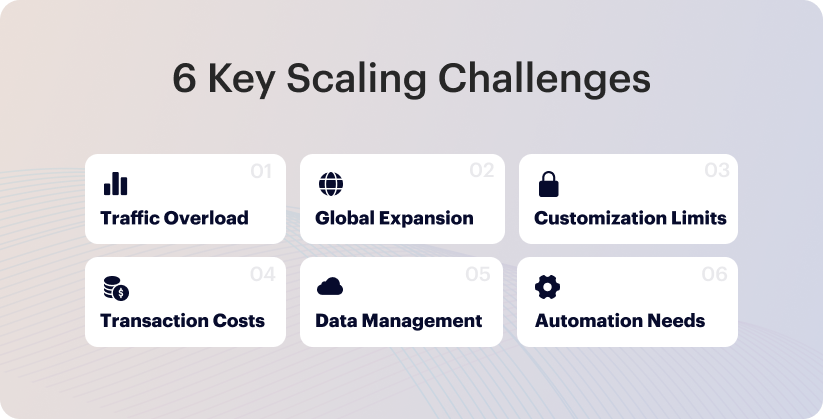
| 1. Traffic Overload Issues | If the underlying infrastructure is unable to manage the extra traffic, it can cause serious performance problems. With Shopify, the cloud-based infrastructure handles large spikes in traffic, so crashes from overload are rare. Performance issues usually stem from factors such as a poorly optimized theme or an excessive number of third-party apps, which can slow down the store. |
| 2. Global Expansion Needs | The necessity to enter foreign markets is becoming more and more important as eCommerce companies expand, particularly in the B2B eCommerce sector. Shopify simplifies the process with Markets and built-in tools. The platform supports multiple currencies with automatic conversions. Real challenges may still arise around fulfillment through third-party services. Invoicing under local laws can also require extra integrations. |
| 3. Customization Constraints | Do you ever feel that the customization choices on your current platform are too limited? Shopify restricts substantial backend tweaks while providing customization options within its framework. But it could be suppressed by, for example, paying for the Plus subscription. |
| 4. Process Automation Required | Repeated tasks that can take a lot of time and resources are common in eCommerce operations. Order fulfillment, inventory control, and customer follow-ups are examples of manual operations that might make it difficult for your team to work effectively. For that reason, businesses use ERP integrations (e.g., Flow or Klaviyo) to scale up eCommerce management. |
| 5. High Transaction Costs | On Shopify, transaction fees depend directly on whether a store uses Shopify Payments and its subscription plan. But for brands with low margins these fees can significantly erode profits, and in countries without Shopify Payments merchants face even higher costs due to higher fees from third-party providers. |
| 6. Data Management Complexity | The amount of data generated by enterprise eCommerce solutions increases in tandem with their growth. Making wise business decisions requires efficient management of this data. However, companies can find it difficult to use insights that could guide marketing plans or enhance consumer experiences in the absence of a strong data management strategy. |
Building a Custom Shopify Architecture
Despite their convenience, thousands of other stores employ pre-built themes. With a distinctive visual identity and user experience that precisely matches your company’s goals and the expectations of your target market, custom Shopify development guarantees that your brand stands out.
It is possible to optimize custom themes and architectures for your particular requirements by eliminating extraneous code and features that cause page load times to increase. Improved search engine ranks and noticeably higher Core Web Vitals scores are frequent outcomes of this focused strategy.
Integrations and apps
Webhooks and APIs are essential for integrating third-party services, enabling smooth system communication, and enabling real-time data updates. Marketing tools, logistics platforms, CRMs, and ERPs are frequently integrated. A more streamlined and cohesive operation can be achieved by linking your Shopify store with other crucial business tools.
When pre-existing apps are insufficient, custom Shopify development with apps might offer features that are specifically designed to meet corporate requirements. Off-the-shelf solutions cannot manage certain business processes, offer specialized functionality, or interface with other systems like custom apps can.
Bespoke software, for instance, can automate complicated processes like processing wholesale orders, providing bulk discounts, or more effectively managing returns and exchanges. This can improve customer satisfaction and business operations by saving time and lowering the chance of mistakes.
Future-Proofing Your Store
Use scalable, modular components when designing your infrastructure for Shopify to easily manage new additions, traffic surges, and integrations. Make use of headless commerce (e.g., Hydrogen, Next.js, Gatsby), and APIs to make sure your store adapts to your company’s demands. Future-proofing speeds your growth, enhances performance, and decreases downtime.
Conclusion
Remaining competitive and scaling effectively require a strong, unique Shopify architecture. Your store may adjust to shifting consumer expectations and market conditions without having to undergo expensive redesigns if you prioritize scalability, flexibility, and maintainability.
Are you prepared to grow your store using a Shopify solution that will last? Collaborate with Stellar Soft to create a unique architecture that is suited for expansion.
FAQ
What is scalable Shopify architecture?
An infrastructure for Shopify and design that can accommodate growing traffic, product SKUs, and transaction volumes without experiencing performance deterioration is referred to as scalable Shopify architecture. It supports expansion through server-side efficiency, modular app integrations, and optimized theme code.
When should a store upgrade to Shopify Plus?
Stores that need multi-channel and multi-store functionality, extensive automation, or huge traffic spikes should think about Shopify Plus. Dedicated support for large-scale operations, improved APIs, and enterprise eCommerce capabilities are all made available through upgrading.
How does architecture affect performance?
A well-designed architecture guarantees seamless page rendering even with high visitor volumes, decreases load times, and lessens server strain. Reduced conversion rates, increased bounce rates, and sluggish reaction times can all result from poor architecture.
Can small stores benefit from scalable solutions?
Yes, small businesses may manage expansion without needing significant redesigns or migrations if they use scalable architecture early on. As the company expands, it also future-proofs the website, making feature growth and performance optimization simpler.