
eCommerce developmentApp developmentCustom developmentHeadlessMigrationReplatformingConsultingWeb designUX/UI designIntegrationMaintenanceShopify developmentShopify Website Development ServicesShopify Store DevelopmentShopify Speed OptimizationShopify Plus Development CompanyShopify Theme DevelopmentProfessional Shopify App Development ServicesProfessional Shopify Migration ServicesExpert Shopify CRO ServicesShopify Website Design ServicesShopify Development CompanyShopify Theme Customization ServicesShopify IntegrationShopify Store SetupShopify Conversion Rate OptimizationCustom softwareSaaS Development ServicesBlockchain Development ServicesFinancial Software Development ServicesMVP developmentConsultingMobile appsWeb portalsAI softwareMagento developmentIT staff augmentationBeringCa'PietraCultnaked – Fashion StoreIntoSocialWorld Jewish Travel - AI AssistantCote&CielBiomaAfterCartHey HolyBears with benefitsVintage furniture sellerBaketivityStellar SEO AppKing of ChristmasChemist4YouEasy ToolErgoBabyRevenue ForecastingNLPG MasterbookSelena TitanNetparcelBeautyInsighterCopperMountainAI Call QA PlatformAlbertbowWorld Jewish TravelGolden State UrologyLGFG Fashion HouseGLOCK WatchesWhat Is Agentic Commerce? The Next Revolution in Digital ShoppingHow Much Does AI App Development Cost in 2026?5 Signs Your AI App Isn’t Ready for LaunchWhy Modern Consumer Brands FailFrom Store Staff to eCommerce Director: Scaling a Norwegian Denim Brand Globally

Christina Cosmeceuticals: Shopify Theme Migration to Online Store 2.0

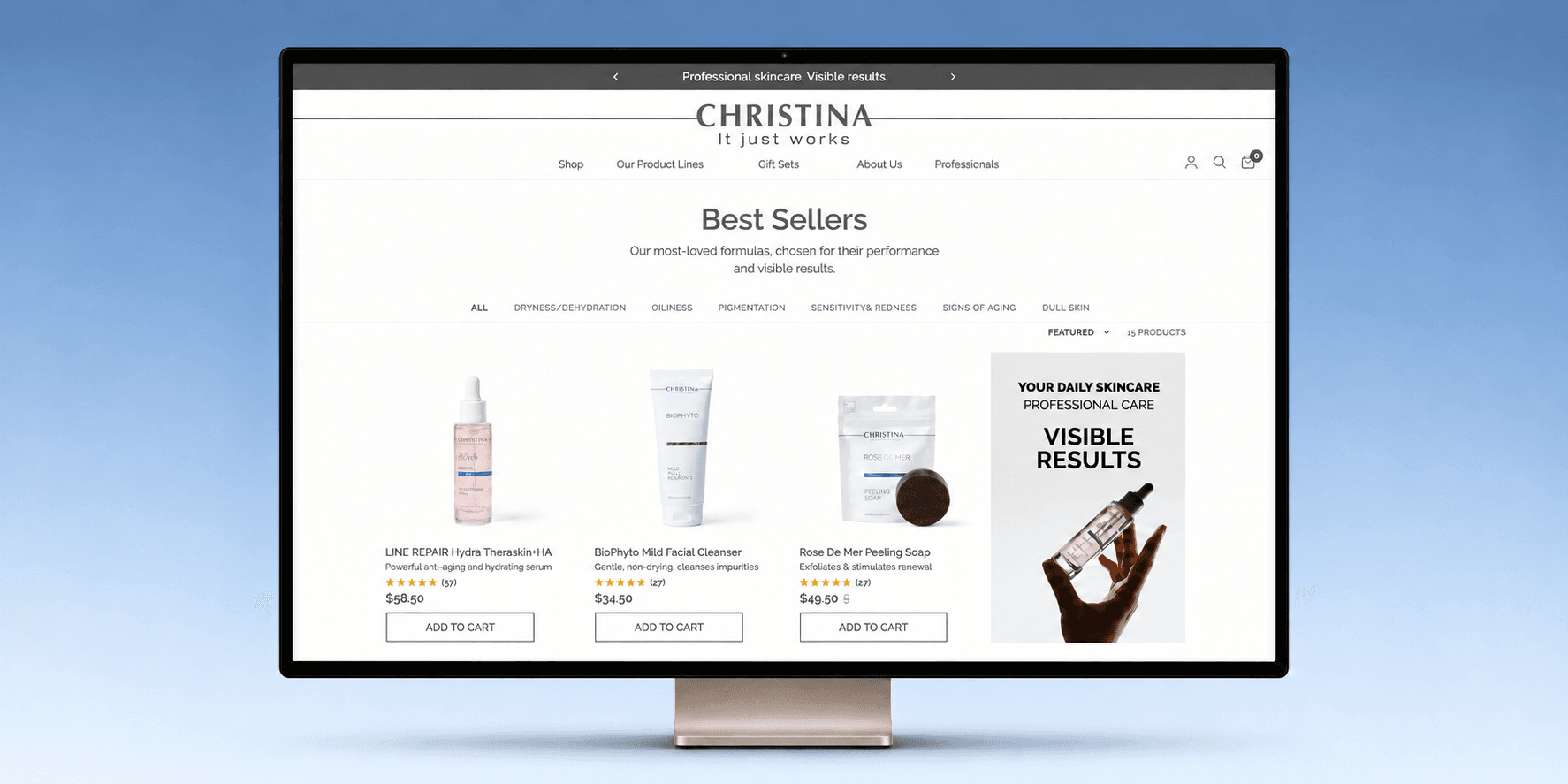
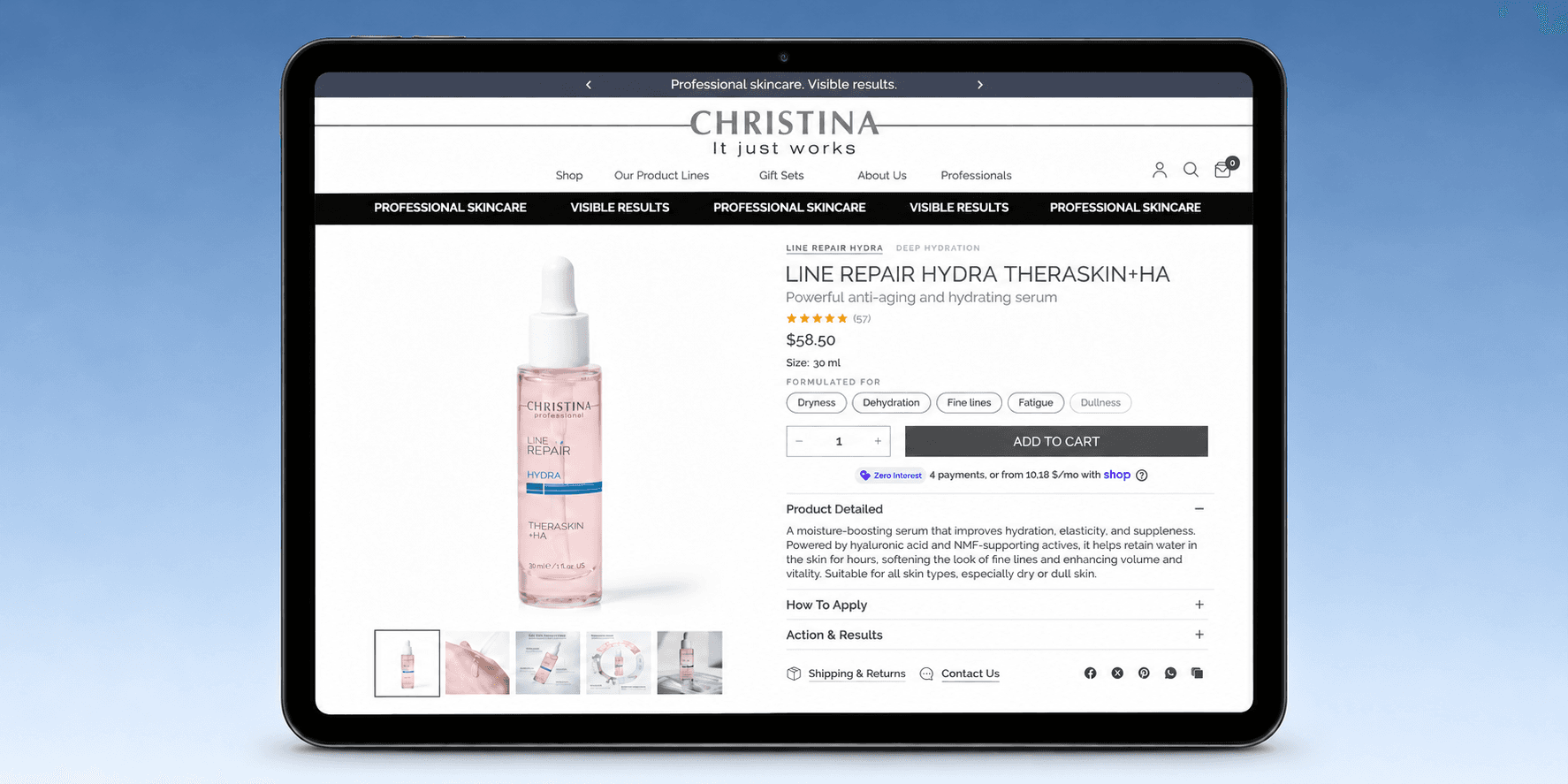
The Christina Cosmeceuticals store ran on a heavily customized vintage Shopify theme where every fix broke something else. We stabilized it, then, as maintenance costs grew, recommended moving to Shopify Online Store 2.0 and rolled out the new theme gradually via A/B testing. We also updated B2B registration and tested ways to migrate customer balances.

Jack Ananchenko

Reviewed by: Jack Ananchenko, Co-founder, CEO

Nov 25, 20269 min read
IsraelUSAIsrael · USA
Christina Cosmeceuticals: Shopify Theme Migration to Online Store 2.0

Christina Cosmeceuticals

Beauty & Skincare · Professional Cosmetics · B2C and B2B E-commerce

The Essentials

PM, 2 Shopify Front-end Developers, QA

Approximately 2–3 years, ongoing collaboration

Shopify Development

Shopify Theme Development

Shopify Theme Customization

Shopify CRO

Shopify Speed Optimization

Shopify Integration

eCommerce Maintenance & Support

6 stores and a corporate website

Israeli store: ~253K sessions per year

87% from mobile devices

Tech Stack

Shopify Online Store 2.0Helium Customer FieldsRedeemlyShopify B2B

B2C and B2B on Shopify for a Professional Skincare Brand

Christina Cosmeceuticals is an Israeli professional skincare brand founded in 1982. The company develops dermatological products for salons, clinics, and at-home skincare, sells its products in over 70 countries, and has earned a strong reputation among dermatologists and skincare professionals.

The online store serves two audiences: retail customers and skincare professionals and salons that require wholesale pricing and personalized discounts.

Online sales are handled through six stores (Israel, the US, France, Spain, Germany, and Italy), alongside a corporate website without checkout functionality. Israel is the primary market, generating approximately 253,000 sessions and over 4,200 orders annually, or around 21,000 sessions and 350 orders per month.

The store's current ecosystem includes Shopify Companies, Helium Customer Fields and new customer approval workflows, Rise.ai, Redeemly and store credit, Judge.me, an external payment gateway for Israel, product bundles, discounts, GA4, Microsoft Clarity, and A/B testing with Rollouts.

Shopify Vintage Theme: Technical Debt, Custom Code, and App Conflicts

When the client approached us 2–3 years ago, the store was running on a Shopify 1.0 theme architecture (which Shopify refers to as a vintage theme) that had been heavily customized over the years. In vintage themes that supported sections, merchants could add and rearrange sections in the theme editor only on the homepage.

Other pages relied on Liquid templates, while apps embedded their code directly into theme files. The more apps were added, the harder it became to predict what the next change might affect.

That was exactly the situation here: some features and integrations were unstable or broken, managing content without developer assistance was difficult, and the theme architecture no longer met modern Shopify requirements.

Why We Recommended Migrating to Shopify Online Store 2.0

We first stabilized the store by fixing critical issues, restoring integrations, optimizing site speed and SEO, and updating individual templates and sections. These improvements helped, but the underlying architecture remained outdated, and maintenance costs continued to rise.

We therefore recommended migrating to Online Store 2.0 to provide a more stable foundation, better performance, easier content management, and greater flexibility for developing both B2C and B2B functionality. The client agreed.

Key Highlights

+37%

Israel Sales

In net sales within 90 days of the new theme launch.

+34%

US Sales

In net sales over the same 90 days.

+5 pp

Repeat Customers

Returning customer rate grew in both Israel and the US.

The Challenge of Replacing a Shopify Theme That Supports Retail and Wholesale Sales

The outdated architecture made it difficult to develop the store reliably. There were three main reasons.

Theme Tech Debt

Heavy customization and unstable or broken components meant any change could trigger a regression.

Logic Split Across Apps

B2B access, discounts, bundles, balances, and reviews ran on conflicting apps, not all supporting B2B.

Workarounds Everywhere

Each change needed a workaround, so even small tasks took longer to build, test, and ship.

As a result, every update became time-consuming, costly, and risky.

What a Store Loses When Checkout Breaks

If the storefront, checkout, or payment integration fails, customers cannot place orders, and the store loses revenue. For B2B customers, an outage also prevents access to their pricing, discounts, store credit, and company-specific terms.

What Had to Remain Intact During Migration: Data, Integrations, and the Israeli Payment Gateway

  • Keep the store running and data intact. Migrate without interrupting sales or losing customer, product, or order data.

  • Keep the old theme running until the new one launches. The vintage theme had to be maintained throughout development.

  • Maintain compatibility with integrations. B2B onboarding, bundles, reviews, discounts, loyalty programs, store credit, and analytics.

  • Account for the external payment gateway in Israel. It limited the use of native Shopify Store Credit and certain checkout features.

  • Preserve separate B2C and B2B logic. Customer tags, Shopify Companies, and company locations.

Migration to Online Store 2.0 in Five Stages

Continuing to patch the old theme no longer made sense. Rebuilding it and switching the entire store over in a single day was also too risky: the same storefront supported retail sales, wholesale pricing, customer balances, and the payment gateway in Israel. We therefore divided the work into five stages:

Vintage theme stabilization → Migration to Online Store 2.0 → Refactoring critical components → Reconnecting and optimizing integrations → Enhancing B2C and B2B functionality

The modular architecture of Online Store 2.0 provided components that could be developed, tested, and scaled across different markets without affecting the rest of the store.

Reusable Sections, A/B Rollout, and a Separate B2B Flow: Key Components of the New Theme

  • Modular theme. Reusable sections and blocks that allow pages to be built in the Theme Editor without constant developer involvement.

  • Phased rollout. The new theme was compared against the old one through A/B testing with real traffic.

  • Separate B2C and B2B flows. Registration with manual approval, customer tags, Companies and company locations, and personalized wholesale terms.

  • Customer balance migration options. Evaluated approaches for transferring balances from the old system, accounting for B2C, B2B, and the external payment gateway in Israel.

  • Integration audit and reconfiguration. Reviewed and reconfigured integrations to reduce conflicts between apps.

Technical Details: A/B Rollout, B2B, and Store Credit

The biggest challenge was rebuilding a heavily customized store that processes sales every day without introducing regressions into B2C and B2B workflows. Customer balances presented a separate challenge: the same mechanism had to work for individual retail customers, companies with multiple employees, and the external checkout process in Israel.

Attempt #1: Targeted Fixes to the Vintage Theme

Targeted fixes stabilized the store temporarily but did not eliminate the technical debt. The next step was therefore a full migration to Online Store 2.0.

A/B Testing the New Shopify Theme: 50/50 Traffic Split and Performance Monitoring

We used Rollouts to split traffic evenly between the old and new themes and compared conversion rates, bounce rates, checkout initiation rates, average order value, and CTR. If the new theme underperformed in any area, the impact would be visible across half the traffic rather than the entire store.

B2B Registration in Shopify: Helium Customer Fields, Manual Approval, and Access to Wholesale Pricing

Wholesale customers register through an extended form built with Helium Customer Fields. Each application is reviewed and approved manually, and only then does the customer gain access to wholesale terms.

We implemented B2B-specific content display based on customer tags and customer status, adapting how prices and discounts appear for B2B scenarios. Approved wholesale customers have separate terms and redirects. At the Shopify B2B level, customers are associated with Companies and company locations.

Corporate Balances in Shopify B2B: Limitations of Rise.ai, Native Store Credit, and Redeemly

Existing customer balances had to be migrated from the old system while remaining accessible to both retail and wholesale customers. Each option came with its own limitations.

  • Attempt #2: Rise.ai Gift Cards for B2B Balances. Did not support the required B2B checkout flow.

  • Attempt #3: Native Shopify Store Credit. Works at the company location level, but its use in Israel was restricted by the external payment gateway. In addition, multiple employees within the same company could potentially access a shared balance.

  • Attempt #4: Redeemly. The basic B2C flow worked. However, in B2B, the app displayed the customer's personal balance instead of the corporate balance, and bulk imports did not support Company ID.

During testing, Redeemly proved suitable for the basic B2C scenario, but migrating corporate balances required a separate solution. Neither Shopify's native functionality nor the available third-party apps fully supported this use case.

Auditing and Reconfiguring Shopify Apps: Bundles, Discounts, Judge.me, and Analytics

During the migration, we didn't simply transfer the existing apps as they were. We reviewed and reconfigured bundles, discounts, Judge.me, checkout, SEO, and analytics to ensure that each app handled its intended functionality without interfering with the logic of other integrations.

Tech Stack: Shopify Online Store 2.0, Shopify B2B, Helium, Redeemly

Platform and Frontend:

  • Shopify Online Store 2.0

  • Liquid, HTML5, CSS/SCSS, JavaScript

B2B and Customer Accounts:

  • Shopify B2B, Companies, Company Locations

  • Customer tags

  • Helium Customer Fields

Loyalty and Store Credit:

  • Rise.ai

  • Smile

  • Redeemly

  • Native Shopify Store Credit

Reviews:

  • Judge.me

Analytics, Experimentation, and Performance:

  • GA4

  • Microsoft Clarity

  • Rollouts

  • Google Lighthouse / PageSpeed Insights

What Changed After the New Theme Launch

The new theme was launched in November 2025. According to Shopify Analytics, the following changes were recorded after the launch (comparing the 90 days following the release with June–September 2025).

Sales in Israel During the 90 Days Following the New Theme Launch

  • Gross sales - +44%.

  • Net sales - +37%.

  • Total sales - +37%.

  • Orders - +34%.

  • Returning customer rate - +5 percentage points.

  • Average order value - +4%.

Sales in the US Over the Same Period

  • Gross sales - +8%.

  • Net sales - +34%.

  • Total sales - +33%.

  • Orders - +31%.

  • Fulfilled orders - +23%.

  • Returning customer rate - +5 percentage points.

  • Average order value - +1.9%.

For Retail Customers and Skincare Professionals: A More Stable Storefront and Clear Access to Wholesale Terms

  • A faster, more stable storefront with more consistent page templates.

  • Fewer errors previously caused by conflicts between the theme and apps.

  • A clear process for wholesale customers: registration, approval, personalized pricing, and terms.

  • Proper separation of B2C and B2B functionality.

For the Christina Team: Content Management in Theme Editor and Smaller, More Frequent Releases

  • Most changes no longer require working with legacy code: pages are built using reusable sections and blocks.

  • The client's team can make certain content changes independently in Theme Editor, without a separate release.

  • Releases are smaller and more frequent, making them easier to test.

  • Savings come from reduced development hours: less time spent working with legacy code, manually creating templates, and resolving app conflicts. Shopify already handles the infrastructure.

  • Lower risk of costly incidents during launch thanks to the phased migration.

Storefront Stability After Migrating to Online Store 2.0

Shopify handles uptime, hosting, and scaling. Our responsibility was the storefront: we replaced the overloaded vintage theme, cleaned up legacy code, and reconfigured critical integrations. The new theme can now be developed for different markets without adding unnecessary complexity with every update.

  • linkedin
  • x
  • facebook
  • Clutch
  • Upwork
  • Reddit

Is Your Store Still Running on a Vintage Shopify Theme ?

We'll assess your theme and apps and, if migration makes sense, propose a phased transition plan to Online Store 2.0 while your store continues to process sales.


Jack ananchenko

Jack Ananchenko

CEO and Co-founder

Vladimir gubarev

Vladimir Gubarev

COO and Co-founder

By submitting this form, you agree to our Privacy Policy and Terms & Conditions.

How We Can Help You

See What Else We've Built