
eCommerce developmentApp developmentCustom developmentHeadlessMigrationReplatformingConsultingWeb designUX/UI designIntegrationMaintenanceShopify developmentShopify Website Development ServicesShopify Store DevelopmentShopify Speed OptimizationShopify Plus Development CompanyShopify Theme DevelopmentProfessional Shopify App Development ServicesProfessional Shopify Migration ServicesExpert Shopify CRO ServicesShopify Website Design ServicesShopify Development CompanyShopify Theme Customization ServicesShopify IntegrationShopify Store SetupShopify Conversion Rate OptimizationCustom softwareSaaS Development ServicesBlockchain Development ServicesFinancial Software Development ServicesMVP developmentConsultingMobile appsWeb portalsAI softwareMagento developmentIT staff augmentationBeringCa'PietraCultnaked – Fashion StoreIntoSocialWorld Jewish Travel - AI AssistantCote&CielBiomaAfterCartHey HolyBears with benefitsVintage furniture sellerBaketivityStellar SEO AppKing of ChristmasChemist4YouEasy ToolErgoBabyRevenue ForecastingNLPG MasterbookSelena TitanNetparcelBeautyInsighterCopperMountainAI Call QA PlatformAlbertbowWorld Jewish TravelGolden State UrologyLGFG Fashion HouseGLOCK WatchesWhat Is Agentic Commerce? The Next Revolution in Digital ShoppingHow Much Does AI App Development Cost in 2026?5 Signs Your AI App Isn’t Ready for LaunchWhy Modern Consumer Brands FailFrom Store Staff to eCommerce Director: Scaling a Norwegian Denim Brand Globally

Edurino: Modernizing Shopify Plus Across Markets and Migrating B2B

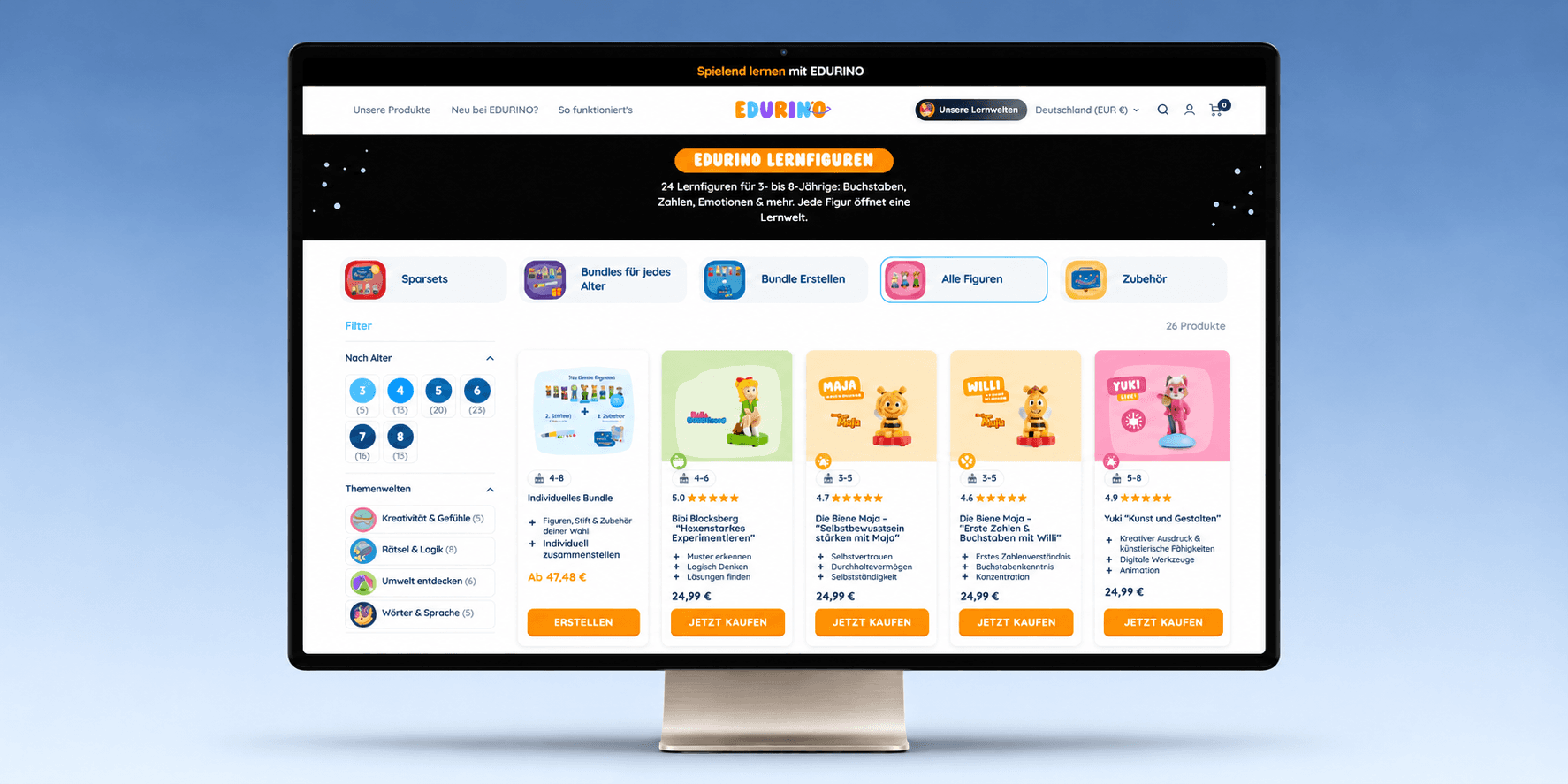
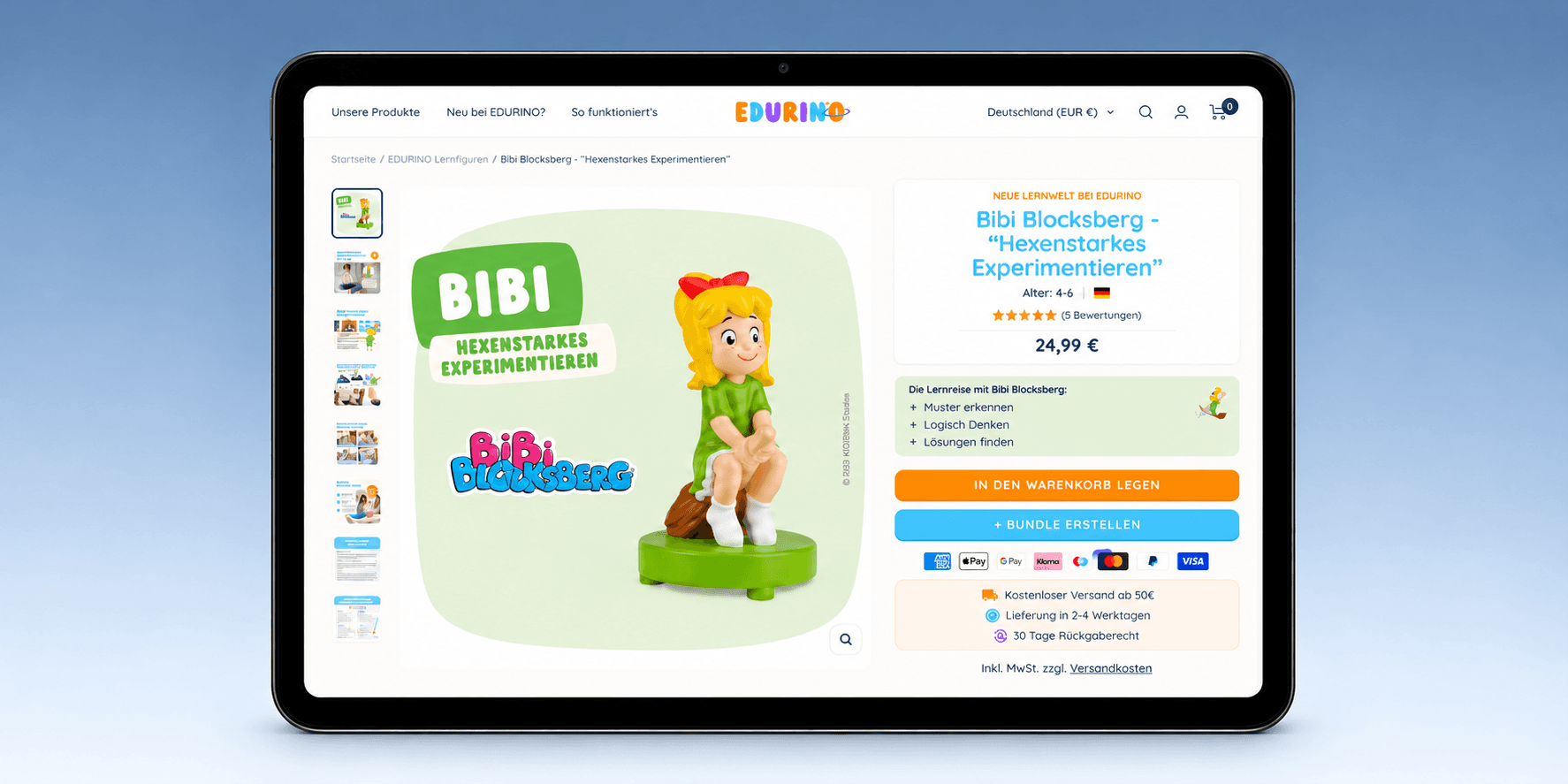
“It looks like a hospital: too white, plain, and flat” - that’s how Edurino described its website when we started. Under the hood were Shogun, scattered templates, many third-party apps, and a separate legacy B2B setup. We moved key pages from Shogun to Shopify Online Store 2.0 and rebuilt the cart and Bundle Builder. The project also included work on the migration to Shopify B2B. Every change ships in phases while the store keeps selling.

Jack Ananchenko

Reviewed by: Jack Ananchenko, Co-founder, CEO

Nov 25, 202612 min read
GermanyGermany
Edurino: Modernizing Shopify Plus Across Markets and Migrating B2B

Edurino

EdTech brand developing a digital learning system for children aged 4-8.

The Essentials

Shopify Plus Development

Shopify CRO

UX/UI Design

Shopify Integration

Shopify Speed Optimization

eCommerce Maintenance & Support

12 Stellar Specialists

Ongoing collaboration

776K sessions over 7 months in Germany

Tech Stack

Shopify PlusShopify B2BMarketsEverstox

An EdTech Brand’s D2C Store on Shopify Plus That Outgrew Its Architecture

Edurino develops a play-based learning system for children aged 4-8. It combines a mobile app, physical figurines, and an ergonomic stylus to help children build skills for school. Edurino is a Series B EdTech company.

The figurines, styluses, and sets are sold through the official online store on Shopify Plus. For Edurino, this is the main sales channel and primary point of contact with parents, following a classic D2C model. The scale is evident even in a single market: from January to July 2026, the German store recorded 776,871 sessions and 42,724 orders. According to Shopify Analytics, the online store's conversion rate was 3.58%. Around 87% of sessions came from mobile devices, making the mobile storefront and its performance critically important.


A Legacy Storefront Built on Shogun and Custom Templates, with B2B in a Separate System

When we joined the project, the B2C store was already running on Shopify, but the storefront consisted of multiple layers. Some pages had been built in Shogun, while others relied on custom templates and individual sections. Each solution had originally addressed a specific need, but together they did not scale well across pages and markets.

Here is what we found:

  • Outdated structure of key pages: Homepage, product detail pages (PDPs), product listing pages (PLPs), and cart.

  • Inflexible section system. Launching a new landing page, seasonal campaign, or A/B test required developer involvement.

  • Complex cart and bundle logic distributed across the theme and apps.

  • Mobile UX and performance issues.

  • Numerous third-party apps and integrations that affected one another.

  • Different markets, languages, catalogs, and purchasing scenarios that were becoming increasingly difficult to maintain.

  • Marketing depended on developers even for minor changes.

The B2B business operated separately from the main store. Customer, company, pricing, invoicing, and order fulfillment data passed through several systems, including JTL and Everstox. This resulted in manual work, duplicate records, and questionable data quality. In addition, the old registration logic had corrupted some customer records, which would later create complications during the B2B migration.

In practice, Edurino had two parallel ecosystems: Shopify for B2C and a separate legacy infrastructure for B2B, invoicing, and order fulfillment. There was no unified architecture connecting them, and each new market or purchasing scenario became more difficult to support than the previous one.

New Markets, Campaigns, and B2B: Why Edurino Needed an Ongoing Shopify Partner

Edurino approached us with more than a single task. The company was launching new products and entering new markets, running seasonal campaigns, and expanding B2B sales. It also wanted to systematically improve conversion rates and average order value using data from Shopify Analytics, GA4, and Microsoft Clarity. The store's existing structure could no longer keep up with this pace.

The company therefore needed a long-term Shopify technical partner capable of handling development, integrations, CRO, expansion into new markets, and the gradual restructuring of its e-commerce architecture. Building individual pages on request would not solve the underlying problem.

Key Highlights

+19%

Gross Sales

From December 2024 to November 2025.

120,376

Orders per Year

+7% in orders from December 2024 to November 2025.

~300

Completed Tasks

Over nine completed months, we handled around 300 tasks, averaging more than 30 per month.

Why Shopify Store Expansion into New Markets Was Limited by Apps and Templates

The main problem can be summed up in one sentence: the e-commerce infrastructure did not allow Edurino to scale quickly and safely enough. Three issues made the store difficult to scale.

Fragmented Storefront

Pages were built in Shogun, custom templates, and legacy sections, making it difficult to reuse layouts and components across pages and markets.

One Change, Multiple Systems

The cart, bundles, order fulfillment, invoicing, tracking, and customer data were interconnected. A change to the cart could affect checkout, discounts, or order transmission to the warehouse.

Slow Campaigns and Tests

Marketing had to wait for developers, while campaigns and A/B tests required considerable time and manual checks.

How Cart and Discount Errors Affect Sales

Edurino sells in several countries, and any storefront or checkout outage immediately stops sales. This is particularly damaging during major campaigns and new product launches: the traffic budget is already being spent, but customers cannot complete their purchases.

The store does not necessarily have to go down for problems to occur. An error in pricing, bundles, discounts, Markets settings, or order fulfillment logic is enough to cause incorrect orders, lost revenue, and additional workload for customer support and operations teams.

Shopify Markets, Everstox, and Corrupted Legacy Data: The Constraints We Worked Within

  • Within Shopify only. All solutions had to fit within the platform's architecture, checkout limitations, and Shopify Markets rules.

  • Legacy logic could not be disabled all at once. Integrations with Everstox, invoicing systems, tracking, Klaviyo, bundles, and other apps had to remain operational throughout the changes.

  • Each market had its own rules. DACH, the UK, the Netherlands, and Ireland differed in languages, pricing, catalogs, and product assortments. B2B, as a separate sales channel, also had its own catalogs, VAT requirements, and payment terms.

  • B2B migration was constrained by the quality of legacy data: customers, catalogs, company locations, VAT information, and payment terms.

  • Store and app accounts did not match. A separate workstream involved integrating Shopify Accounts with Keycloak, the authentication system used by the Edurino app. The same person could use different email addresses for the store and the app, making it impossible to reliably merge their accounts and order histories into a single record.

Phased Migration from Shogun to Shopify Online Store 2.0 Instead of Adding Another Layer on Top of the Old System

The platform itself was not the problem for Edurino. Shopify Plus has everything needed for multiple markets and B2B: Markets, Shopify B2B, metaobjects, and Functions. The problem was what had accumulated on top of it over time: page builders, templates for individual pages, and apps that duplicated each other's functionality. Moving to another platform would not untangle these dependencies, while rewriting everything from scratch in a single release would pose an unacceptable risk for a store that generates sales every day.

That is why we proposed a phased modernization. We are gradually replacing Shogun and PageFly with Shopify Online Store 2.0's native architecture: reusable sections, templates, metafields, and metaobjects. In parallel, we have updated the homepage, product and collection pages, cart, Bundle Builder, and checkout. A separate workstream covered the migration to Shopify B2B and integrations with order fulfillment, invoicing, marketing, and analytics systems.

Our work covers seven areas: performance and Core Web Vitals; mobile-first UI/UX; custom Shopify development; third-party app integration and debugging; discounts and gifts with purchase (GWP); SEO, migrations, and data imports; and critical bugs, refactoring, and code cleanup across the DACH, UK, and B2B stores.

Reusable Sections, Shopify Markets, and Shopify B2B: The Target Architecture

  • Modular storefront built on Online Store 2.0. A library of reusable sections and templates that allows the marketing team to build pages and campaigns independently.

  • Content stored in metafields and metaobjects instead of hardcoded blocks. PDPs, PLPs, and landing pages can scale across markets without duplicating code.

  • Multi-market foundation: DACH, the UK, the Netherlands, and Ireland, with different languages, catalogs, prices, promotions, and product availability.

  • Commerce logic tailored to Edurino's business model: Bundle Builder, gifts with purchase (GWP), discount rules, cart upsells, and campaign-specific pricing.

  • Shopify B2B architecture: Company accounts and locations, separate catalogs, VAT settings, and payment terms, with invoicing and Everstox integration for order fulfillment.

  • Infrastructure for A/B testing: Separate templates and components that allow experiments to run without rebuilding the storefront.

  • Performance monitoring: We continuously monitor Core Web Vitals to ensure new features do not slow down the site.

  • Stable integration layer: Klaviyo, Reviews.io, tracking, analytics, bundle and promotion apps, with checks for conflicts between them.

How We Untangled Bundles, Gifts, Cart Logic, and B2B Data on a Live Shopify Plus Store

Attempt #1: Bundles and GWP Using Ready-Made Apps and a Conflict with Personizely Cart Transform

Initially, third-party Shopify apps were used for bundles, gifts with purchase (GWP), cart functionality, and promotions. This was a logical starting point: fast implementation without custom code.

However, the standard settings did not cover some of Edurino's scenarios, and the apps began conflicting with one another. For example, the Freebies/GWP logic conflicted with Cart Transform in Personizely. In such cases, we debugged and adapted the integration. When that was not enough, we replaced the standard behavior with custom code.

Attempt #2: Cleaning Customer Data Before Importing It into Shopify B2B

The initial plan for the B2B migration was to import customers and companies directly from the legacy systems. During preparation, we discovered that the old registration logic had corrupted some records. Importing the data without validation would have transferred these errors into the new system.

We therefore switched to a controlled process:

Export → Validation → Cleaning → Test Import → Final Import

We used Matrixify for bulk operations involving customer and product data.

Custom Bundle Builder on Shopify: Steps, Product Availability, and URL Parameters

Ready-made bundle apps did not cover all of Edurino's scenarios, so we built the Bundle Builder using custom logic. It manages product selection and transitions between steps, checks availability, works with URL parameters, and displays content specific to each bundle.

Gifts with Purchase for Multiple Markets: A Gift That Automatically Appears and Disappears from the Cart

Gifts are automatically added to and removed from the cart. The logic takes into account the market, cart contents, promotion conditions, and rules of each campaign. A promotion available in Germany should not accidentally apply in the UK, and a gift should not remain in the cart when the customer removes the product it was associated with.

Progress Bars, Upsells, and Gift Thresholds in the Cart

We added progress bars for gifts, upsells, product recommendations, gift thresholds, and complex discount scenarios to the cart. All of these features must work together with bundles and GWP without allowing discounts to be applied twice.

Theme Editor Sections Built with Metafields and Metaobjects

For the homepage, product and collection pages, cart, and campaigns, we created sections and templates that the Edurino team can configure in the Theme Editor. Products, content, and section settings are pulled from Shopify's data model rather than hardcoded. To change a block on a PDP or landing page, the team only needs to edit the data in the admin panel. The template remains unchanged, and the same section works across all markets.

Migration to Shopify B2B: Companies, Catalogs, VAT, and Payment Terms

The Shopify B2B migration covered company accounts and locations, separate catalogs, VAT settings, and payment terms. Invoicing and the Everstox integration for order fulfillment were handled as separate workstreams.

Staging, Copies of the Live Theme, and Phased Releases: How We Deploy Changes

We test changes on staging and copies of the live theme, conduct QA, and release updates in stages for individual markets. We specifically check that changes to the cart, bundles, gifts, or discounts do not break checkout, tracking, or order transmission for fulfillment. After introducing new features, we monitor Core Web Vitals to prevent performance regressions.

CategoryTools & Technologies
Platform and FrontendShopify Plus, Shopify B2B, Shopify Markets, Liquid, HTML5, CSS/SCSS, JavaScript, Metafields and metaobjects, Shopify Functions / Cart Transform and Shopify APIs - where required by custom logic
Commerce and IntegrationsEverstox - order fulfillment, Klaviyo, Reviews.io, Bundle Biscuit, Personizely, Shoplift - A/B testing, Matrixify - bulk imports and data migrations, Powerful Form Builder, Shogun, PageFly - legacy page builders we are gradually phasing out
Analytics, CRO, and PerformanceGA4, Google Tag Manager, Microsoft Clarity, Shopify Analytics, Core Web Vitals, Google Lighthouse / PageSpeed Insights

How Edurino's Sales, Storefront, and Marketing Operations Have Changed

Edurino Sales and Orders from December 2024 to November 2025

  • Gross sales: + 19%

  • Orders: +10%

  • Gross Sales per Order: +12%

For Customers: A Vibrant Mobile-First Storefront That Reflects the Product Itself

  • The storefront has become more vibrant and better reflects Edurino's playful nature. It is designed for both children and parents.

  • A more convenient mobile purchasing journey across the homepage, PDP, PLP, cart, checkout, and Bundle Builder.

  • Easier bundle creation and gift redemption: Customers can see what they have selected, what they will receive, and how much more they need to spend to reach the next threshold.

  • Improved performance and Core Web Vitals through optimization of resources, code, and third-party apps.

  • Fewer error-prone scenarios after stabilizing discounts, GWP, and cart logic.

For Marketing: Landing Pages Built from Ready-Made Sections in Theme Editor, Without Developers

  • New pages are assembled from ready-made sections through Theme Editor, without requiring a separate development task.

  • Solutions scale across markets: Existing sections and templates can be adapted for different markets.

  • Small, frequent improvements instead of large, infrequent releases. Over nine completed months, we handled approximately 300 tasks, or more than 30 per month, including campaign updates, bug fixes, and A/B variants. This represents the volume of work, not the number of deployments.

  • Lower subscription costs. Phasing out some page builders and unnecessary apps reduces monthly service fees.

Uptime Provided by Shopify Plus, Stable Commerce Logic Maintained by Us

Shopify Plus handles uptime, hosting, and scaling under load. Our responsibility is storefront and commerce logic stability: refactoring legacy code, auditing apps, debugging conflicts, and conducting QA on copies of the live theme. QA and phased releases for individual markets have reduced the risk of cart or discount changes disrupting checkout or order fulfillment.

  • linkedin
  • x
  • facebook
  • Clutch
  • Upwork
  • Reddit

Expanding into new markets, yet every campaign still needs a developer ?

We’ll audit your theme, apps, and integrations to map a seamless transition to a flexible foundation - without interrupting your sales.


Jack ananchenko

Jack Ananchenko

CEO and Co-founder

Vladimir gubarev

Vladimir Gubarev

COO and Co-founder

By submitting this form, you agree to our Privacy Policy and Terms & Conditions.

How We Can Help You

See What Else We've Built