eCommerce developmentApp developmentCustom developmentHeadlessMigrationReplatformingConsultingWeb designUX/UI designIntegrationMaintenanceShopify developmentShopify Website Development ServicesShopify Store DevelopmentShopify Speed OptimizationShopify Plus Development CompanyShopify Theme DevelopmentProfessional Shopify App Development ServicesProfessional Shopify Migration ServicesExpert Shopify CRO ServicesShopify Website Design ServicesShopify Development CompanyShopify Theme Customization ServicesShopify IntegrationShopify Store SetupShopify Conversion Rate OptimizationCustom softwareSaaS Development ServicesBlockchain Development ServicesFinancial Software Development ServicesMVP developmentConsultingMobile appsWeb portalsAI softwareMagento developmentIT staff augmentationBeringCa'PietraCultnaked – Fashion StoreIntoSocialWorld Jewish Travel - AI AssistantCote&CielBiomaAfterCartHey HolyBears with benefitsVintage furniture sellerBaketivityStellar SEO AppKing of ChristmasChemist4YouEasy ToolErgoBabyRevenue ForecastingNLPG MasterbookSelena TitanNetparcelBeautyInsighterCopperMountainAI Call QA PlatformAlbertbowWorld Jewish TravelGolden State UrologyLGFG Fashion HouseGLOCK WatchesWhat Is Agentic Commerce? The Next Revolution in Digital ShoppingHow Much Does AI App Development Cost in 2026?5 Signs Your AI App Isn’t Ready for LaunchWhy Modern Consumer Brands FailFrom Store Staff to eCommerce Director: Scaling a Norwegian Denim Brand Globally

Kleem Organics: Boosting Conversions for a Shopify Skincare Store

The store's cart, subscriptions, and discounts operated independently, so over two years, we brought Rebuy Smart Cart, Recharge, and promotional mechanisms together into a unified purchase flow supported by A/B testing. Orders per session increased by 42%, while an “obvious” cart upgrade was never rolled out to all traffic because testing showed that it generated fewer sales.

Jack Ananchenko

Reviewed by: Jack Ananchenko, Co-founder, CEO

Nov 25, 202610 min read
MaltaMalta
Kleem Organics: Boosting Conversions for a Shopify Skincare Store

Kleem Organics

Beauty & Skincare · D2C E-commerce

The Essentials

Shopify Development

Shopify CRO

Shopify Integration

UX/UI Design

PM, 2 developers, designer, QA, CRO specialist

2 years, ongoing

D2C organic skincare brand

169,005 sessions and 5,965 orders in 2025

Tech Stack

ShopifyLiquidRebuy Smart CartRecharge

D2C Skincare Store on Shopify Before CRO: Rebuy, Recharge, and Discounts That Didn't Work Together

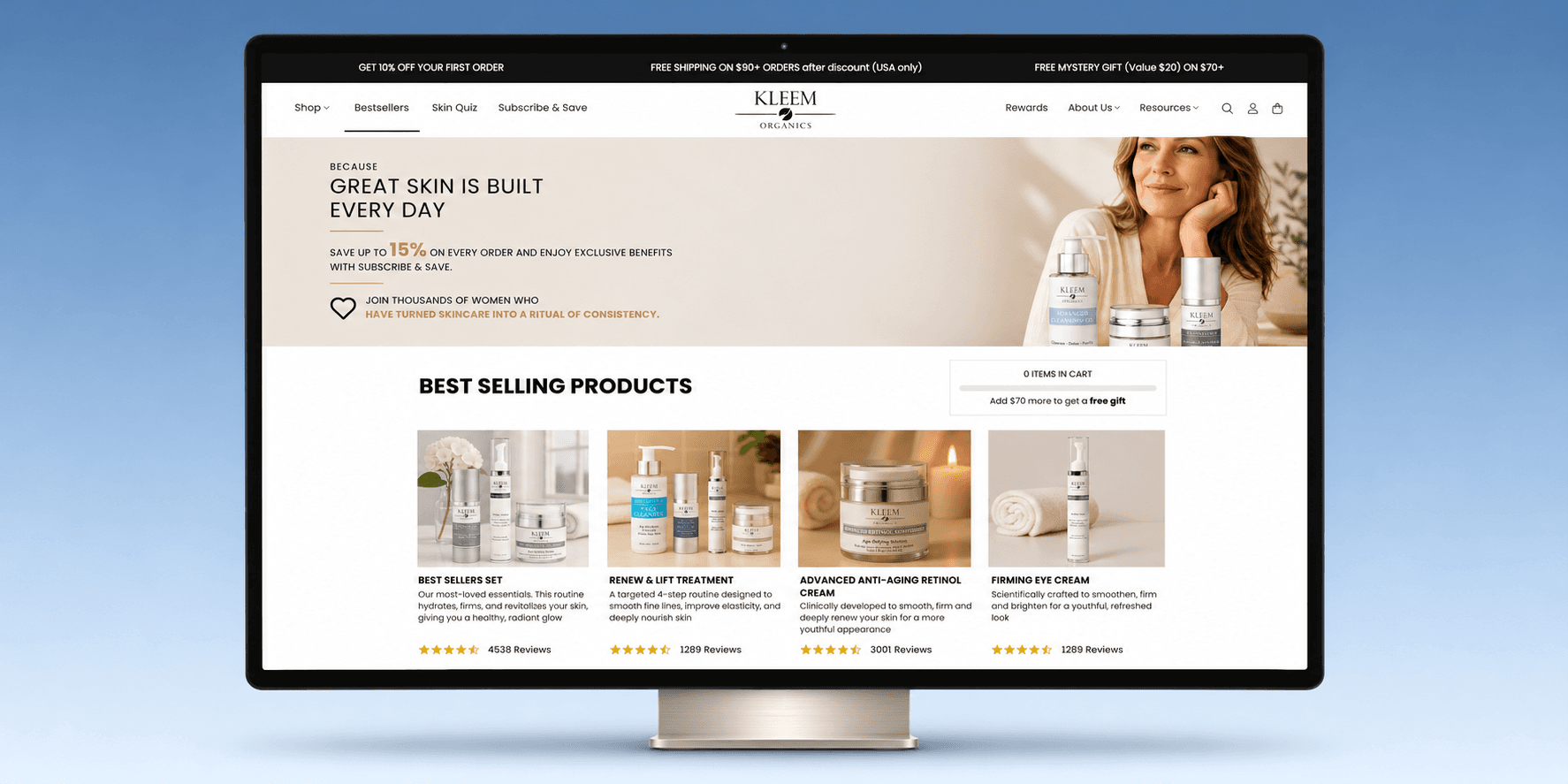
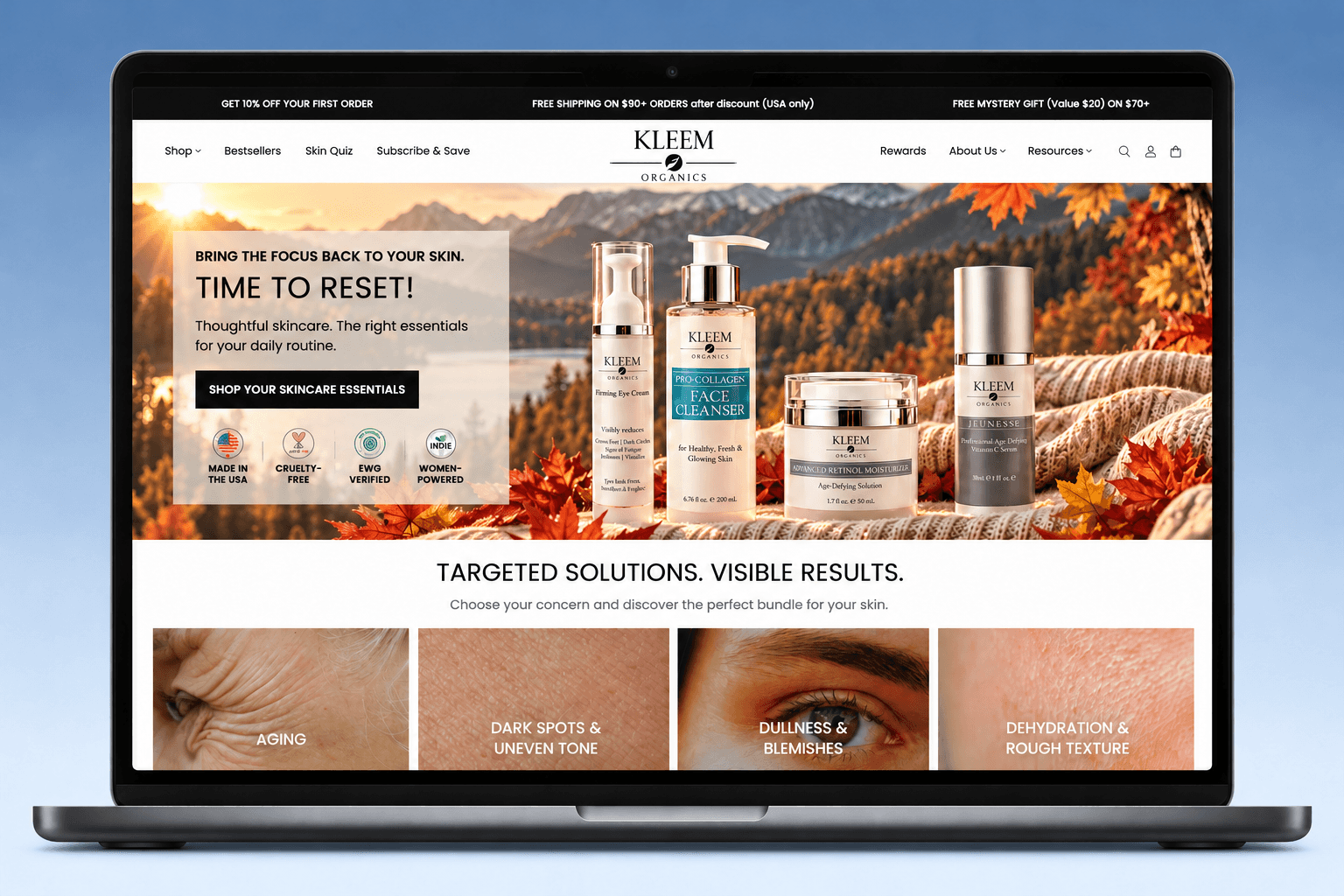
Kleem Organics is an organic skincare brand specializing in skincare products, including anti-aging solutions. It sells directly to consumers through its own website and marketplaces. The brand focuses on certified organic ingredients, eco-friendly packaging, and direct communication with customers.

The Shopify store supports one-time purchases and subscriptions, personalized upsells, automatic gifts, and volume discounts. The store has a conversion rate of 1.89% and a returning customer rate of 28.6%. Traffic is split roughly equally between mobile and desktop devices.

When we joined the project, the store was already up and running and performing reasonably well. Rebuy, Recharge, and Shopify Discounts were already integrated. However, each component had been added to solve a specific problem, and they had never been brought together into a cohesive customer journey from the product page to checkout.

In practice, this created several issues. The difference between a one-time purchase and a subscription wasn't clear enough on product pages. Discounts from different systems could conflict.

Gifts and upsells were difficult to manage. Recharge occasionally encountered errors when managing subscriptions. And every change had to be manually coordinated across Shopify, Rebuy, and Recharge, slowing down the launch of each new CRO hypothesis.

Why Invest in CRO When the Store Is Already Generating Sales?

There was no critical failure or migration to handle. The store was operating, so the challenge was different: how to generate more revenue from the traffic it already had.

At this traffic volume, even a small improvement in conversion rate, average order value, or repeat purchases can produce a noticeable increase in revenue. The client wanted to improve product page and cart conversion rates, increase average order value and the share of repeat purchases, streamline the subscription journey, and gain better control over upsells, volume discounts, and gifts added to orders.

Another priority was to stop launching changes without validation and start measuring how each one affected business metrics.

+42%

Orders per Session

Each visit brings more orders: 50 per 1,000 sessions in 2026 vs. 35 in 2025

+19%

Monthly Orders

591 orders a month on average in 2026, up from 497 in 2025

0

Sales Interruptions

Every update shipped while the store kept taking orders

The Challenge: Why Shopify Cart, Subscriptions, and Discounts Were Difficult to Coordinate

The store was consistently receiving orders, but the cart, subscriptions, discounts, and additional offers operated separately. Traffic was coming in, yet the mechanisms designed to increase average order value and encourage repeat purchases weren't working together.

There were three reasons behind this.

Scattered Promo Logic

Rebuy, Recharge, and Shopify Discounts handled different scenarios. Subscription discounts, Buy 2 / Buy 3 offers, gifts, and free shipping could conflict, creating a risk of discounts being combined incorrectly.

Disconnected Purchase Journey

Product pages, the cart, and subscriptions evolved separately, so customers didn't always see consistent offers at different stages of the purchase journey.

Decisions Without Data

Changes were launched without systematic testing. In CRO, even a solution that looks better visually can reduce conversion rates or revenue.

Constraints: Working With a Live Store and Active Subscriptions

  • The store cannot be taken offline. In 2025, it averaged 16 orders per day, with peak daily sales exceeding 42 times the daily average. Storefront or checkout downtime prevents new purchases and subscriptions, while issues during marketing campaigns directly affect conversion rates and revenue. That's why critical changes undergo QA and controlled releases.

  • Working within the existing architecture. The theme and custom logic had to remain compatible with Rebuy Smart Cart, Recharge, Shopify Discounts, and marketing integrations.

  • Existing subscriptions must continue working. Changes had to preserve active subscriptions and the familiar checkout experience for returning customers.

  • Discounts that must work together. Subscription discounts, Buy 2 / Buy 3 offers, automatic gifts, and free shipping thresholds had to coexist in the same cart without conflicts or double discounts.

How to Coordinate Cart, Subscriptions, and Discounts Across Shopify, Rebuy, and Recharge

Each of these mechanisms is standard on its own. The complexity comes from having them operate across different systems. Shopify, Rebuy, and Recharge handle different parts of the purchase journey, but they all need a consistent understanding of what's in the cart, whether it's a one-time purchase or a subscription, which discounts have been applied, and whether a gift qualifies. Discount conflicts arise when these systems interpret that information differently.

The second challenge was less technical. We needed to distinguish between solutions that looked better and those that actually generated more sales. They aren't always the same, as the technical section below illustrates.

Solution: Incremental Shopify Store Conversion Rate Optimization

We kept the existing Shopify architecture and started by aligning the cart, subscriptions, and promotional mechanisms. The next stage is a product page redesign.

We didn't recommend replatforming. The store was generating sales and attracting traffic, while the weak points were the connections between its components rather than the platform itself. Rebuilding a system that generates sales every day would introduce significant risks without guaranteeing an increase in conversion rates.

Our workflow follows this cycle:

Data → Hypothesis → Development → QA → Release or A/B Test → Evaluation of Impact on Conversion Rate, AOV, and Revenue

Changes undergo QA in a Shopify staging theme. We use A/B testing to evaluate the impact of cart and promotional changes before rolling them out to all traffic. This keeps the store running without interruptions and ensures that decisions about the cart and discounts are backed by data.

Key Components of the Conversion System: Smart Cart, Subscribe & Save, and CRO Features

  • Multi-tier Rebuy Smart Cart. We coordinated Buy 2 / Buy 3 discounts, automatic gifts, and tiered reward thresholds for additional gifts and free shipping.

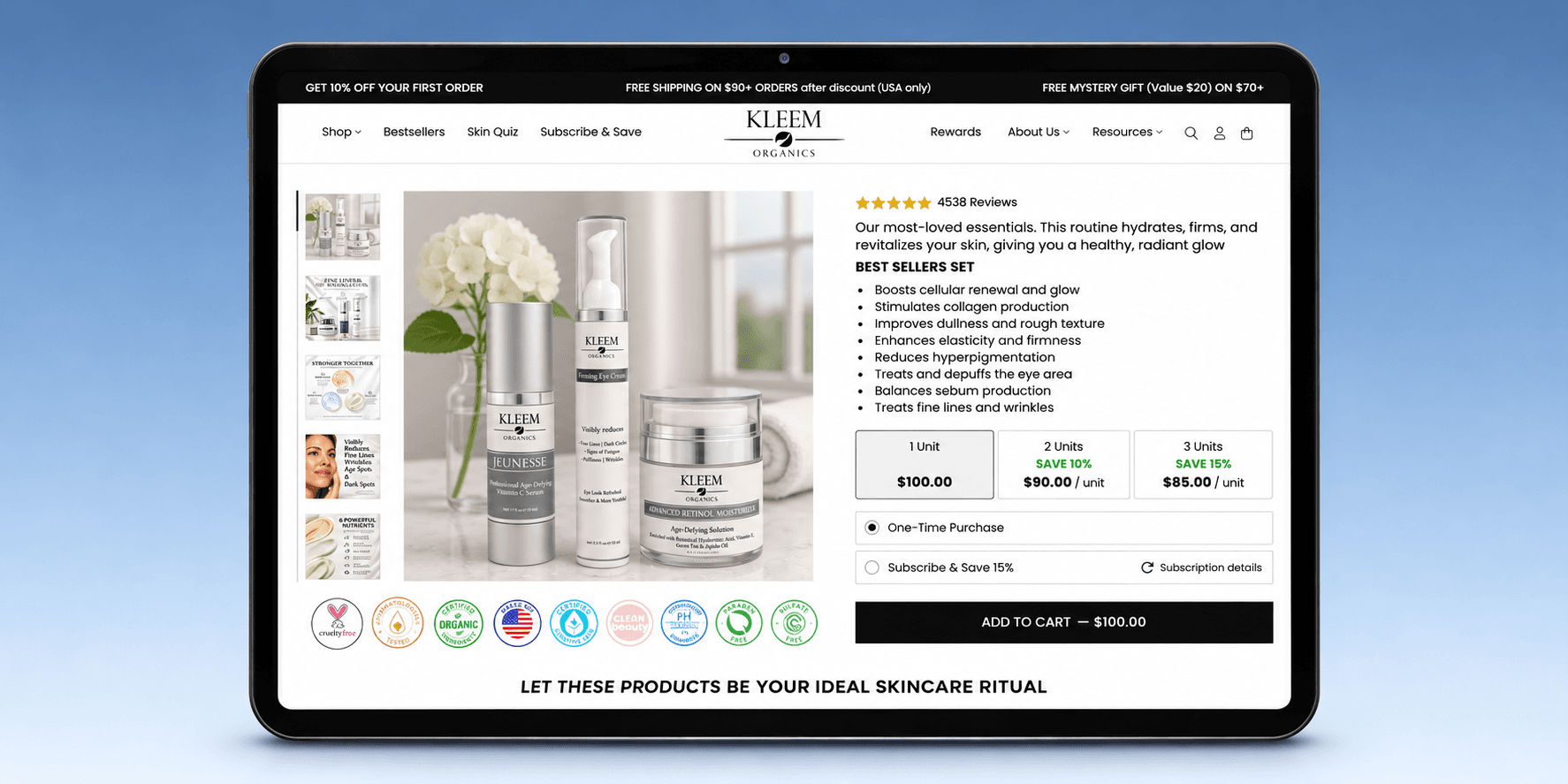
  • A Seamless Subscription Journey. We synchronized Recharge with the Shopify purchase flow, implemented Subscribe & Save with a 15% discount, and fixed an error that occurred when switching between subscription variants.

  • Independently Manageable CRO Components. Sticky Add to Cart, product page upsells, badges, incentives to purchase larger quantities, and gifts added to orders. Each component can be modified and tested independently without rebuilding the entire storefront.

How We Tested Rebuy Smart Cart V2, Prevented Discount Conflicts, and Stabilized Recharge Subscriptions

This section covers what didn't work on the first attempt. That happens all the time in CRO, and these experiments are ultimately what help build a system that works.

Attempt #1: Rebuy Smart Cart V2 Looked Better, but A/B Testing Revealed Lower Conversion Rates

The first major task seemed obvious: replace the old cart with Rebuy Smart Cart V2. The new version offered a more modern UX and broader promotional capabilities.

The easiest approach would have been to make the switch in a single release. Instead, we ran an A/B test comparing the old version with the new one. The results favored the old cart, which delivered higher conversion rates and more revenue.

We therefore decided not to roll out Smart Cart V2 to all traffic. A visual improvement alone wasn't a good enough reason. The test results became the starting point for the next iteration.

Attempt #2: Buy 2 / Buy 3, Gifts, and Free Shipping in One Cart Without Double Discounts

The second attempt involved a common challenge for D2C stores: enabling several ready-made promotional features at once and expecting them to work together. Subscription discounts, Buy 2 / Buy 3 offers, gifts, and free shipping all worked individually, but combining them introduced risks.

There were two risks. The technical one was incorrect discount stacking, potentially resulting in double discounts. The other was communication: it became increasingly difficult to explain exactly what customers were getting.

We separated the logic by priority, defining what each mechanism controlled, which offers could be combined, and which couldn't. We tested each scenario separately. Gift and free shipping thresholds are now integrated into the cart, where customers can track their progress and see how much more they need to spend to qualify for a gift or free shipping.

Attempt #3: Subscription Switching Error in Recharge

Subscriptions initially relied on Recharge's standard logic, which caused an error when switching between subscription variants.

We investigated the flow, adjusted the storefront integration with Recharge, and stabilized subscription management.

Custom Shopify Theme Code for CRO Components

We developed custom theme-level code for Kleem Organics to integrate CRO components into the storefront, including Sticky Add to Cart, product badges, product page upsell blocks, and purchase option displays. We also adapted the logic governing how the storefront interacts with Rebuy and Recharge.

Next Stage: Product Detail Page (PDP) Redesign

After working on the cart, the team turned its attention to the product page. The goal of the redesign is to increase add-to-cart actions. The new version will communicate product benefits and the difference between one-time purchases and subscriptions more clearly.

It will also feature a clearer product information hierarchy, quantity-based incentives, upsell blocks, social proof, and Sticky Add to Cart.

We'll evaluate the new page's impact on add-to-cart actions through A/B testing.

Technology Stack: Shopify, Liquid, Rebuy, Recharge

Platform and Frontend:

  • Shopify

  • Liquid, HTML, CSS, JavaScript

E-commerce and CRO:

  • Rebuy Smart Cart (V2 was tested) – cart, upsells, reward tiers

  • Recharge Subscriptions – subscription management, Subscribe & Save

  • Shopify Discounts – discounts and promotional mechanisms

  • Shopify Analytics – data for developing hypotheses and evaluating tests

Custom Development:

  • Custom theme code for CRO components: Sticky Add to Cart, badges, PDP upsells, and purchase option displays

  • Adaptation of storefront interactions with Rebuy and Recharge

Process:

  • A/B testing of cart and promotional hypotheses

  • QA on a Shopify staging theme and the live store

Results: More Orders per Session and a Clearer Journey From Product Page to Checkout

Orders and Sessions: 2025 vs. January–July 2026

  • +42% orders per session. In 2025, the store received around 35 orders per 1,000 sessions, compared with approximately 50 in January–July 2026.

  • +19% monthly orders. The store averaged 497 orders per month in 2025, rising to 591 in January–July 2026. In the first seven months of 2026, it had already received around 4,140 orders, equivalent to 69% of its total order volume for 2025.

  • Next priority: average order value. Growth is currently driven by order volume, so the next iterations, including the redesigned product page, will focus on increasing average order value.

What Changed for Customers: Cart Progress Indicators, Subscribe & Save, and Sticky Add to Cart

  • The Add to Cart button remains accessible while scrolling through the product page.

  • The cart shows progress toward qualifying for gifts and free shipping.

  • Buy 2 / Buy 3 offers help customers identify the best-value quantity during the purchase process.

  • One-time purchases and Subscribe & Save options are more clearly distinguished.

  • The subscription switching error has been fixed.

What Changed for the Client's Team: Decisions Based on A/B Testing, Not Guesswork

  • Decisions about the cart and promotional mechanisms are based on A/B test results.

  • Changes are released incrementally, with product page components, cart features, subscriptions, upsells, and promotional logic handled separately.

  • Future iterations are less expensive. CRO components on product pages and in the cart are reusable, so each new hypothesis doesn't require development from scratch.

Store Stability During Updates: Staging Theme, QA, and Rollback

The store remained operational throughout development. Changes are prepared in a separate Shopify staging theme, undergo internal QA, and are only then published or launched as A/B tests. We release higher-risk changes incrementally to avoid modifying the entire purchase journey at once.

Shopify handles hosting, uptime, and scaling. If something goes wrong, the previous theme can be republished.

  • linkedin
  • x
  • facebook
  • Clutch
  • Upwork
  • Reddit

Shopify Traffic Isn’t Turning Into Sales ?

We’ll find where your cart, subscriptions, and discounts conflict and roll out only what A/B tests prove, without pausing sales.


Jack ananchenko

Jack Ananchenko

CEO and Co-founder

Vladimir gubarev

Vladimir Gubarev

COO and Co-founder

By submitting this form, you agree to our Privacy Policy and Terms & Conditions.

How We Can Help You

See What Else We've Built